
Home / Machines / Rubber Belt Tumble Shot Blasting Machine for Copper and Thin-Wall Parts
Rubber Belt Tumble Shot Blasting Machine for Copper and Thin-Wall Parts
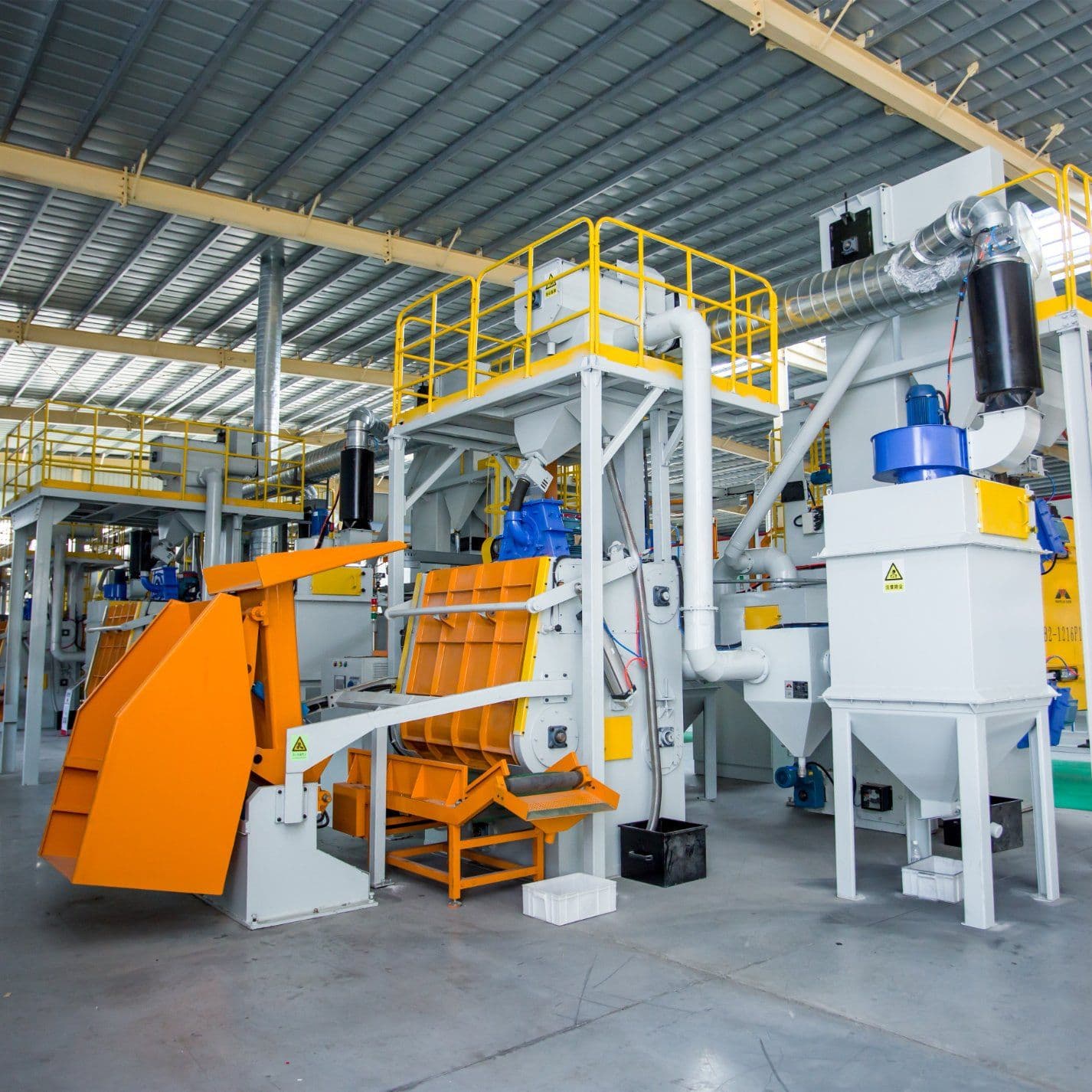
A batch tumble machine that carries workpieces on a soft rubber belt and tumbles them through a cantilevered centrifugal blast, so thin-wall copper and aluminium parts are decoated without being bent, marked or pressed.
PREPARE FOR
WHAT’S NEXT.
Match workpiece handling, blasting configuration and production flow to your application.
Request a quotationWhy a soft carrier instead of a clamp
Copper, aluminium and thin-wall castings share one unpleasant property: they are easy to clean and easy to damage. A part that is perfectly cleanable in principle may already be scrap the moment it is clamped. A steel clamp can flatten a thin wall, leave a witness mark on a machined face, or crack a casting with a residual internal stress. Rubber-lined drums and hooks were the industry's first answer, and they remain the right one for small, fragile, high-value parts.
The rubber belt tumble is a refinement of that answer. Instead of lifting the workpiece and dropping it, or holding it in a fixture, the machine carries the part on a soft belt and lets its own weight do the turning. The belt is the contact surface: it grips enough to move the workpiece, and it yields instead of marking it. There is no clamp force to design around, because there is no clamp. This is why the same machine can run a thin-wall housing in the morning and a heavier bracket in the afternoon without retooling the holding system.
The consequence for the process is direct. Because the part is free to turn rather than fixed in orientation, it presents a different face to the blast on almost every pass. The treatment is not a fixed jet pointed at a fixed surface; it is a statistical process over a tumbling mass, which is exactly what irregular, semi-finished parts need.
What the cantilevered blast head changes
The blasting end is a cantilevered centrifugal head: the blast wheel is mounted on an arm that reaches into the drum, so the abrasive falls onto the moving bed from above without the wheel body blocking the discharge path. Two consequences follow from that geometry.
First, the abrasive curtain reaches the top surface of the load while the drum turns it underneath. A conventional stationary wheel aimed horizontally at a tumbling drum spends a good part of its cycle throwing abrasive at the inside wall of the machine. Hanging the head over the bed removes that waste.
Second, the cantilever arrangement is what makes multiple heads practical. Because each head reaches in from outside rather than being buried in a plenum, a second, third or fourth head can be added at a different height or angle without rebuilding the drum. Higher-capacity configurations therefore scale by adding heads and adjusting the load, not by changing the machine's structure. The cycle time, the abrasive consumption per part and the finished profile are then reviewed against the workpiece and the required finish rather than fixed by the machine's original configuration.
The abrasive circuit follows the same principle: the fall through the load is what does the work, so the separator and the recirculation path are designed around consistent particle size rather than around maximum air volume.
What this machine is built for
- Deformation-free handling — the soft belt carries the load and the workpiece turns under gravity; there is no clamping force to distort thin walls or mark finished faces.
- Consistent cleaning across a tumbling mass — the workpiece changes orientation as it travels, so irregular and semi-finished geometry is cleaned without dedicated fixturing for each part family.
- No dedicated centring or orientation tooling — you change the batch and the belt loading, not the fixture. One machine covers several workpiece families.
- Scalable blast energy — additional cantilevered heads can be added to raise cleaning capacity for heavier deposits, reviewed against the workpiece and the required finish.
- Dust and noise control — a pulse filter unit downstream of the drum keeps particulate capture effective and supports compliant emission levels.
- Automatic unloading — the batch is discharged without manual handling, which removes a repeated manual step and the exposure it creates.
Where the application boundary sits
This format is a batch machine, and it is honest to say what that implies. It processes a load at a time, so it fits naturally into a production step where parts arrive in baskets, trays or loose batches. For a production line that requires parts to pass continuously without accumulation, a belt conveyor or hook conveyor machine is the better structural choice.
The parts that suit it best share three characteristics: thin walls, a surface that has already been machined or partly finished, and a coating that must come off without taking the base metal with it. Copper and aluminium bushing blanks, thin-wall cast housings and machined brackets fall into that group. Heavy solid sections and very large parts are not the natural territory of a drum this size.
Treated surface condition, cycle time, abrasive type and the number of blast heads are all confirmed after your parts have been reviewed. Share the material, wall thickness, geometry, incoming coating and the finish you need, and the configuration is worked out against that data.
DEFINE THE CONFIGURATION.
- Workpiece
- Copper and aluminium parts, thin-wall castings, machined brackets
- Handling
- Soft rubber belt carrier, workpiece turned by gravity, batch processing
- Surface removal
- Cast, paint and oxide layers without cutting into the base metal
- Blast head
- Cantilevered centrifugal head, additional heads reviewed per workload
- Dust control
- Pulse filter unit downstream of the drum
- Discharge
- Automatic batch unloading
- Configuration
- Reviewed against material, wall thickness, geometry and required finish
BRING US YOUR WORKPIECE.
Share a photo or drawing, material, maximum dimensions and expected output. These details help us review a suitable configuration.
Send project requirements