Floor preparation is a profiling job, not a cleaning job
Most coating failures on an industrial floor do not begin in the coating. They begin at the interface between the coating and the concrete, and they begin before the first coat is applied. A floor that looks clean but has a smooth, closed surface will not hold a resin system, whatever the datasheet says about adhesion.
Shot blasting is chosen for floors because it changes the surface in two ways at once. It removes the material that should not be there - the failed coating, the adhesive, the laitance, the oil film - and it opens the concrete underneath so that the coating has something to key into. Grinding removes material but tends to polish and close the surface. Acid etching depends on how the concrete was finished and on how well the floor was rinsed, and it leaves residue that has to be neutralised. Blasting leaves a dry, dust-free, uniformly profiled surface that can be coated the same day.
What the machine removes
- Epoxy, polyurethane and MMA coatings, including systems that have already blistered or de-bonded.
- Adhesive residue and thin-set mortar under failed flooring.
- Paint, line marking and safety markings in warehouses and car parks.
- Laitance and the weak top layer of a new slab, before a hardener or a resin system goes on.
- Surface hardeners and sealers that have worn unevenly and left the floor patchy.
- Oil, grease and rubber deposits that a scrubber has only spread around.
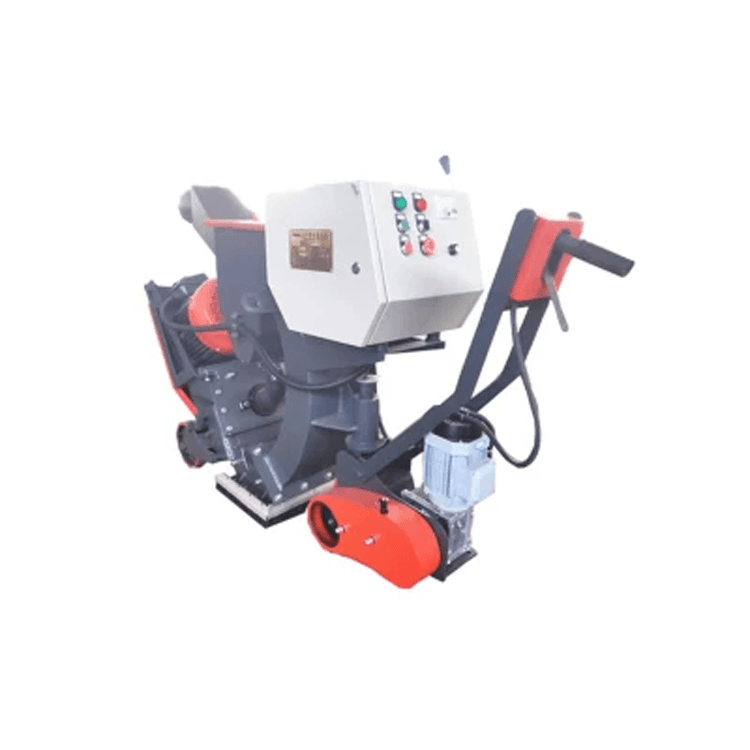
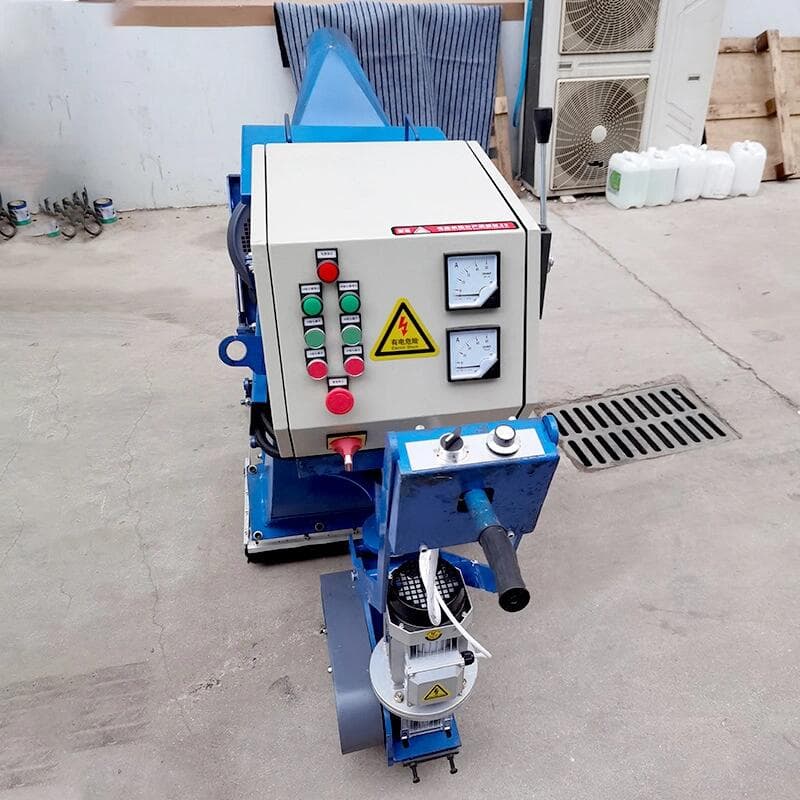
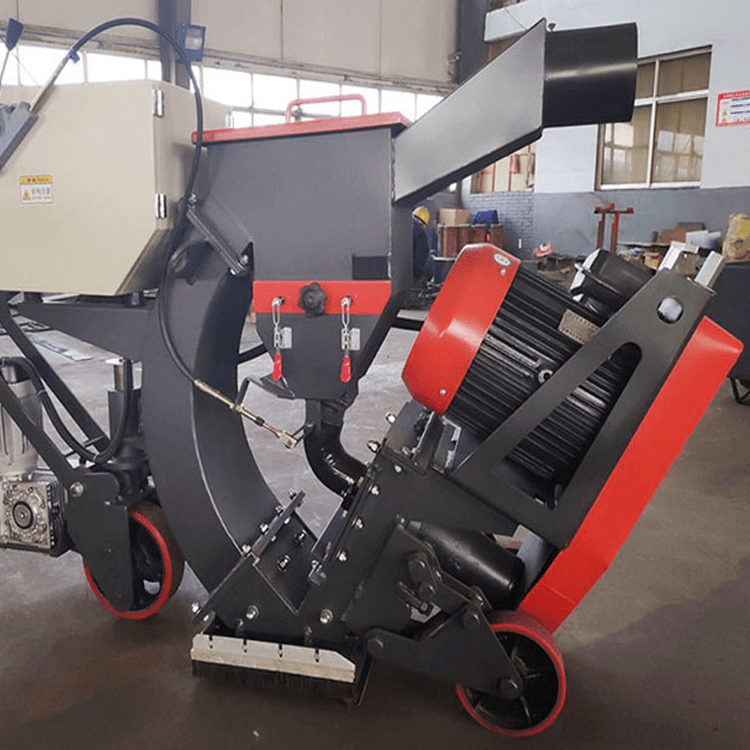
Inside the walk-behind floor machine
- One blast wheel in a 380 mm sealed head. A single wheel gives a more controllable impact pattern at this width, and the sealed chamber holds the abrasive against the floor so the machine can work in an occupied building without a dust cloud.
- Rebound recovery with a cyclone separator. Shot is captured as it bounces back, lifted into the separator, stripped of dust and fines, and returned to the wheel. Media that stays clean keeps the profile consistent across a large floor, which matters when a floor is being prepared in sections over several nights.
- Onboard cartridge filter. The blast chamber runs under negative pressure and exhaust air passes through the filter before release, so the machine can work next to production equipment without shutting the area down for dust control.
- Variable travel speed with reverse. Speed sets how many impacts each square metre receives, and therefore the depth of cut and the profile. Reverse is what makes it practical to work up to a wall, back off, and start the next run.
- A low, compact body. The machine has to pass through standard doorways and lift lobbies, and it has to be manoeuvrable between racking legs and around columns.
Setting the profile, not just the depth
Concrete surface profile is usually specified on the ICRI scale, from CSP 1 to CSP 10. A typical floor coating specification calls for CSP 3 to CSP 5, and a thin high-build system may call for CSP 2 to CSP 3. The machine reaches that range in a single pass; how far into the range it lands is set by three things:
Abrasive size. Coarser shot produces a deeper, more open profile. Fine shot produces a tighter profile and a lighter cut. The right grade is the one that meets the specified CSP without cutting deeper than the specification allows.
Travel speed. Faster travel means fewer impacts per square metre and a shallower profile. Speed is the field adjustment used to move within the specified range once the abrasive grade is fixed.
Number of passes. On a sound slab one pass is normally enough. On a slab with a hardener, a sealer, or an old coating that has been partly removed, a second pass is used to reach the specified profile rather than forcing the first pass to do all the work.
The profile should be checked, not assumed. A surface comparator or a replica tape reading taken on the first section tells you whether the settings are right before the whole floor is run.
Output, consumables and running cost
Practical coverage for the 380 mm head runs at roughly 40 to 80 m²/h per pass, including turning, abrasive top-up and emptying the dust bin. On a large open floor that is the number to schedule against; on a floor full of racking and columns the effective rate is lower because more of the shift goes into manoeuvring.
Abrasive is the main consumable, and consumption rises sharply with how much material is being removed. Stripping a sound floor of light contamination uses far less shot than removing a thick, well-bonded epoxy. Wear parts - wheel blades, chamber liners, the sealing skirt and the recovery hose - are the second cost, and they wear faster on abrasive aggregate than on a smooth power-floated slab.
Limits, and where hand tools take over
- Within about 50 mm of a wall, column or door frame. The blast head cannot seal against a vertical face, so these strips are finished with a hand-held blaster or a grinder before coating.
- Drains, gullies and thresholds. These are masked and finished by hand; the machine is not run over an opening.
- Heavy build-ups. A coating several millimetres thick, or a screed that has to come up, is removed by other means first and blasted afterwards.
- Green or damp concrete. The slab has to be cured and dry enough for the coating system, and a dry surface is also what the blast chamber needs to seal and recover abrasive.
- Floors with a fragile topping. If the substrate is weak, blasting will reveal it rather than fix it, and that is useful information to have before the coating is ordered rather than after it fails.
What we confirm before quoting
Before a configuration is proposed we establish:
- Floor area and layout - total square metres, run lengths, and how much of the floor is broken up by racking, columns and services.
- Coating or contamination to be removed - type, thickness, and whether it is bonded or already lifting.
- Substrate condition - slab age, finish, any hardener or sealer, and whether the surface is sound enough to receive the specified system.
- Specified profile - the CSP or roughness the coating manufacturer requires, and who verifies it.
- Power and access - available supply, doorway widths, lift capacity, and working hours in an occupied building.
- Schedule - the area to be completed per shift, which determines whether one machine is enough or the work has to be split into sections.
Send photographs of the floor, the coating that has to come off, and the specification the new system has to meet, and we will tell you plainly whether this machine is the right one for the floor, or whether a different configuration or a different preparation method is the better answer.