Shot Blasting Bogies, Wheel Sets and Underframes
Preparing rail vehicle components for overhaul painting: what to blast, what to mask, and how to avoid damaging bearing seats and machined faces.
A rail overhaul blast is not a cleaning job with a bigger machine. The components carry machined surfaces, bearing seats, threaded holes and inspection markings that must survive the process, and the coating that follows has to hold for the next overhaul interval. The work is defined as much by what you protect as by what you clean.
Define the acceptance standard first
Most overhaul specifications for rail vehicle structures reference ISO 8501-1 for cleanliness and ISO 8503 for profile, often alongside a national or operator standard. Sa 2.5 is the usual baseline for underframe and bogie structures that will receive a full paint system; Sa 3 appears where the coating is thin or the environment is aggressive.
Two things need to be written down before the first component is loaded. The first is the cleanliness grade and the profile range, because they determine the abrasive and the cycle time. The second is the inspection method: comparator and profile gauge on a defined test area, with a record per component. Without that record, an argument at acceptance is settled by opinion.
Masking is the engineering content of the job
Bearing seats, seal faces, wheel treads, brake disc mounting faces, threads and dowel holes must be protected. The choices are physical masking, controlled blasting that avoids the area, or post-blast machining.
Physical masking is the most reliable and the slowest. Caps and plugs must be rated for the abrasive stream and must not leave residue that contaminates the coating. Reusable moulded caps are expensive but pay for themselves over an overhaul programme; tape and foam do not survive a wheel blast.
The alternative is to design the blast program around the component: fixed wheel positions, component rotation, and a curtain that never reaches the masked zone. This works well on a dedicated line with one component family and badly on a mixed overhaul shop.
Never rely on "the operator will be careful" for a bearing seat. If the seat is hit, the component moves from cleaning to rework, and the cost of that rework exceeds the whole blasting budget for the part.
Distortion and residual stress
Underframes and bogie frames are welded structures with locked-in stress. Blasting one face heavily and leaving the other untouched can move a frame enough to matter at reassembly. Two rules reduce the risk: blast symmetrically where the geometry allows, and keep the wheel power and the abrasive size moderate on thin webs and flanges.
Wheel sets are a different case. The wheel tread and the axle journal are machined and usually masked; the wheel web and the axle body are blasted. The mass is high enough that distortion is not the concern, but the surface finish on the journal is, which brings the job back to masking.
Choosing the machine type
Rail components split into two handling families.
Heavy, awkward frames — bogie frames, underframe sections, couplers — suit a hanger type machine, where the published hook capacity range is 600–10,000 kg and throughput 1.0–2.0 t/h depending on configuration. The part hangs free so all faces can be presented to the wheels, and the hook can be rotated between passes.
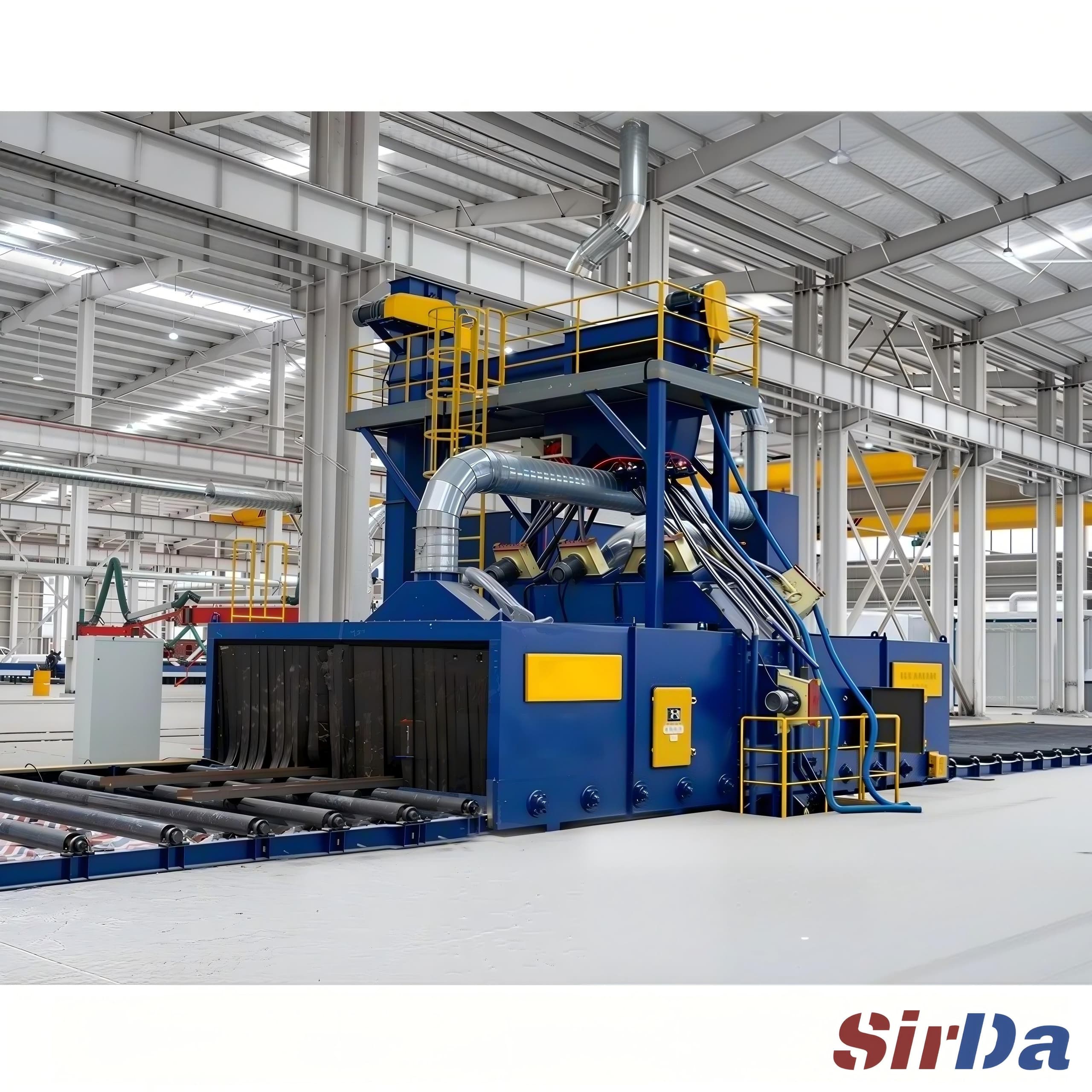
Long, regular sections and wheel set batches — side sills, solebars, batches of wheels — suit a roller conveyor machine, which handles workpieces of 5–30 t at 2.0–5.0 t/h. The constraint is the pass-through envelope: anything wider or taller than the opening has to go through a different route.
A third option for mixed overhaul shops is manual blasting inside a cabinet, which is slower per part but tolerates irregular shapes and one-off masking. It is often the correct answer for a workshop that overhauls a handful of vehicles a year.
Abrasive selection for rail work
Steel shot is the usual choice for structural components: it produces a dense, uniform profile and its rounded shape is less aggressive on welded details. Grit or a shot-grit blend is used where mill scale is heavy or where a coarser profile is specified.
Size follows the profile requirement. On thick underframe sections a medium-to-coarse grade is common; on thin body panels a finer grade avoids distortion and punch-through.
The working mix matters more than the original purchase specification. Overhaul shops often run campaigns of dirty, heavily corroded components that generate fines quickly. Check the mix at the start of each campaign, not once a quarter.
Dust and contamination
Rail components arrive with brake dust, grease, oil and sometimes asbestos-containing friction material from older stock. Dry blasting will aerosolise all of it. The dust collector must be sized for the contamination load, and the filters must be appropriate for the material being handled.
Where asbestos or other regulated contaminants are possible, the blast cannot be a normal dry process without a specific risk assessment and controls. This is not a detail to resolve after the purchase order.
Acceptance checks that prevent rework
Before a component leaves the cabinet:
- Cleanliness checked against the comparator on a defined area, not on a convenient one.
- Profile measured with a gauge or replica tape at three points.
- Masked surfaces inspected for abrasive ingress and damage.
- Threads checked with a go/no-go gauge.
- Identification markings confirmed legible; if they were removed by blasting, the re-marking method must be agreed in advance.
Masking as an engineered station
Masking is where most overhaul programmes lose time and where most avoidable damage happens. It should be planned as a station with its own equipment, consumables and time allowance, not as a task the operator improvises between cycles.
The items that need protection are consistent: bearing seats, journals, machined mating faces, threaded holes, hydraulic ports, earth studs and identification plates. Each needs a method that survives the abrasive stream. Rated caps and plugs work. Tape and foam do not. Where a surface cannot be capped, the alternative is to program the blast so the stream never reaches it, which means the presentation of the part has to be designed, not left to the hook.
The masking material itself becomes a consumable budget line, and a reusable cap that survives fifty cycles is cheaper than a consumable one that survives one. Keep the caps with the fixture for that component family so a changeover does not involve hunting for the right size.
Throughput planning for overhaul campaigns
Overhaul work is campaign-based, not continuous. A shop may run twenty bogie frames in a week and then nothing for a month, and the machine has to be sized for the campaign peak without being uneconomic for the quiet periods.
Two numbers decide the sizing: the peak weekly volume and the longest single component. Sizing for the peak alone produces an oversized machine that runs at low load most of the year. Sizing for the average produces a bottleneck every campaign. The practical answer is usually to size for the peak with a margin and to plan campaigns so that the machine is shared across component families rather than dedicated to one.
Planning an overhaul cell
The project cases show how overhaul shops typically sequence blasting with disassembly, inspection and painting. The pattern that works is to separate the heavy frame route from the small-component route, and to treat masking as a station with its own time allowance rather than as an operator task squeezed between cycles.
Send the component drawings, the annual volume and the coating specification through our contact form and we will map them against the published machine envelopes before any configuration is proposed.