Wheel Blast vs Air Blast: How to Choose
A decision guide for choosing between centrifugal wheel blasting and compressed-air blasting, based on geometry, volume and coating requirements.
The choice between a wheel blast machine and an air blast cabinet is usually presented as a price question. It is not. The two processes deliver abrasive to the surface in fundamentally different ways, and that difference decides which parts each can clean economically.
The physical difference that matters
A wheel accelerates abrasive mechanically and throws it in a fan-shaped curtain. An air nozzle accelerates abrasive with compressed air and projects it in a narrow cone.
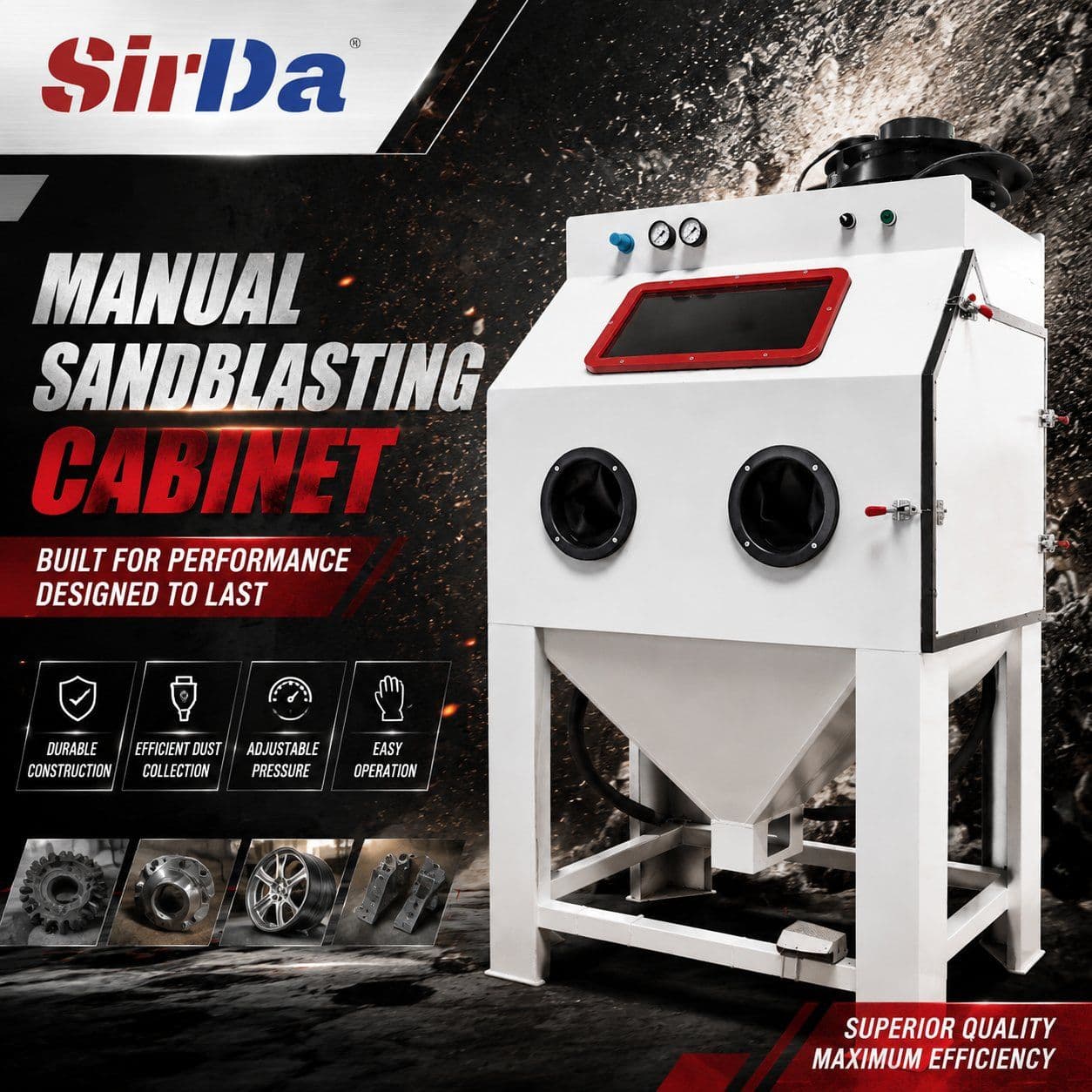
The wheel moves a large mass of abrasive per unit of energy, which makes it cheap to run at high volume. The air nozzle moves a small mass but can be aimed precisely, which makes it effective on complex geometry, inside recesses, and on parts that cannot be rotated under a curtain.
Everything else follows from that.
When wheel blasting wins
Wheel blasting wins when the part can be presented to the curtain, when the volume is high, and when the required profile is uniform.
- Plate, sections and simple castings can be conveyed or hung so that every face passes the wheels. Coverage is fast, and the cost per square metre is low.
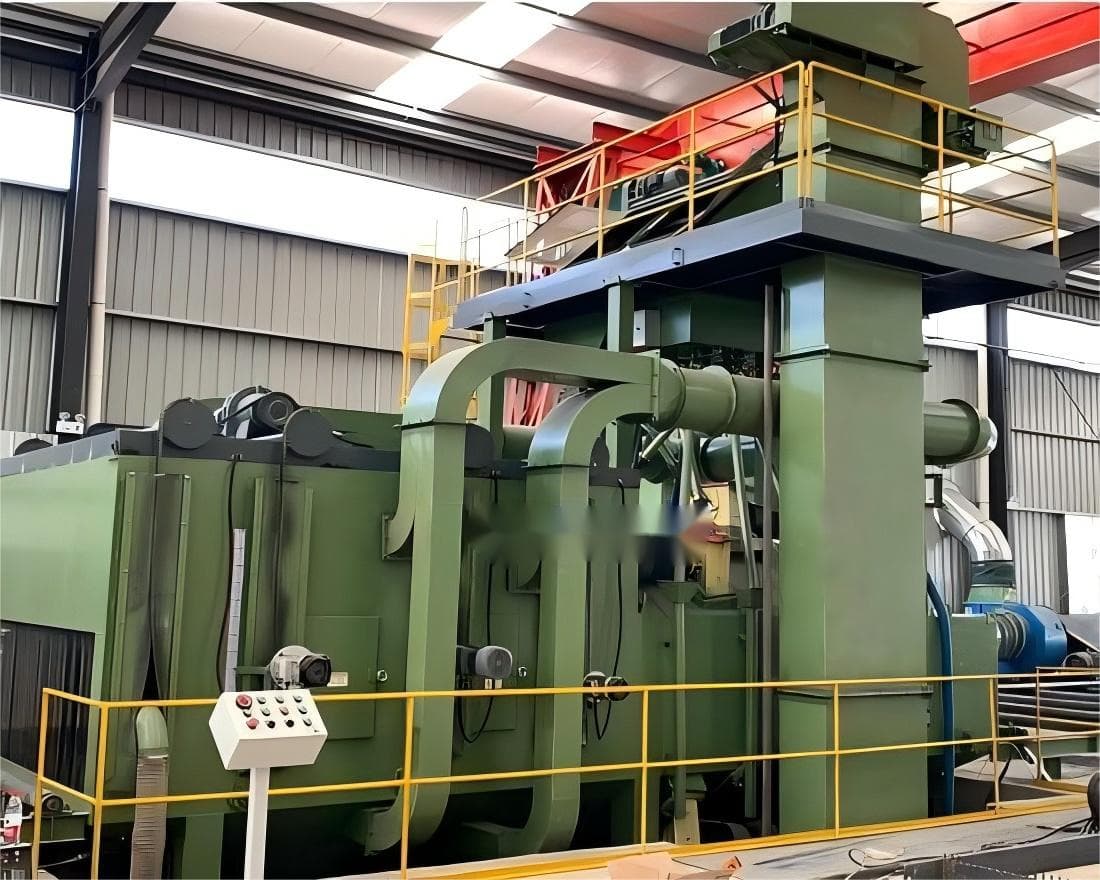
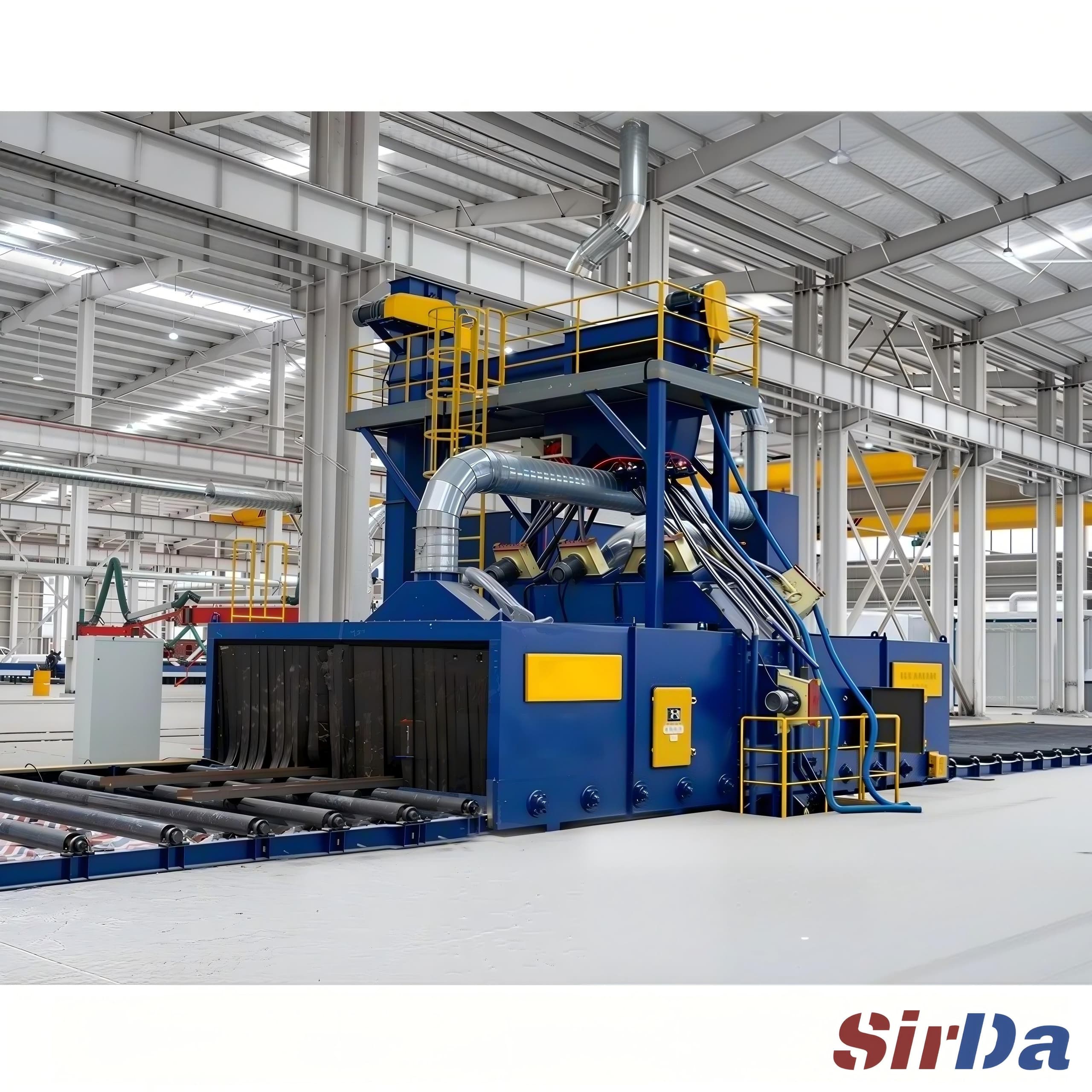
- High volume justifies the capital cost. A roller conveyor machine at 2.0–5.0 t/h or a tumble belt machine at 0.6–1.2 t/h removes labour from the process.
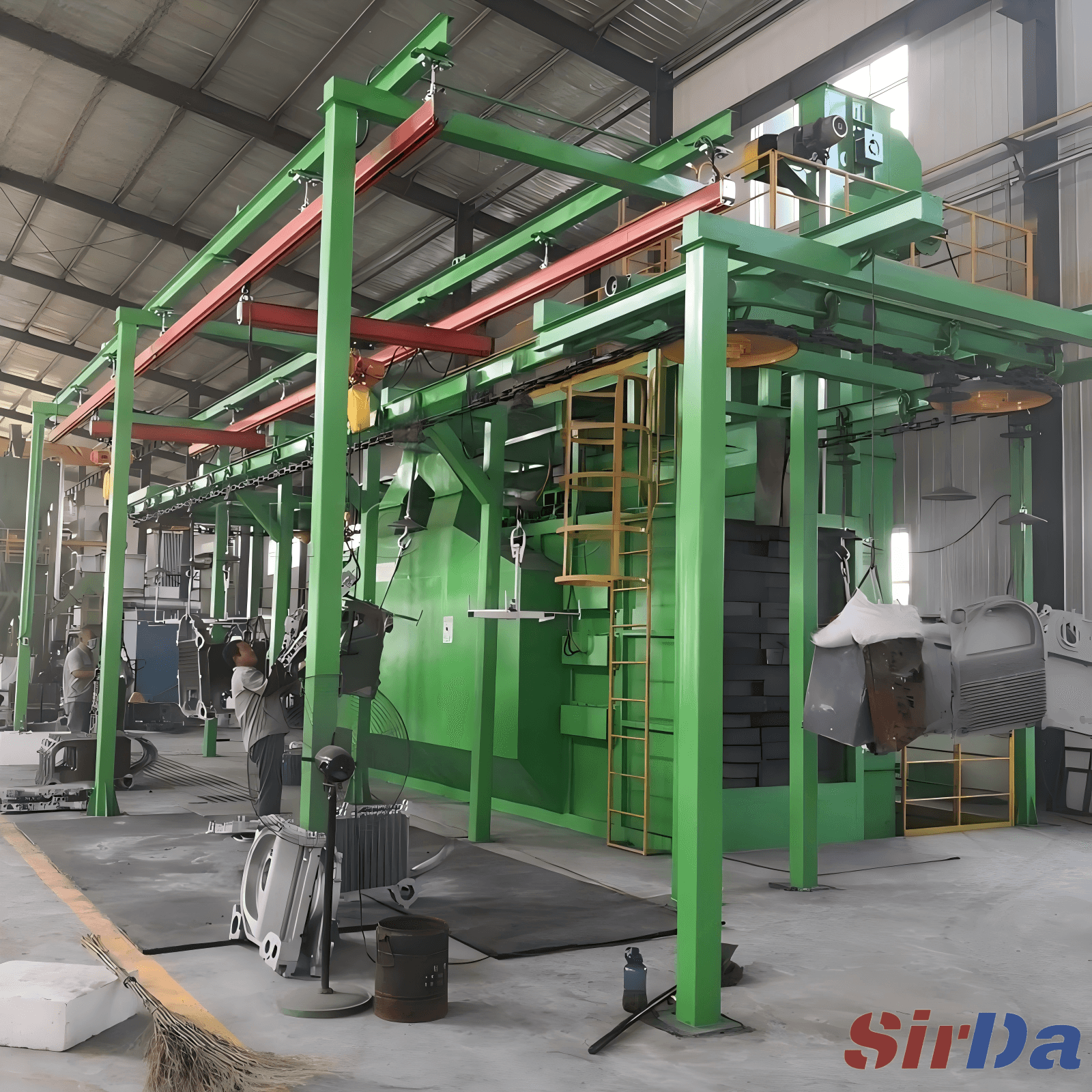
- Large parts are handled well by a hanger type machine, where the published hook capacity reaches 10,000 kg and the part can be rotated between passes.
The limits are geometric. A deep recess, a bore, the underside of a flange, or the inside of a fabricated box will not be reached by a curtain unless the part is repositioned. Wheel blasting does not bend around corners.
When air blasting wins
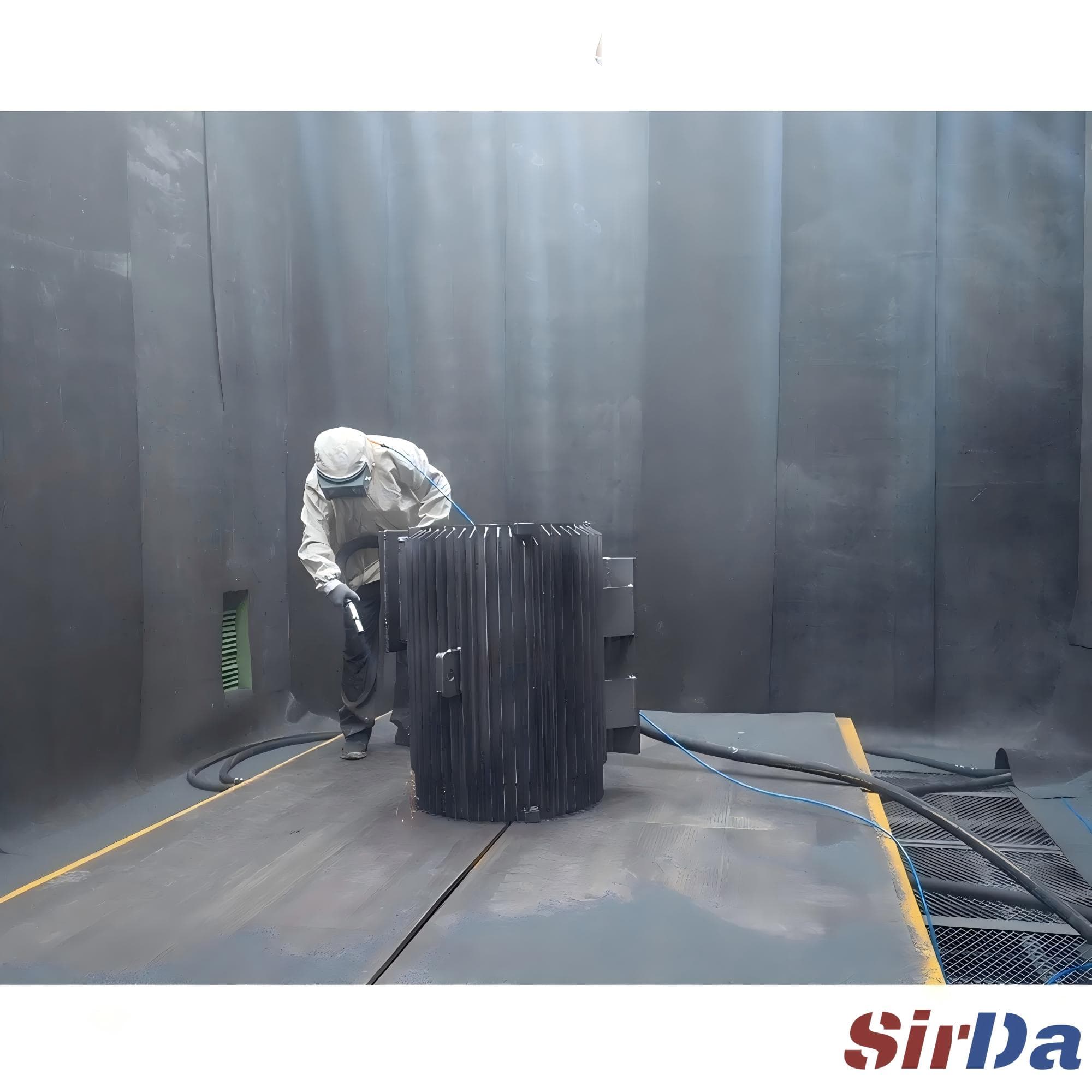
Air blasting wins when the abrasive has to be aimed.
- Complex castings and fabrications with internal passages and recessed surfaces.
- Local repair and touch-up, where only a small area needs cleaning.
- Thin or delicate parts, because the nozzle can be held at a distance and the intensity controlled by hand.
- Mixed, low-volume work, where a cabinet with manual manipulation is more flexible than a fixture for every part.
The cost is compressed air. Air blasting consumes far more energy per square metre of cleaned surface than wheel blasting, and nozzle wear changes the blast pattern continuously. It is the right process for the work a wheel cannot reach, not a cheaper alternative for work it can.
The hybrid answer
Many shops need both, and the sensible layout separates them by part family rather than by convenience. Heavy structural work goes through the wheel machine; complex or small-batch work goes to the air cabinet. Trying to force everything through one process produces either slow cycle times or uncleaned recesses.
There is also a middle route: a wheel machine with manual touch-up guns inside the cabinet, used for the few areas the curtain misses. This is common on hanger machines where a complex casting needs a pass by hand after the automatic cycle.
Cost comparison that survives scrutiny
Compare cost per square metre at the specified cleanliness and profile, not cost per hour. The calculation needs four inputs:
- Abrasive consumption per square metre, measured on a test part.
- Energy per hour — wheel power for the wheel machine, compressor power for the air cabinet.
- Labour hours per part, including handling and masking.
- Maintenance per year — blades and liners for the wheel, nozzles and hoses for the air cabinet.
Air blasting usually loses on energy and wins on flexibility. Wheel blasting usually wins on energy and loses on geometry. If the calculation is close, the deciding factor is normally changeover: which process handles your part mix with less fixture work.
Masking and part protection
Both processes require masking of bearing surfaces and threads, but the failure modes differ. A wheel curtain is harder to keep out of a masked area because it covers a wide fan; an air nozzle is easier to direct away but easier to accidentally point at the wrong place.
For parts with many masked features, the wheel machine's fixed geometry can actually be an advantage: once the program avoids the seat, it does so every cycle.
Energy, compressed air and the real running cost
The energy difference between the processes is larger than most comparisons admit. A wheel converts electrical power into abrasive velocity mechanically, with a short transmission path. An air system converts electrical power into compressed air, distributes it through pipes, and then converts pressure into velocity at a nozzle. Each conversion loses energy, and the compressor adds heat, maintenance and a separate failure mode.
That is why air blasting is usually reserved for work a wheel cannot reach. Used as a general-purpose cleaning method on flat plate, it consumes several times the energy per square metre. Used as a touch-up tool on the ten percent of a part a wheel misses, it is entirely rational.
Compressed air also has a quality requirement. Moisture and oil in the air line cause nozzle blockage and contaminate the surface being prepared, which matters when the next step is coating. Air dryers and filters are part of the process equipment, not plant utilities.
Skills, maintenance and spares
The two processes demand different maintenance skills. A wheel machine is mechanical: bearings, blades, liners, belts and separators. An air cabinet is pneumatic and wear-heavy at the nozzle: hoses, nozzles, valves and couplings.
Spares strategy follows the same split. Wheel machines need a matched blade set, a control cage and liners on the shelf. Air cabinets need nozzles and hoses, and they need them more often, because nozzle wear is continuous and directly changes the blast pattern.
Operator skill differs too. A wheel machine is set up once and runs; the operator's job is loading and inspection. An air cabinet depends on the operator's hand movement, and two operators will produce different results on the same part unless the technique is defined and trained. That variability is acceptable for touch-up and unacceptable for a specification-critical surface.
Choosing by part family, not by preference
The most reliable way to settle the choice is to sort the work by part family rather than by volume. A family shares geometry, material and handling, and the process that suits one member usually suits the rest.
Sort the order book into families, assign a process to each, and count the hours each family consumes. The process that covers the most hours is the one to invest in first; the remainder can go to the other process, to a subcontractor, or to a manual station.
This avoids the two common errors: buying the cheaper process for the largest family and then spending the savings on rework, or buying the flexible process for everything and paying for it on the volume work. Preference is not a selection criterion. Family, geometry and hours are.
Verification is the same for both
Cleanliness is checked against ISO 8501-1 comparators, profile against ISO 8503 methods, and coverage by inspection of the whole surface, not just the accessible faces. The process choice does not change the acceptance criteria, only the cost and the cycle time to meet them.
If you are unsure which process fits a part family, send the drawing and the required grade through our contact form. We will tell you where each process stops working, and which published machine envelope covers the part.