
Removing weld spatter without stopping production
Weld spatter is a functional defect, not just a cosmetic one: it blocks NDE, ruins coating adhesion and disrupts the next weld. Here is what manual removal really costs, how to size an in-line blast station against your takt, and the failure modes that stop the line again.
Why spatter cleanup keeps stopping your line
Weld spatter is the defect a fab shop produces and cleans up most often: droplets of molten metal expelled from the weld pool that land on the base metal, the tooling and the floor. It is not a structural defect, but it is a functional one, interfering with nondestructive examination, coating adhesion, corrosion protection, and the next weld on the same joint. ASME B31.3 and AWS D1.1 require spatter removed wherever it interferes with NDE or service conditions, pipeline coatings such as FBE and 3LPE need a spatter-free surface to bond, and stainless in corrosive service treats spatter beads as crevice corrosion initiation sites.
What catches most shops out is the bonding. Spatter does not merely sit on the plate; it metallurgically bonds to the base metal through the heating and cooling cycle, strongest where the droplet landed on unprepared, oxidised steel. From a certain point no mechanical method separates it without taking base metal with it, which is why prevention beats cleanup.
What manual cleanup actually costs
Most fab shops clear spatter with tools already on the floor, and each has a measured limit:
- Angle grinder with a grinding or flap disc - fast, universally available and useful for local spot prep, but it produces no blast-comparable finish. In an independent shipyard comparison (Dankiw and Fosdike, 2018) a #36 grit grinder and a #40 flap disc measured 30-40 µm on the same steels that gave 50-80 µm from bristle blasting, and the grinder leaves directional grooves that can undermine coating adhesion on weld caps and edges.
- Needle gun - listed among impact media in SSPC-SP 11 and effective against heavy spatter, loose mill scale and corners, including geometry a rotary tool cannot reach. Where the pins reach, a profile is possible, but SSPC-SP 11 requires bare metal with at least 25 µm (1 mil) of profile verified, and in practice the profile is irregular, typically 30-60 µm.
- Wire brush - the right answer for light to moderate spatter, the wrong one for anything else. A brush burnishes rather than profiles, and the carbon steel brush used on a carbon steel weld will contaminate stainless.
- Chemical stripping - removes coating, not spatter, and creates no anchor profile whatsoever. A follow-on mechanical or blast step is still required before anything can be coated.
The real cost is not the tool but the pacing. Each is a serial, operator-paced operation run outside the flow of production, and on a line running pressure parts or tank shells, the cleanup bench quietly becomes the constraint on how much the shop can ship.
Moving removal into the flow
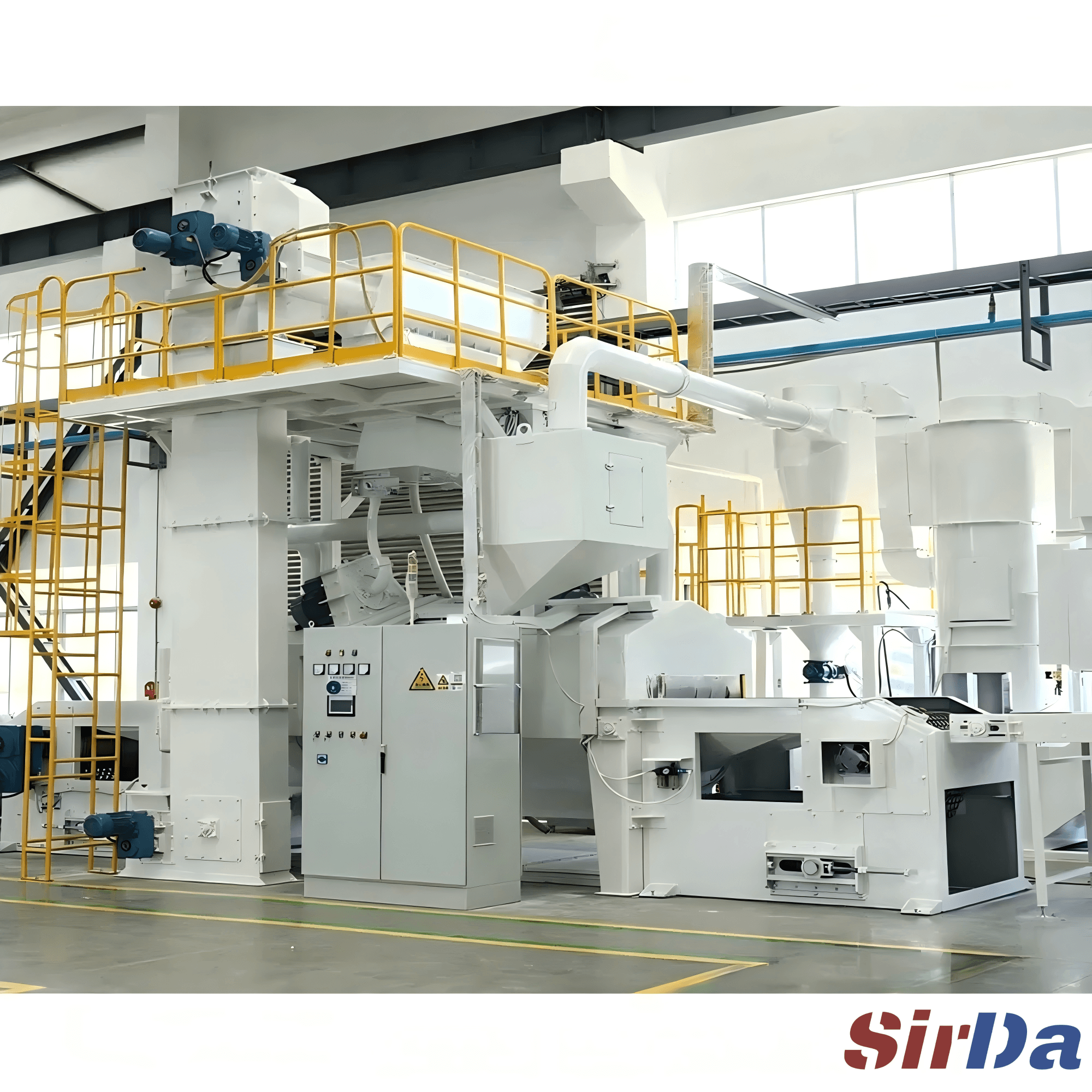
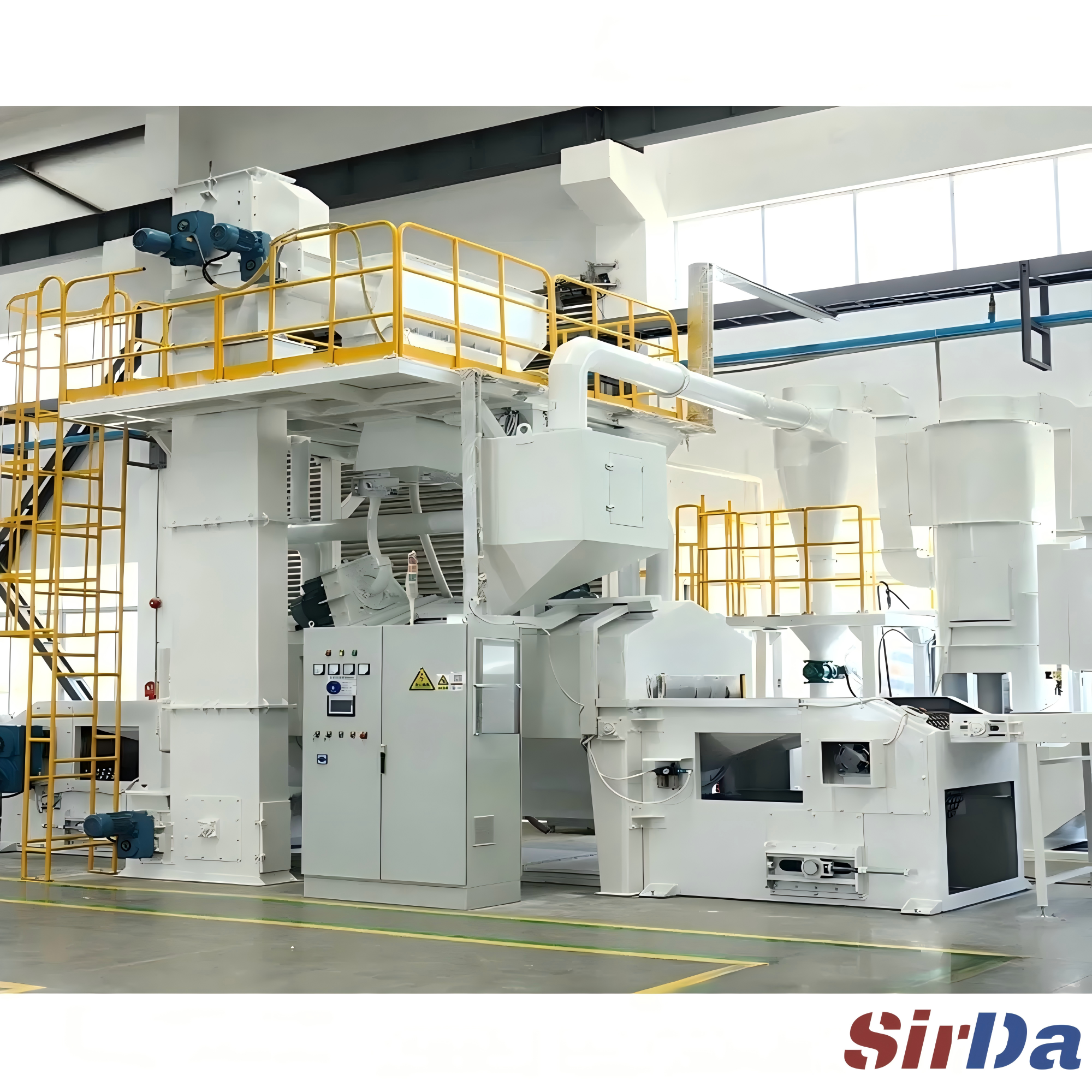
The alternative is to put the blast machine in the line, so spatter comes off as the part passes rather than after the part has been parked. The arithmetic starts with cycle time, and it is a length divided by a speed: the effective length of the blasting chamber divided by the conveyor speed. In the field that number is always corrected upward for part spacing, part size, cleaning intensity and a machine efficiency factor, then multiplied by one plus a safety factor.
That corrected figure has to live inside the takt time of the surrounding line, which is available production time divided by customer demand. Cycle slower than takt and work backs up in front of the station, which becomes the new bottleneck; cycle much faster and you have paid for capacity the line cannot use. The blast station should run slightly ahead of the welding cell feeding it, with a buffer wherever the gap between two stations is too wide for one to absorb.
Typical fab-shop values for the two-stage approach give a starting point rather than a specification. A rough pass with 3-4 mm steel shot at HRC 45-50 suits heavy plate welds, while 1.5-2 mm shot at HRC 35-40 suits thin or precision parts. Wheel speed runs 1500-2000 rpm for roughing and 1000-1500 rpm for finishing, conveyor speed 0.5-1 m/min for roughing and 1-2 m/min for finishing, impingement angled 45-60° to the work, with one to two passes for simple weldments and two to three for complex ones. Shot leaves the wheel at 60-80 m/s and loses roughly 10% of its kinetic energy per metre of travel, so the workpiece sits 0.7-1.5 m off the wheel centreline. Conveyor speed therefore becomes a live parameter rather than a setup decision, so residence time can follow the severity of the spatter.
Media, dust, and the failure modes that stop you again
Media selection is where most in-line blast programs go wrong. Angular steel grit shears spatter off; round shot peens and blends. Spatter that has been welded and cooled is a hard, dense deposit that round shot rolls over where grit will cut it away. On stainless work, use stainless media or a non-contaminating abrasive, because a carbon steel wheel leaves free iron that will rust.
Dust collection for a blast room is not sized like general ventilation. A blasting environment wants an air-to-cloth ratio of 2.5:1 or lower; a higher ratio burns through cartridges early, a lower one means you oversized the machine. Vertically mounted cartridges typically last about 30% longer than horizontal ones, since dust falls off rather than cascading onto the cartridge below. Bottom-entry ducting keeps abrasive from impinging straight onto the media, pulse cleaning pressure commonly sits between 0.4 and 0.6 MPa, and a differential pressure gauge across the filter bank is the earliest warning that something is wrong.
Keep the separator and the collector as separate functions. The separator handles usable abrasive and strips fines from the recovery stream; the collector handles airborne particles carried in the exhaust. OSHA is explicit that where abrasive is recirculated, exhaust ventilation must not be relied on to remove fines from the spent abrasive.
The recurring failure modes are worth writing on the wall:
- Spatter already bonded to the base metal - no blast media will separate it without taking the base metal with it.
- Anti-spatter spray on the joint face - silicone or oil contaminates the weld and causes porosity. Spray the surrounding base metal only, never the joint.
- A spattered gas nozzle - it disrupts shield gas flow, which produces more spatter, which builds up faster. Clean the nozzle every few passes.
- 100% CO2 shielding - spatter levels are high by design. An 80/20 or 90/10 argon mix cuts them substantially.
- Voltage and wire feed speed out of balance - too much wire speed for the voltage, or too much voltage for the wire speed, both throw spatter. A settings problem is not a machine fault.
- Media too fine for the deposit - fine shot burnishes where it should cut, so the bead stays and the cycle time stretches to compensate.
None of these parameters can be settled from a desk. They have to be fixed against your own weldments, which is why a cycle-time trial on real parts is the only honest way to size a machine. SIRDA Machinery builds roller conveyor, mesh belt and custom blast rooms around the takt you actually run.