
What shot peening does to fatigue life
Shot peening is a cold working process: overlapping impacts from spherical shot leave a layer of residual compressive stress at the surface, and that layer is what delays fatigue crack initiation. This article covers the Almen intensity and coverage numbers that define a peening process, why more peening is not always better, which media failures and contamination problems derail a production cell, and how the media separation train, dust collection and exposure time translate into the takt time a continuous line actually runs.
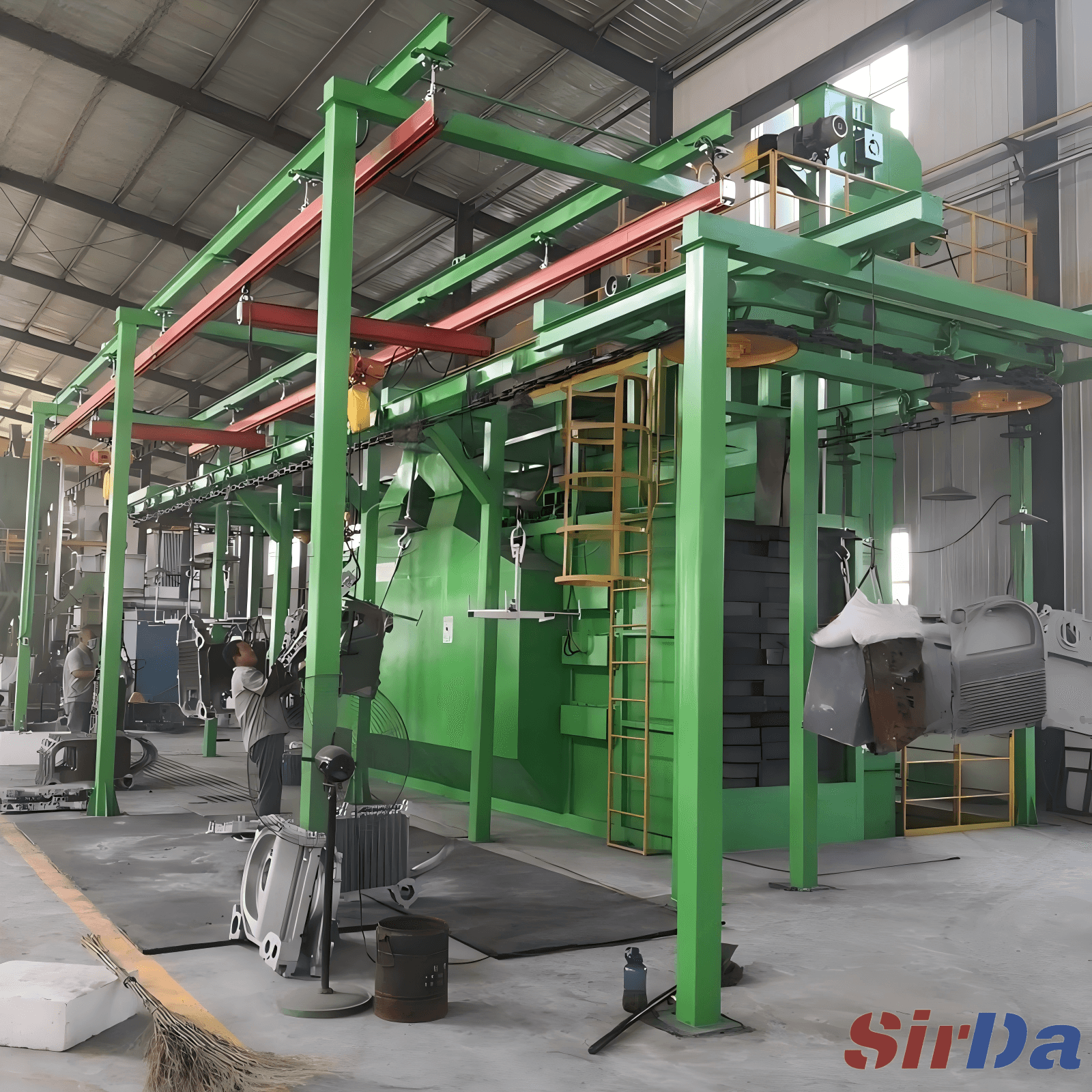
What shot peening actually changes
Shot peening is not a cleaning process, and confusing it with blast cleaning is the most common reason a peened part still fails. A blast operation cuts: an angular particle shears scale off the surface and leaves a rough, clean face. A peening impact does something else. A small spherical shot plastically deforms a shallow volume of metal, stretching the surface layer sideways. That layer is constrained by the elastic material beneath it, so when the shot leaves, the surrounding metal squeezes it back into compression.
Repeat those impacts and the indentations merge into a continuous layer of residual compressive stress, roughly 0.1 to 0.5 mm deep depending on shot size, intensity and base material hardness. The peak compressive value usually sits slightly below the outer surface rather than at it, balanced by a lower-magnitude tensile stress deeper in. No metal is removed, and the surface ends up smoother than a blasted one, around Ra 3.2 to 12.5 µm.
The same impact also work-hardens the layer, raising surface hardness by 10 to 30 percent in most metals, and on a carburised steel it can transform retained austenite at the surface into martensite, adding another half to two HRC. The residual stress is what does the fatigue work.
How that turns into fatigue life
A fatigue crack almost always starts at a free surface, where cyclic tensile stress is highest and the material least supported. Compressive residual stress acts against that: on a Goodman diagram the operating point moves left and the allowable alternating stress rises with it.
The published numbers are large enough to plan around. A compression spring in EN 10270-1 DH carbon steel, working between corrected stresses of 104 and 727 MPa, would risk fatigue failure soon after 100,000 cycles; peened, the predicted life exceeds 10 million cycles. A study by the SAE Fatigue Design and Evaluation Committee reported plain welds failing at 250,000 cycles and peened welds surviving past 2.5 million. For carburised and quenched gears, intensive peening has been reported to lift bending fatigue limits by more than 30 percent, sometimes 50 to 100 percent.
What decides whether you get that benefit is not a single setting, and this is where most production peening goes wrong. Research on AISI 4140 under rotating-bending showed fatigue life rising non-monotonically with coverage: at 37 MPa the best result came at 1000 percent coverage, a 797 percent increase, while at 44 MPa the optimum fell to 400 percent. At 1500 percent, life dropped 33 percent against the 1000 percent case. Roughness climbed from Ra 0.20 to 6.15 µm and hardness from 199 to 343 HV as coverage went from 100 to 1500 percent, and residual stress peaked at -294 MPa at 100 percent but reached -503 MPa at 1500 percent, at the cost of near-surface tensile excursions. More peening produced more compression and less life. The compressive layer also relaxes over time at elevated service temperature, so the benefit is best characterised for parts well below the creep-active range.
Intensity and coverage: the two numbers on the drawing
A peening process is specified by two independent parameters, and confusing them is how a shop ends up with a surface that looks right but performs badly.
Intensity is measured on Almen strips: flat coupons of SAE 1070 cold-rolled spring steel at 44 to 50 HRC, in three types differing in thickness, A at 1.29 mm, N at 0.79 mm and C at 2.39 mm. The strip is clamped, peened on one face, unclamped, and the arc it takes is read on a gauge. Readings are written as arc height and strip type, 0.012A meaning 0.012 inch on an A strip, and one unit on a C strip equals roughly 3.5 units on an A strip. Formally, intensity is the arc height at the saturation point, defined under SAE J443 as the exposure time beyond which doubling the time adds no more than 10 percent to the arc height.
Coverage is the share of the target area actually struck. It is not a measure of intensity, and it does not grow linearly with exposure time; the last few percent of bare surface take disproportionately long, so coverage is treated as exponential. Industry convention treats 98 percent measured coverage as full coverage, and a spec calling for 200 percent means twice the exposure time of that condition. Verification uses a fluorescent tracer compound applied before peening and inspected under UV afterwards, where struck areas are visibly dimpled.
Both parameters must be specified together. Typical intensity calls sit at 0.008 to 0.014A for automotive coil and valve springs, and 0.012 to 0.020A for truck and trailer leaf springs. Machine builders quote the same figure in metric arc height, with 0.38 to 0.50 mmA common for bevel gear root work and 200 percent coverage running 45 to 60 seconds per string. Where residual stress is the acceptance criterion, published specifications target -500 MPa at 0.02 mm below the tooth root and -950 MPa between 0.02 and 0.06 mm below.
Where peening goes wrong, and what the machine has to fix
- Over-peening - pushing coverage past the qualified window raises roughness, nucleates surface micro-cracks and can cost fatigue life, even while the measured compressive stress keeps climbing.
- Under-peening - incomplete coverage leaves a heterogeneous compressive stress field, and cracks initiate early in untreated zones.
- Broken and out-of-round media in the stream - fractured particles do not peen, they cut. Air classification separates by specific gravity, shape-based separation removes non-spherical particles, and MIL-S-13165B sets the maximum proportion of unacceptable particles.
- A drifting shot inventory - as fines and broken media are removed, the working population has to be replenished automatically, or the intensity on the part drifts from the qualified value over a shift.
- Iron contamination - steel shot leaves free iron on aluminium, stainless and titanium. Those materials need glass or ceramic media, and one machine running a single media across mixed work will contaminate something.
- Shot size against a root fillet - media diameter should not exceed roughly half the tooth root fillet radius, or the indentation stops matching the geometry the stress analysis assumed.
- Relaxation in service - compressive residual stress anneals out over time at elevated temperature, so process qualification and service temperature have to be considered together.
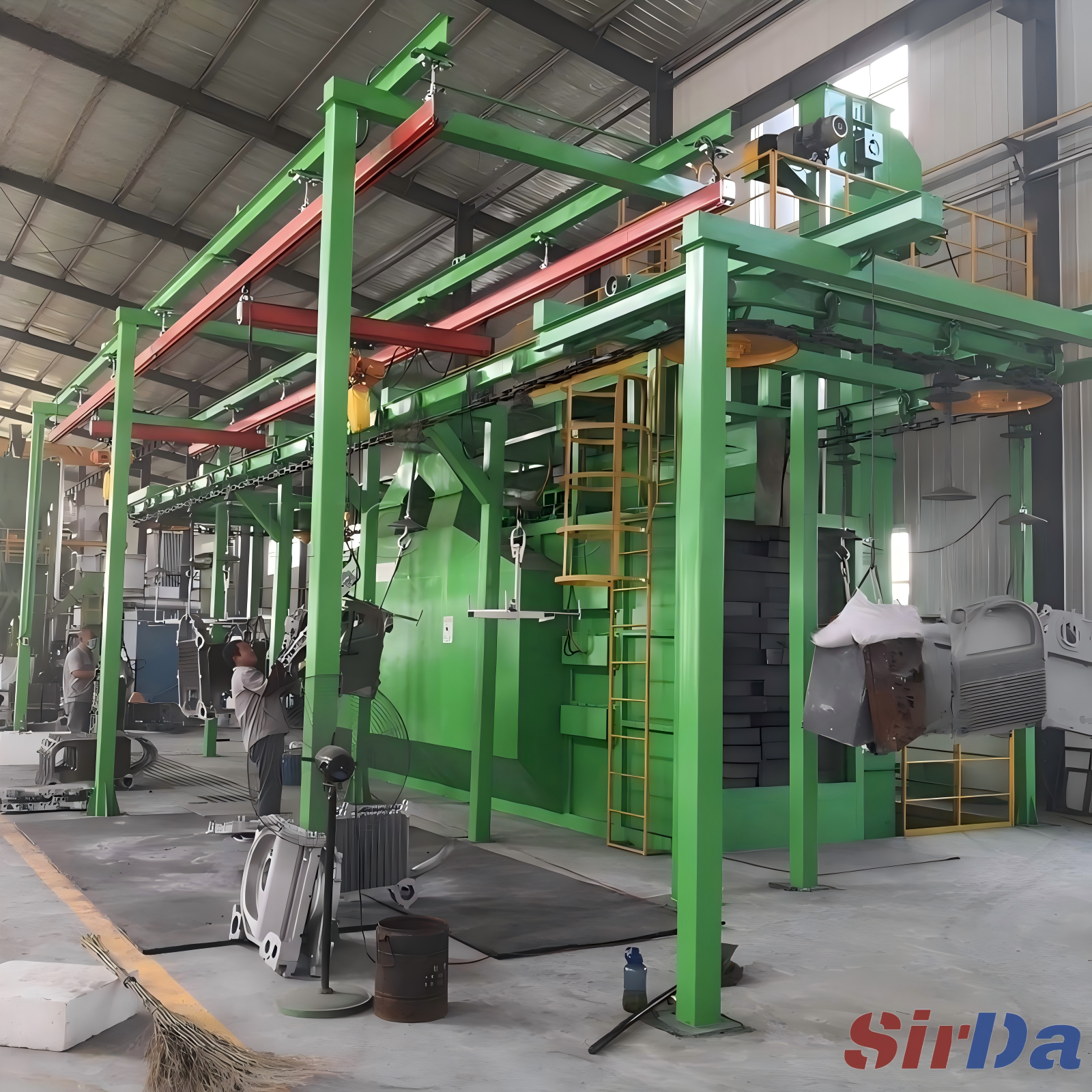
The machine has to carry all of that. Media separation is normally a three-stage train: an air wash that lifts dust and 0.1 to 0.2 mm fines, a cyclone that takes 0.05 to 0.1 mm particles and reduces the load on the collector, and a vibrating screen that sizes what returns to the wheel. Dust collection stays separate, and peening dust is fine metal particulate that must still be captured. Cycle time is set by exposure rather than chamber length, so a 200 percent coverage cycle of 45 to 60 seconds per string dictates the whole takt. And the Almen strip has to sit where the critical surface is, so the fixture and part presentation are part of the process qualification. SIRDA Machinery builds continuous shot blasting and peening lines around that exposure time, that media train and the takt you actually run.