
Why hook conveyor speed decides your finish quality
Hook conveyor speed is a process variable, not a handling one. It sets dwell time, and dwell time sets how many abrasive impacts a surface receives. This article works through the arithmetic, the chain speed bands that hold up in practice, and the four failure modes that trace straight back to the speed setting.
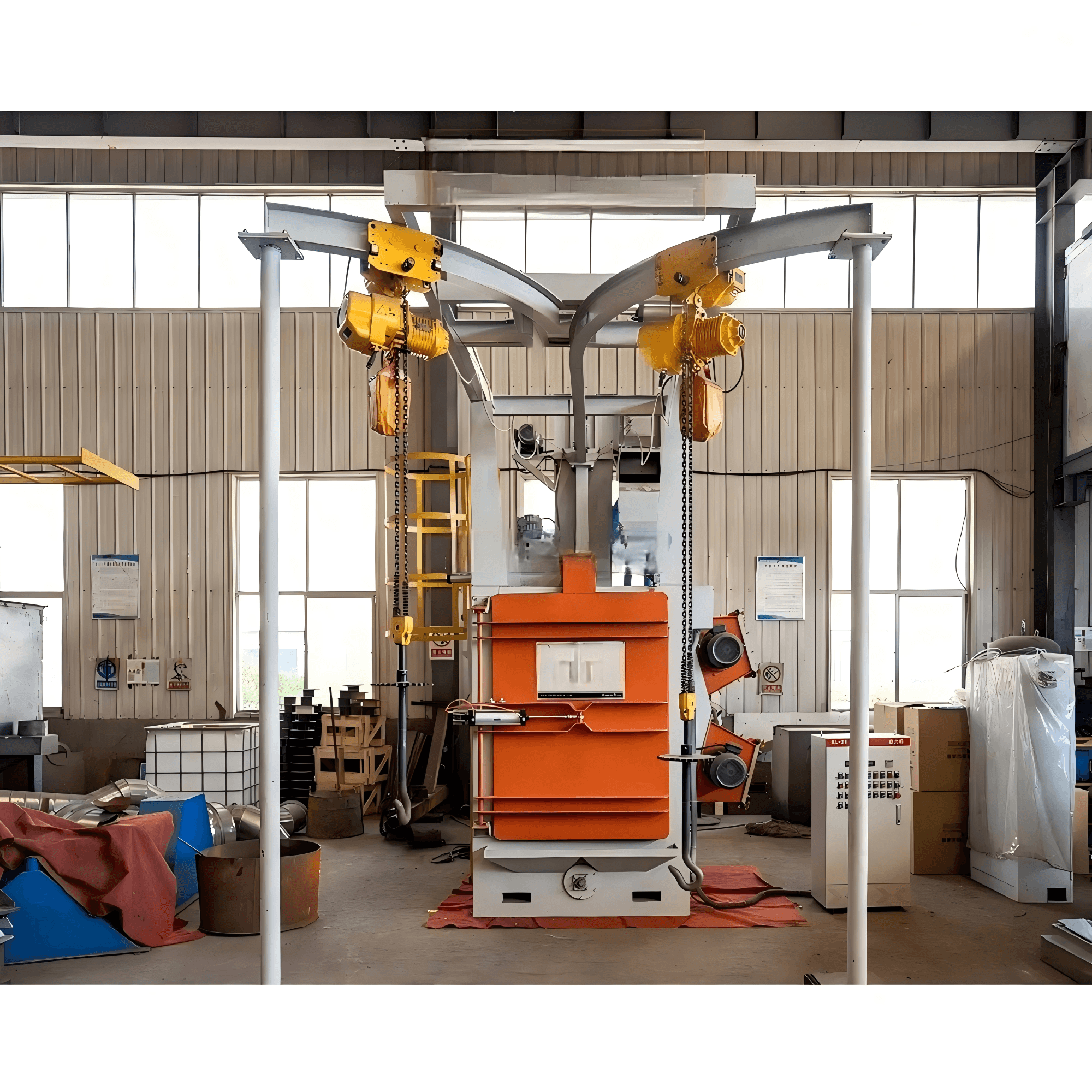
Hook conveyors are usually discussed as a handling problem: how many parts per hour, how long a batch takes to change, how many hooks you need. That framing misses the point. On a hook or continuous overhead machine, conveyor speed is a process variable. It sets how many abrasive impacts each square centimetre of surface receives, and once it changes, no amount of blast wheel power will put the finish back where it was.
The reasoning starts with one equation. If the effective blast length of your chamber is L metres and the chain runs at V metres per minute, every part spends t = L / V minutes inside the blast. Halving the speed doubles the exposure. That is the whole mechanism, and every practical rule about hook lines is a consequence of it.
The three numbers that have to agree
Good coverage is not a single setting, it is three settings in agreement: dwell time, abrasive flow, and part rotation.
- Dwell time follows from chamber length and chain speed. A three-metre effective zone at 1.2 m/min gives 150 seconds of exposure. Move to 2.0 m/min and the same part gets 90 seconds.
- Abrasive flow is what fills those seconds. Shot delivered per minute divided by the surface area passing through gives the overlap count — how many times the same patch of steel is struck. Common practice for Sa2.5 on carbon steel is three to five overlapping impacts; heavy scale, old coating or casting skin needs five to eight; light oxide on aluminium or stainless needs only two to three.
- Rotation is what stops any single spot from being hammered while its neighbour is ignored. A hook that turns three full revolutions during its passage brings essentially every face through the jet at least once.
Watch the blast wheel motor current while you tune. If the wheel is fed to roughly 85 to 95 percent of rated current, media flow is healthy. If current stays low no matter how far the feed gate is opened, the machine is starved of shot and you are chasing a flow problem with a speed problem.
Matching chain speed to the job
The temptation is always to run faster. Faster means more parts per hour, better amortisation, a nicer number on the quotation. The result is a machine that looks productive and returns parts with scale in the recesses.
Rough bands that hold up in practice, for continuous hook lines feeding a coating operation:
- New steel or light surface preparation before painting — run near the top of the range, around 2.0 to 2.6 m/min, with hook rotation close to 3 r/min. The deposit is thin and uniform, and the coating does the heavy lifting.
- General structural derusting to Sa2.5 — the middle band, roughly 1.0 to 1.4 m/min, with rotation around 4 to 5 r/min. This is where most quote-versus-reality disputes get settled.
- Old coating, thick rust, castings with skin — slow down to about 0.7 to 0.9 m/min and accept that throughput will drop. Increasing rotation to 5 to 6 r/min helps more here than adding dwell time does.
- Thin sheet below roughly 3 mm — slow speed, short exposure, low rotation. Thin parts deform from repeated impact far more readily than they fail to clean.
Speed and rotation are a pair. If you shorten dwell time, you must raise rotation to keep the same number of turns inside the chamber; otherwise the part exits with one clean face and one rusty face, which is the single most common complaint on hook lines.
Failure modes that trace straight back to speed
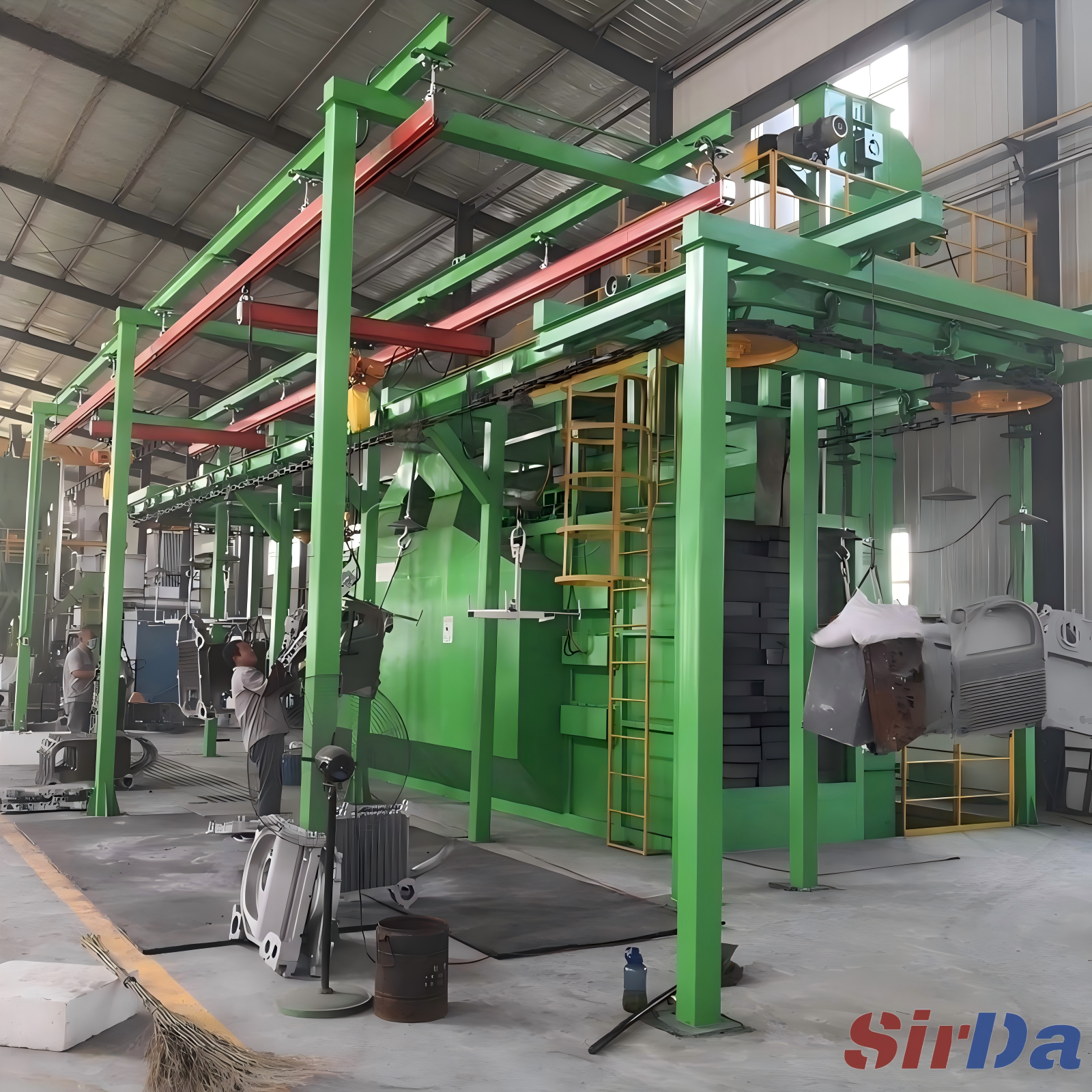
Most complaints on hook machines are not mysterious. They are one of four, and each has a speed-related cause.
- One face clean, the opposite face still scaled. Rotation is too slow for the dwell time, so the part never presents its back surface to the jet. Extend exposure, raise rotation, or both. On machines with PLC control, alternating forward and reverse rotation through the chamber removes the shadow that the hook and the lifting point cast.
- Local over-blasting, roughness out of specification, warped thin plate. The opposite failure: a slow-turning part keeps one shoulder parked in the same jet. Raise rotation and shorten total exposure.
- Uneven results part to part, no consistent pattern. Usually eccentric hanging. A part that is not balanced on its hook swings as it rotates and drifts in and out of the effective stream. Fix the rigging, not the conveyor.
- Recurring blind areas in internal corners and deep pockets. Straight-through blast heads throw at an angle, and a deep cavity with its mouth facing away from the jet is geometrically unreachable at any speed. Rotating the part slowly, or scheduling a manual turn during a long batch cycle, solves what a faster wheel never will.
One more failure worth naming because it is easy to misdiagnose: rotation that stops entirely. Friction wheels and drive rollers wear, tension drops, and the hook passes through the rotation zone without turning. Nothing about that looks like a conveyor fault, and the plant usually responds by slowing the chain, which makes the cycle longer without fixing anything.
There is one more thing worth settling before a hook line is quoted. A speed range that a supplier will commit to on paper is worth more than a peak figure nobody can run. Ask for the effective blast length and the usable speed band, then check them against the slowest part in your mix. Ask how many turns the hook makes at the slowest permitted speed, not at full speed. Ask what happens to rotation when a hook carries an unbalanced load, and whether the drive has enough torque for the heaviest part in the basket.
Most disputes about hook conveyor performance come down to someone treating speed as a handling parameter. It is not. It is the term that sets exposure time, exposure time sets impact count, and impact count is what a customer actually buys when they specify Sa2.5.