Why a road surface is blasted instead of milled
A road, runway or bridge deck almost always fails from the top down. The damage sits in the first few millimetres: polished aggregate, tyre rubber welded into the texture, oxidised bitumen, laitance on a new concrete deck, or a marking paint film that has already started to lift. Removing that layer is what restores the surface, and there are three ways to do it - mill it, grind it, or blast it. Each leaves a completely different surface behind.
Milling and planing cut with teeth. They are fast and they will take off a thick layer, but they shatter aggregate at the cut line, leave grooves aligned with the drum, and produce cuttings that have to be loaded and disposed of. Grinding flattens the high points and polishes the low ones; on a deck with shallow reinforcement cover it is easy to take off more than intended.
Shot blasting works differently. A steel wheel throws angular steel shot at the surface inside a sealed housing that travels with the machine. The shot impacts, cleans, rebounds, and is captured by a recovery system that lifts it into a separator, removes the dust and debris, and returns it to the wheel. Nothing is left behind on the road: no water, no slurry, no cuttings to sweep up.
What the surface is left with is a uniform mechanical texture. That texture is the real reason to choose blasting over the alternatives. The next layer - asphalt overlay, epoxy, polyurethane, MMA, anti-skid treatment, or a bridge deck membrane - bonds to profile, not to a polished or shattered surface.
What a single pass removes
- Thermoplastic and cold-applied road markings, including thick extruded profiles that a grinder only smears.
- Tyre rubber, oil film and fuel staining in the wheel paths of busy lanes.
- Laitance and weak cement paste on new concrete decks, before a membrane or overlay goes down.
- Bituminous seal coats, surface dressing and failed micro-surfacing.
- Thin failed coatings and mill scale on steel deck plates.
- Anti-skid aggregate that has worn smooth and no longer meets a friction requirement.
Depth control is the point. A typical single pass takes 0.5 to 3 mm, set by abrasive size, blast wheel power and travel speed rather than by the operator's feel. That is enough to remove the layer that has failed while leaving the structural material, and the reinforcement cover, untouched.
How the walk-behind machine is built
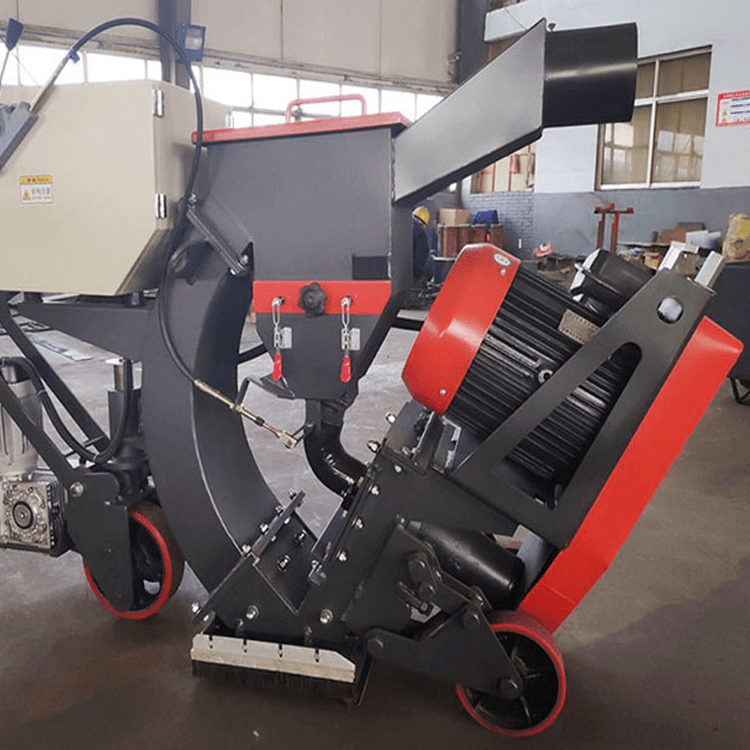
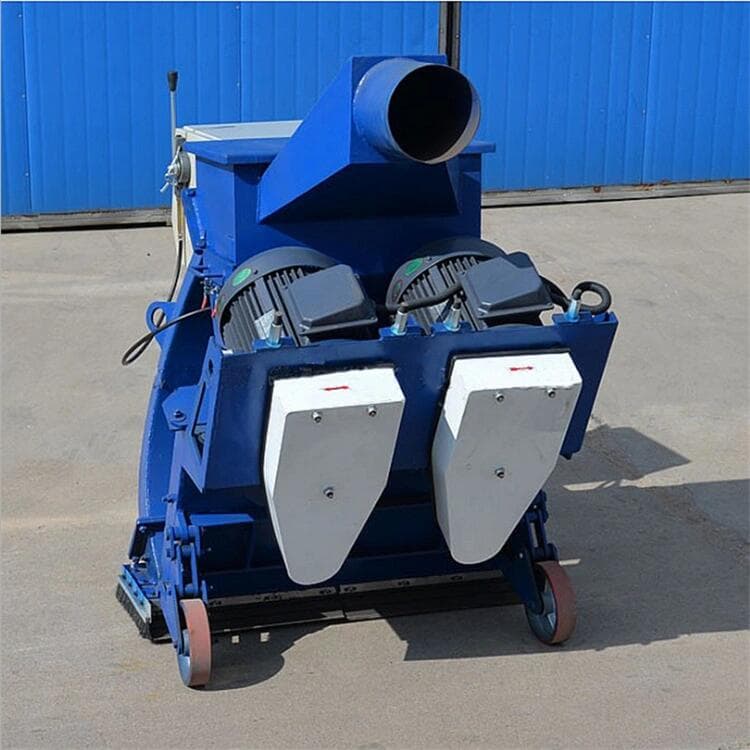
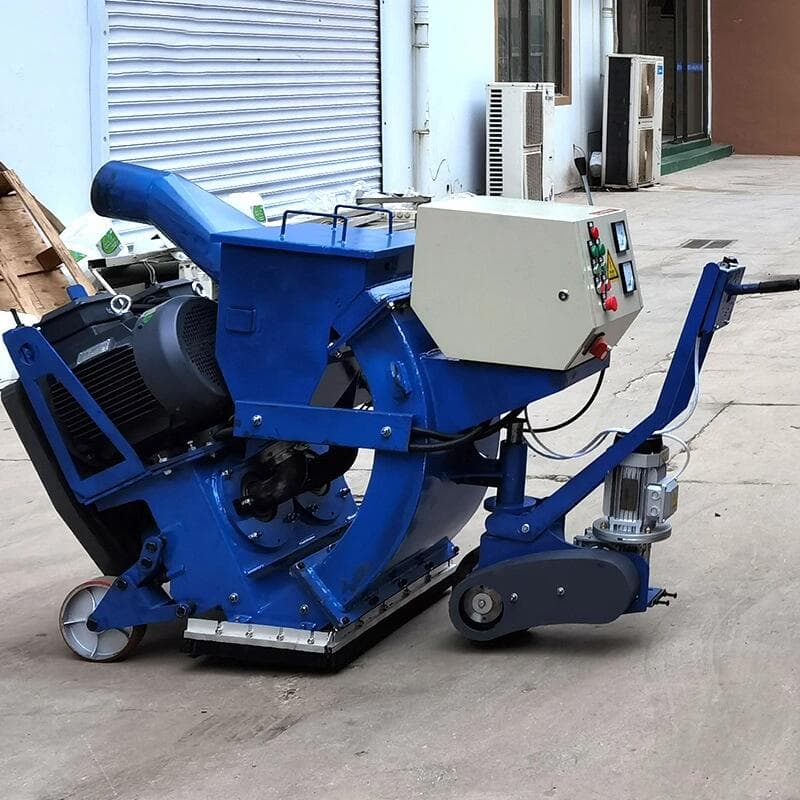
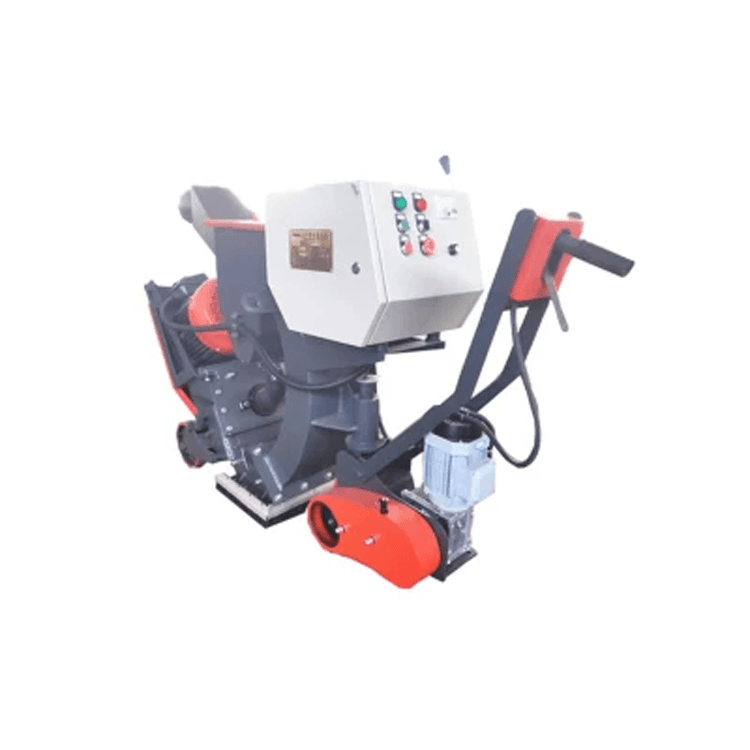
- A sealed blast chamber that travels with the machine. The chamber sits on the surface and is held down by the machine's own weight plus the recovery airflow. Blasting happens inside it, so abrasive and dust do not escape into the street.
- Two blast wheels on the 550 mm head. Two wheels cover the working width with a more even impact pattern than one wide wheel, and the overlap between them is set at the factory rather than left to a nozzle operator.
- Rebound recovery, not just vacuum. Most of the shot is captured as it bounces back into the chamber; the return airflow lifts it into a cyclone separator that takes out dust, fines and debris before the shot goes back to the wheel. Clean media is what keeps the finish consistent from the first metre to the last.
- Dust is captured at the source. The chamber runs under negative pressure and the air is pulled through a cartridge filter, so the visible dust cloud normally associated with surface preparation does not appear. Where local rules are stricter, the exhaust can be routed to a separate collector.
- Variable travel speed, forward and reverse. Speed is the main field adjustment: slower travel means more impacts per square metre and a deeper cut. Reverse lets the machine back out of a corner without a second pass over the same strip.
- Controls grouped at the handle. Blast wheel, abrasive flow, travel speed and emergency stop are all within reach of the operator walking behind the machine.
The three settings that decide the result
Abrasive size. Coarse shot hits harder and cuts deeper; fine shot produces a tighter, more uniform profile. For marking removal and rubber deposits a coarser grade is usually right, while a deck being prepared for a thin membrane is better served by a finer grade that will not over-profile the surface.
Travel speed. This is the setting most often misused. Walking faster than the surface needs leaves a strip that looks clean but still has a film on it; walking too slowly wastes abrasive and can start cutting into sound material. The correct speed is the one that produces the specified result in one pass, and it is established on site on a test strip, not guessed.
Number of passes. Some coatings come off in one pass. Others - thick epoxy, multiple paint layers, or a marking over a seal coat - come off cleanly only when the first pass removes the bulk and the second pass cleans the residue. Two controlled passes are usually cheaper than one slow, aggressive pass that damages the substrate.
Throughput, consumables and running cost
Practical coverage for the 550 mm head runs at roughly 80 to 150 m²/h per pass, including turning at the end of each run, abrasive top-up and emptying the dust bin. Theoretical coverage at full travel speed is higher; the practical figure is the one to plan a shift around.
Abrasive consumption is the main running cost and it is driven by how much material is being removed, not by the machine. Marking removal consumes far less shot than stripping a thick coating. Wear parts - wheel blades, chamber liners, the sealing skirt and the recovery hose - are the second cost, and they are consumed faster on abrasive aggregate than on smooth concrete.
Where this machine stops being the right answer
- Within about 50 mm of a kerb, wall or parapet. The blast chamber cannot seal against a vertical face, so edges are finished with a hand-held blaster or a grinder.
- Deep structural repair. Potholes, rutting and failed joints are cut and patched; blasting prepares the surface around them, it does not rebuild them.
- Thick asphalt removal. If several centimetres have to come off, that is a milling job, and blasting follows behind to prepare what the mill left.
- Wet, frozen or heavily contaminated surfaces. The chamber needs a dry, sound surface to seal and to recover abrasive.
- Confined spaces without ventilation planning. The dust is captured, but the airflow still has to be planned for tunnels, basements and enclosed decks.
What we confirm before quoting
None of the figures we work from are invented. Before a configuration is proposed we establish:
- Substrate and surface type - asphalt, concrete, steel deck, or a mixed surface, and its age and condition.
- What has to be removed - coating type and thickness, marking material, rubber, laitance, or a combination.
- Area and access - total square metres, run lengths, lane widths, and whether the machine can turn at the end of each run.
- The acceptance standard - the required profile or roughness, any friction requirement, and who inspects the result.
- Power and site conditions - available supply, dust and noise limits, working hours, and traffic management constraints.
- Schedule - the area to be completed per shift, which sets how many machines the job actually needs.
Send a photograph of the surface together with the coating or marking you need to remove and the standard the finished surface has to meet, and we will tell you plainly whether this machine is the right one for the job, or whether milling, grinding or a different blasting configuration is the better answer.