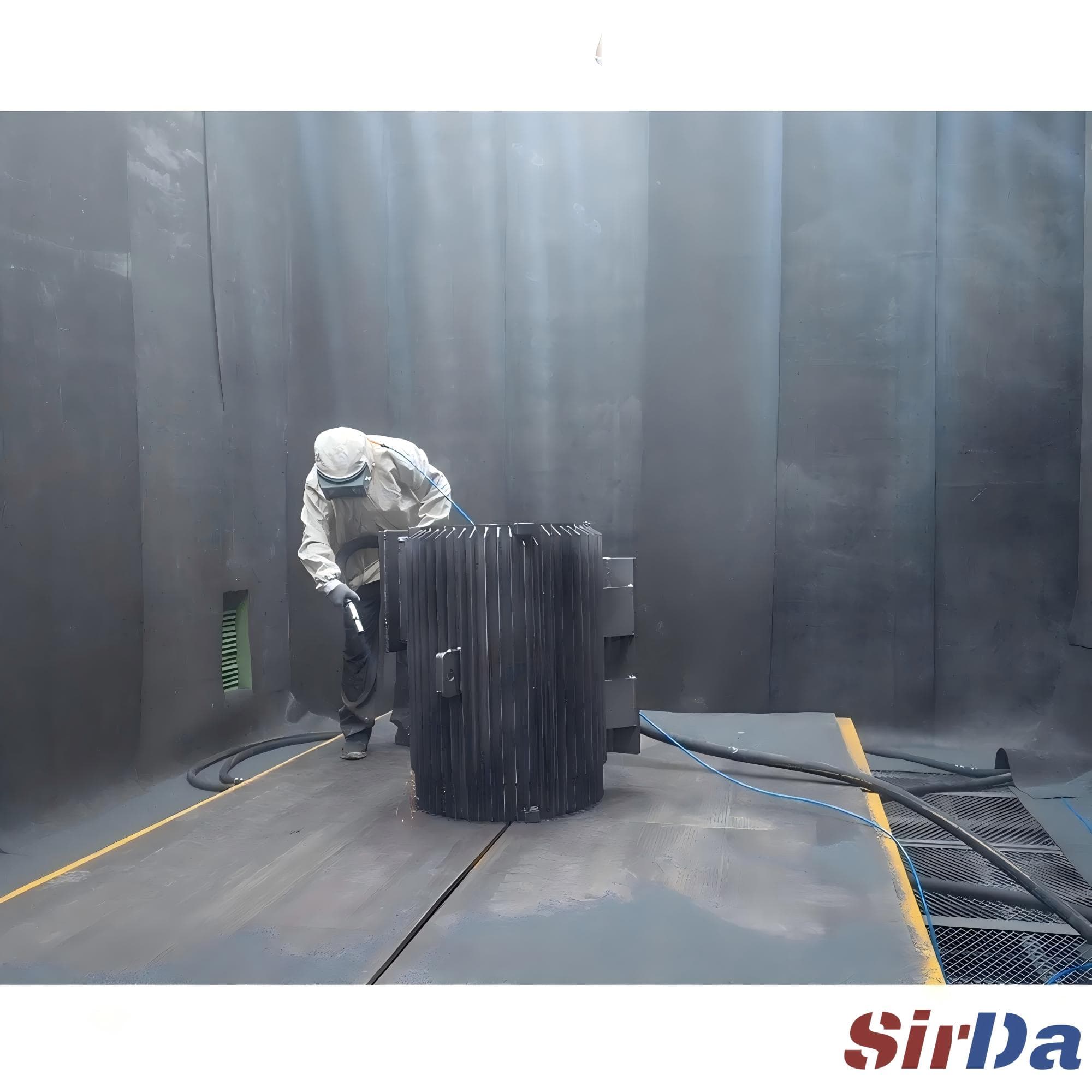
The workpiece stays still and the gun does the travelling
A shot blasting machine assumes the workpiece moves. A rotary table turns it, a hanger swings it, a belt
flips it. Once that motion exists, every point on the surface passes through the blast zone repeatedly, and
coverage follows from geometry rather than from the operator's mood on the day.
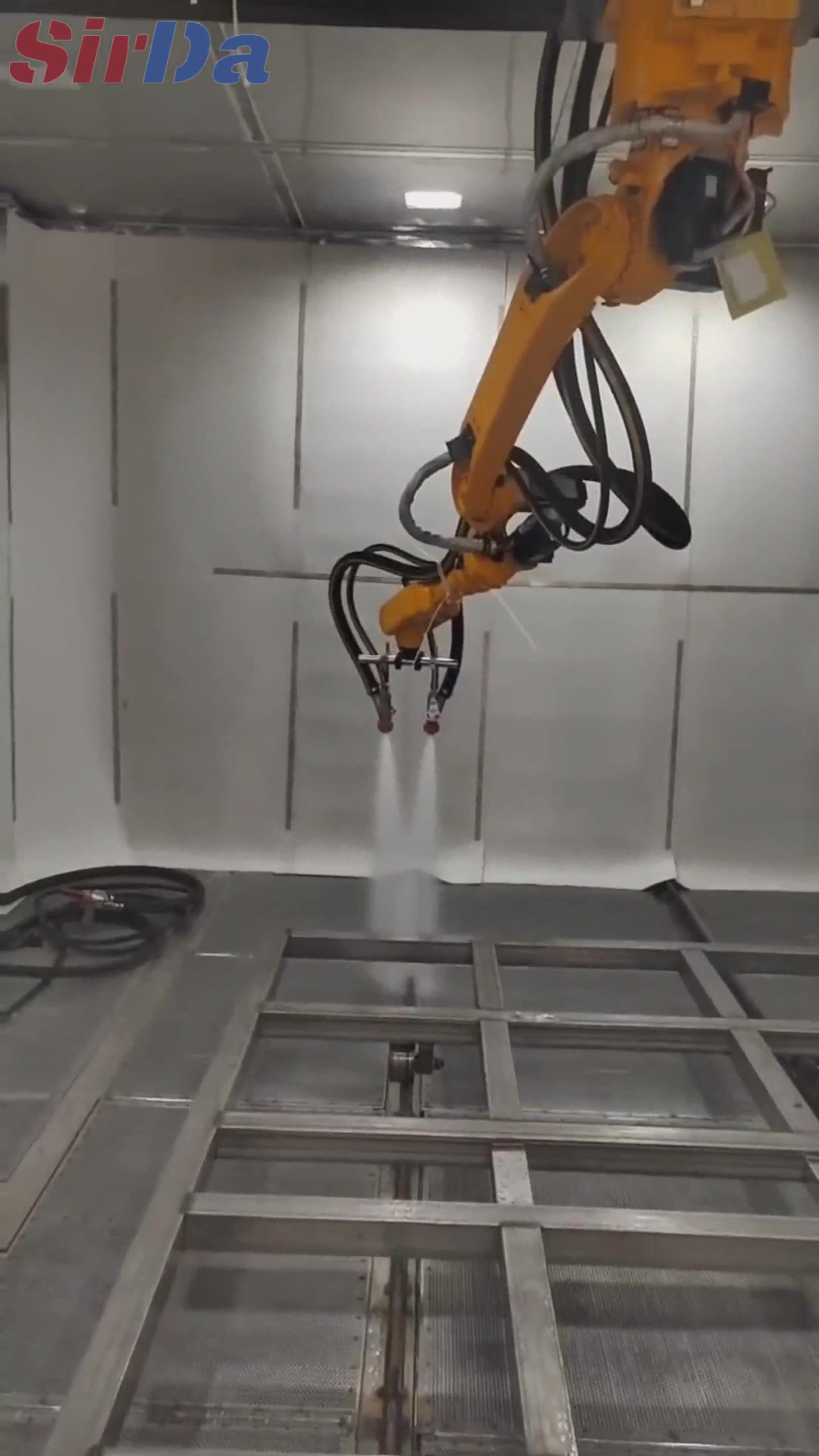
A robotic blasting booth gives that assumption away. The workpiece is anchored on the floor or on a fixture,
and coverage is produced by the arm path instead. That trade makes sense when the part is too large, too heavy,
or too irregular to turn, and the real cost of a heavy job was never the abrasive - it was the crane time spent
flipping the part over to reach the far side.
Coverage becomes a path problem rather than a motion problem
- Path overlap is the only coverage figure that matters - a rotating workpiece breaks up its own shadowing,
but an arm has to overlap adjacent passes until the gap between them is closed. A region that is missed is
missed permanently; there is no later revolution to come back for it.
- Standoff consistency decides surface consistency - the blast pattern widens with distance, so the same
abrasive charge lands very differently at 200 mm and at 400 mm. The value of the robot is that it holds that
distance instead of leaving it to a wrist.
- Deep interiors and flange backs need their own pose or their own gun - the inside of a vessel and the
narrow gap behind a flange are the genuinely difficult places on this class of workpiece, and they are the
part of the scope most worth pinning down before a price is agreed.
- Changeover is a program, not a mechanism - on a blasting machine a new workpiece means new parameters and
a new fixture. Here it means teaching a new path. For vessels, towers and end flanges, where the batch is
modest but the variety is high, that shift is what pulls the cost of a small custom run down.
Falling media is a secondary contamination source
This is where a booth and a blasting machine are genuinely different machines. A blasting machine is a closed
loop: the abrasive is thrown, hits the workpiece, is caught by the blades and liners, separated from the debris
and returned to the hopper. The media circuit never touches the floor.
A booth is open. Media that misses the workpiece drops straight down and lands around it, mixed with the paint
flakes, oxide and rust it just removed. Recover that material from the floor and feed it back to the gun without
separating it, and the debris gets blasted onto the workpiece a second time. The finish does not improve; the
loop gets dirtier with each pass.
So the question worth asking about a booth is not how large the room is, but where the media is recovered, how the
floor is swept, and what state the media is in when it returns to the gun.
What it achieves and where it stops
The result is that surface preparation becomes repeatable from the path and the parameters rather than from the
operator, and coverage no longer depends on being able to turn the part. That suits large workpieces that are
difficult to handle and produced in modest quantities with many variants - vessels, tower shells, ship plate,
structural weldments.
The other direction matters too. Small regular parts in volume remain cheaper on a rotary table or a continuous
belt, because one revolution covers the full circumference in a single pass, far faster than scanning it point by
point, with no deep interior to reach into. A robotic booth is not a replacement for a continuous line. It is the
answer to the work a continuous line cannot take.
Arm reach, gun type, booth dimensions and extraction volume are confirmed after the actual workpiece geometry
and site conditions have been assessed.