Sa 2.5 and ISO 8501: Surface Preparation Explained
What the Sa grades actually require, how rust grades change the job, and why cleanliness and profile are two separate acceptance criteria.
Sa 2.5 is the most frequently specified surface preparation grade in the world and one of the least precisely understood. It appears on drawings, in paint specifications and in contracts as a single shorthand, yet the standard behind it defines a visual condition, not a measurable one. Understanding what the grade does and does not control prevents most preparation disputes.
The ISO 8501 structure
ISO 8501-1 describes rust grades and preparation grades for steel surfaces before coating. The rust grades describe the condition of the steel as received. The preparation grades describe what the surface must look like after treatment.
The two are combined in the specification: a rust grade plus a preparation grade. "Sa 2.5 on grade C steel" is a complete statement of the visual requirement. "Sa 2.5" alone is incomplete, because the starting condition determines how much work is needed and what the finished surface will look like.
Rust grades A to D
Grade A is steel covered largely with mill scale with little or no rust visible.
Grade B is steel that has begun to rust and where mill scale has started to flake.
Grade C is steel where mill scale has rusted away or can be scraped off, with some pitting visible.
Grade D is steel where mill scale has rusted away and general pitting is visible.
The practical consequence is that the same Sa 2.5 result looks different on A and on D. On grade D the pits remain after blasting, and their depth is not removed by the preparation grade. A coating applied over deep pits has thin spots over the pit bottoms and thick spots elsewhere, and pitting corrosion can restart there.
The four blast-cleaning grades
Sa 1 — light blast cleaning. Loose mill scale, rust and foreign matter are removed, but tightly adherent scale and rust remain.
Sa 2 — thorough blast cleaning. Mill scale, rust and foreign matter are removed to the extent that the surface is free of oil, grease and dirt, and only slight staining remains in pits.
Sa 2.5 — very thorough blast cleaning. Mill scale, rust and foreign matter are removed so that the surface is free of oil, grease and dirt, and any remaining staining is limited to light shadows, streaks or spots.
Sa 3 — blast cleaning to visually clean steel. The surface is free of mill scale, rust and foreign matter, with a uniform metallic colour.
The distance between Sa 2.5 and Sa 3 is much larger in cost than in visual difference. Sa 3 requires removing the last traces of staining in pits, which on pitted steel can mean a large increase in exposure time for a small visual gain. On grade A steel the gap is narrower.
What "light shadows, streaks or spots" means in practice
The phrase in the Sa 2.5 definition is where most arguments start. The intent is that the surface is essentially uniformly cleaned, with staining confined to a small fraction of the area and clearly attributable to pit depth rather than to missed blasting.
A useful site rule: the staining must be isolated, and it must be in a depression. Broad grey patches on flat areas are not shadows, they are incomplete cleaning.
Photographs in the standard remain the reference. Where a dispute is likely, agree the reference photographs before work starts rather than after.
Cleanliness is not profile
Sa grades say nothing about roughness. A surface can meet Sa 2.5 and have a profile of almost zero, or a profile far above what the coating can tolerate. ISO 8503 controls profile separately, and both standards have to be specified.
This separation matters because the two properties are produced by different process variables. Cleanliness depends mainly on exposure and abrasive condition; profile depends on abrasive size, energy and angle.
The acceptance criteria the standard does not cover
ISO 8501 is a visual standard. It does not set limits for soluble salts, dust, oil or condensation, and it does not define a maximum profile.
Those are covered elsewhere: ISO 8502 for salt and dust assessment, ISO 8503 for profile, and the coating supplier's data sheet for environmental limits during application. A specification that cites only Sa 2.5 leaves the most common causes of premature failure uncontrolled.
Soluble salt is the most consequential omission. Chlorides left in pits draw moisture through a coating by osmosis and cause blistering and disbondment from below, with the surface still looking correctly prepared at the time of application.
Writing a specification that can be enforced
A preparable specification contains five elements.
- Rust grade before blasting, so both parties know what the starting surface is.
- Preparation grade to ISO 8501-1, with reference photographs nominated.
- Profile band to ISO 8503, including grade and any instrumented Rz limits.
- Salt limit to ISO 8502-3 or equivalent, with the test method and frequency.
- Environmental and time limits between preparation and coating, including the maximum permitted humidity and the recleaning rule for surfaces that flash rust.
With those five, a third-party inspector has something to measure. With "Sa 2.5" alone, the inspector can only compare by eye.
Where the process usually fails
Failure to reach Sa 2.5 on a consistent basis normally comes from one of four causes, and none of them is insufficient wheel power.
Insufficient exposure on part geometry. Wheels produce a pattern; the pattern does not wrap around every edge effectively. Shadowed faces, inside corners and the underside of stiffeners need either repositioning or additional blast positions.
Abrasive contamination. A working mix loaded with fines and broken media cleans more slowly and produces a lower profile at the same setting. Separator condition is a preparation variable, not a maintenance detail.
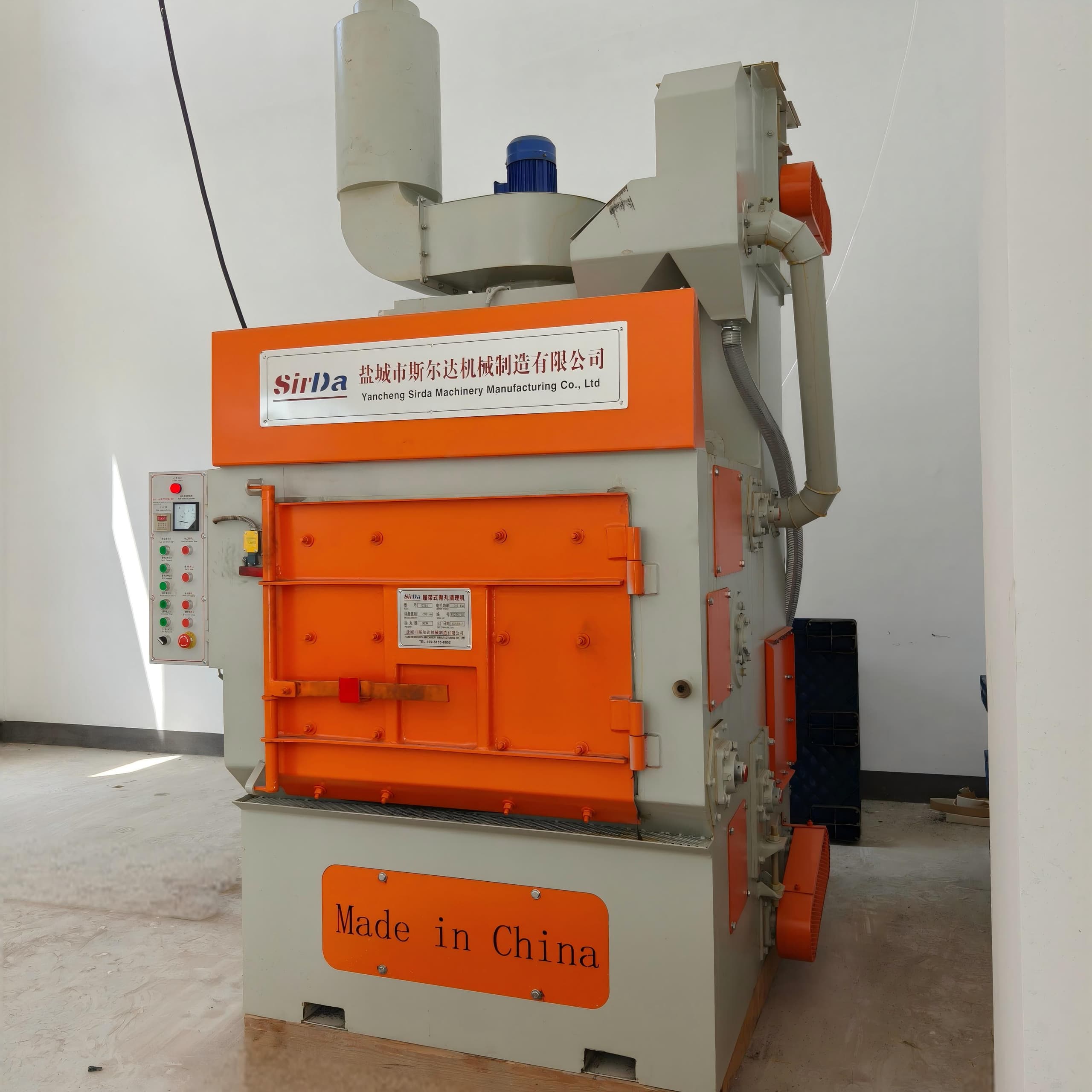
Overloading the machine. A tumble belt machine loaded above its working mass will not turn the load over, and the parts at the bottom of the batch emerge at a lower grade than the parts on top.
Line speed set for throughput. A roller conveyor machine run faster than its qualified speed will pass parts that look acceptable at the exit and fail on inspection after coating. Line speed belongs to the qualified process, not to the production plan.
Comparing quotations on preparation
Quotations for the same nominal grade are rarely comparable, because each supplier states the requirement differently. Before comparing anything, reduce every offer to the same five items: rust grade assumed, preparation grade, profile band, salt limit and inspection regime.
A quotation that assumes grade A steel and a quotation that assumes grade D steel describe very different amounts of work. If the enquiry did not state the rust grade, neither figure is wrong — they are answers to different questions.
The same applies to acceptance. An offer that includes comparator photographs, a profile gauge and a defined inspection frequency is a different product from one that promises "Sa 2.5" and leaves verification to the buyer. The difference shows up later, when the first coating failure is investigated and nobody can establish what the surface actually was.
Verification that matches the standard
Use the reference photographs under the lighting conditions the standard describes. Grade assessments made in direct sunlight or in deep shadow will not be reproducible.
Inspect before any flash rust appears, and record the interval between blasting and inspection. On humid days that interval can be minutes, and an inspection performed after the surface has discoloured is not an assessment of the blasted surface.
For large structures, divide the surface into defined areas and record the grade per area. A single grade for a whole fabrication hides the local areas that will fail first.
If you are specifying Sa 2.5 alongside a profile band and need a machine configuration that holds both, our engineers can work from your drawing and coating system — send the details through the contact form.
Frequently asked questions
What is the difference between Sa 2 and Sa 2.5?
Sa 2 allows slight staining over the surface. Sa 2.5 requires very thorough cleaning with staining limited to light shadows, streaks or spots. The step between them is significant in exposure time on pitted or rusted steel.
Does Sa 2.5 define the surface profile?
No. ISO 8501 is a visual cleanliness standard. Profile is controlled separately by ISO 8503 and must be specified independently, ideally as a band with an upper and lower limit.
Is Sa 3 worth the extra cost over Sa 2.5?
Usually only for specific coating systems or severe service. Sa 3 requires removing staining from pits, which can mean a large increase in exposure for a small visual gain, especially on rust grade C and D steel.
Why does my steel still show grey patches after blasting to Sa 2.5?
Either exposure is incomplete or the patches sit in pits. Staining confined to depressions is permitted; broad patches on flat areas indicate the surface has not been uniformly cleaned.
Does Sa 2.5 remove salt from the surface?
Blasting reduces salt but does not reliably remove it from pits. Soluble salt limits should be specified and tested separately to ISO 8502, particularly for immersion or high-humidity service.
How soon must coating follow blasting?
Before flash rust forms, which depends on humidity and temperature and can be minutes. The specification should state the maximum interval and the recleaning rule if the surface discolours.