Choosing a Shot Blasting Machine Type: A Selection Guide
A selection method that starts from part geometry and throughput, then narrows to tumble belt, hanger, roller conveyor or mesh belt.
Most machine selection mistakes happen before anyone looks at a catalogue. They happen when a buyer starts with a machine type they have seen elsewhere and then tries to fit the parts into it. The reliable order is the reverse: describe the parts, describe the handling, calculate the throughput, and only then choose the family.
Start with geometry, not tonnage
Four questions about the parts eliminate most of the options immediately.
Can the parts tumble without damage? If yes, a tumble belt is usually the cheapest way to process them. If they are thin-walled, machined, threaded or likely to nest, tumbling will damage them or leave them unexposed.
Can they be hung? If the part has a lifting point, a bore or a geometry that hangs stably, a hanger machine exposes all faces in one cycle.
Are they long and regular? Plate, sections, tube and bar suit a roller conveyor because the part itself becomes the conveyor.
Are they flat, fragile or individually fixtured? A mesh belt carries parts through without tumbling them and without requiring a fixture.
Tumble belt: the default for bulk small parts
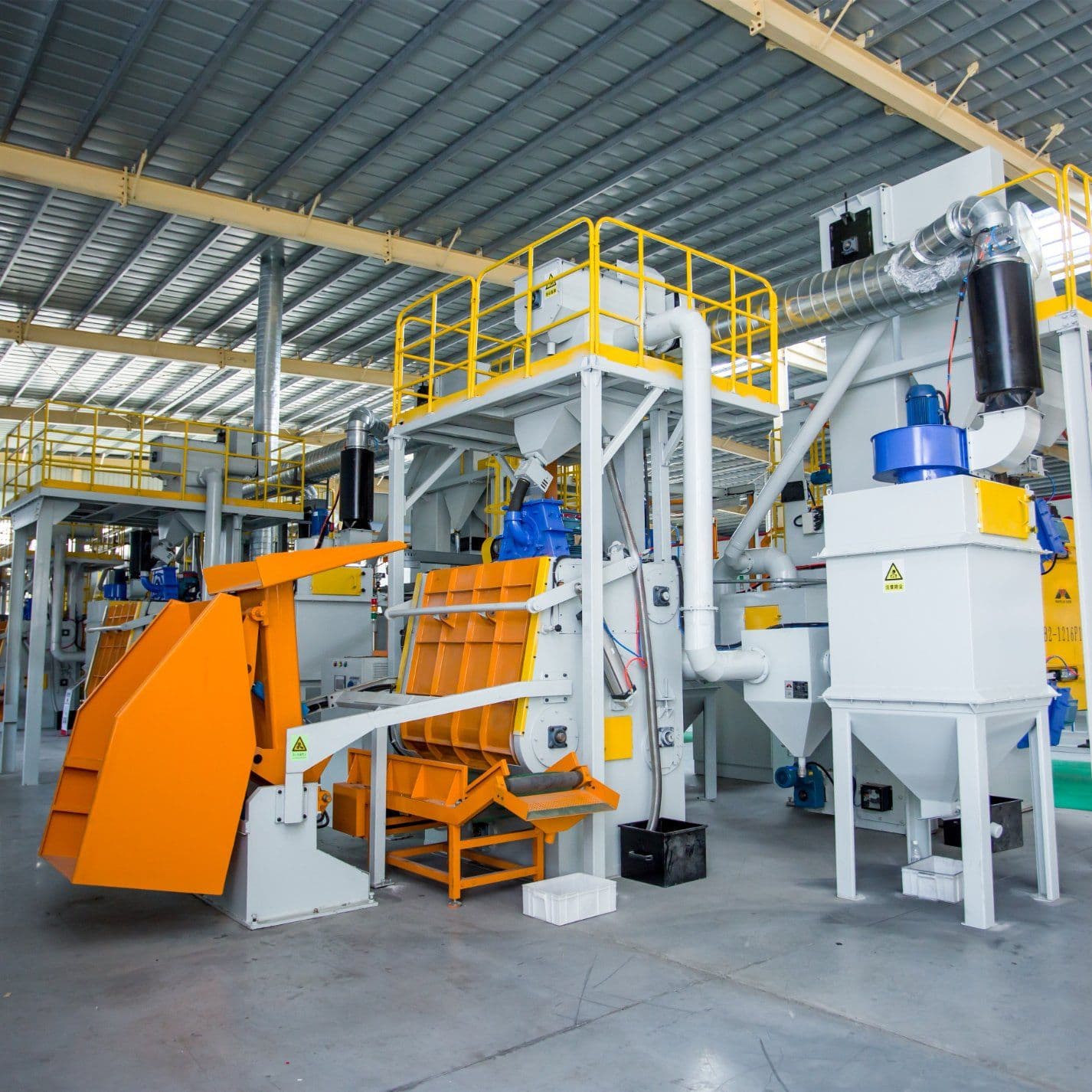
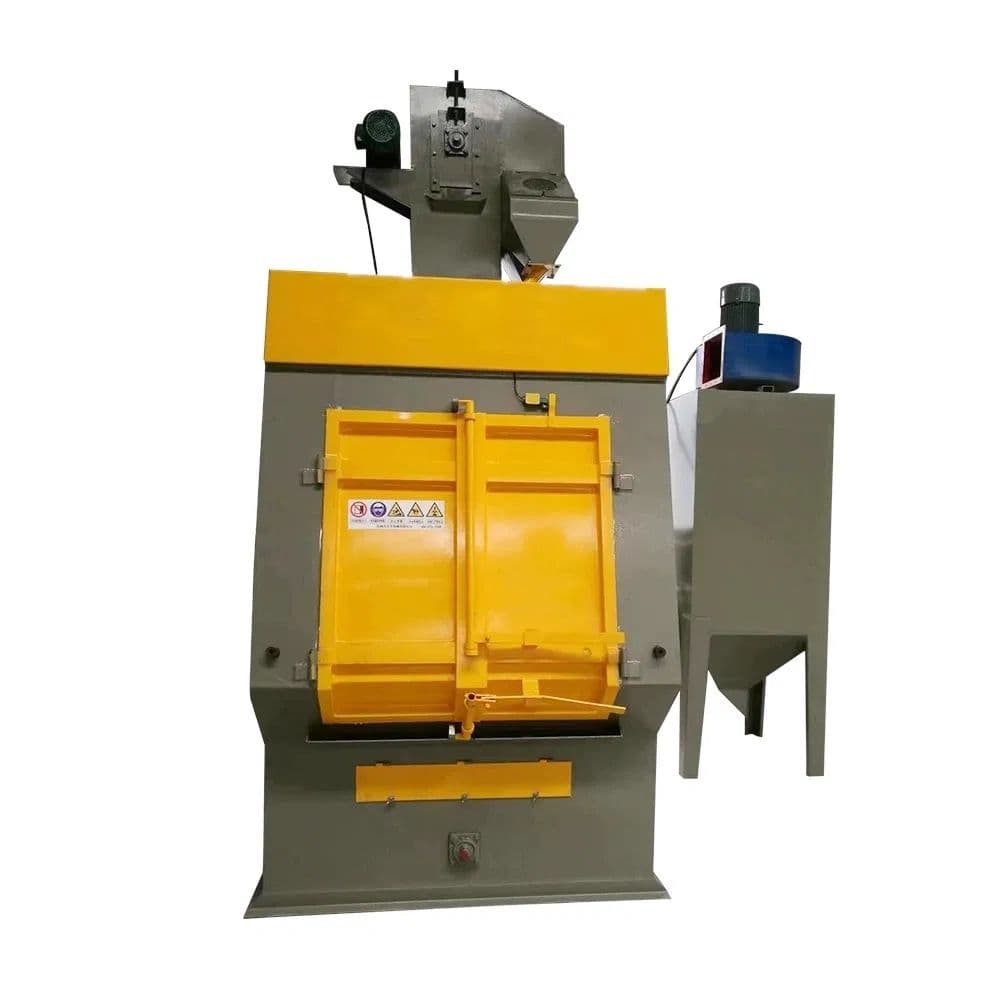
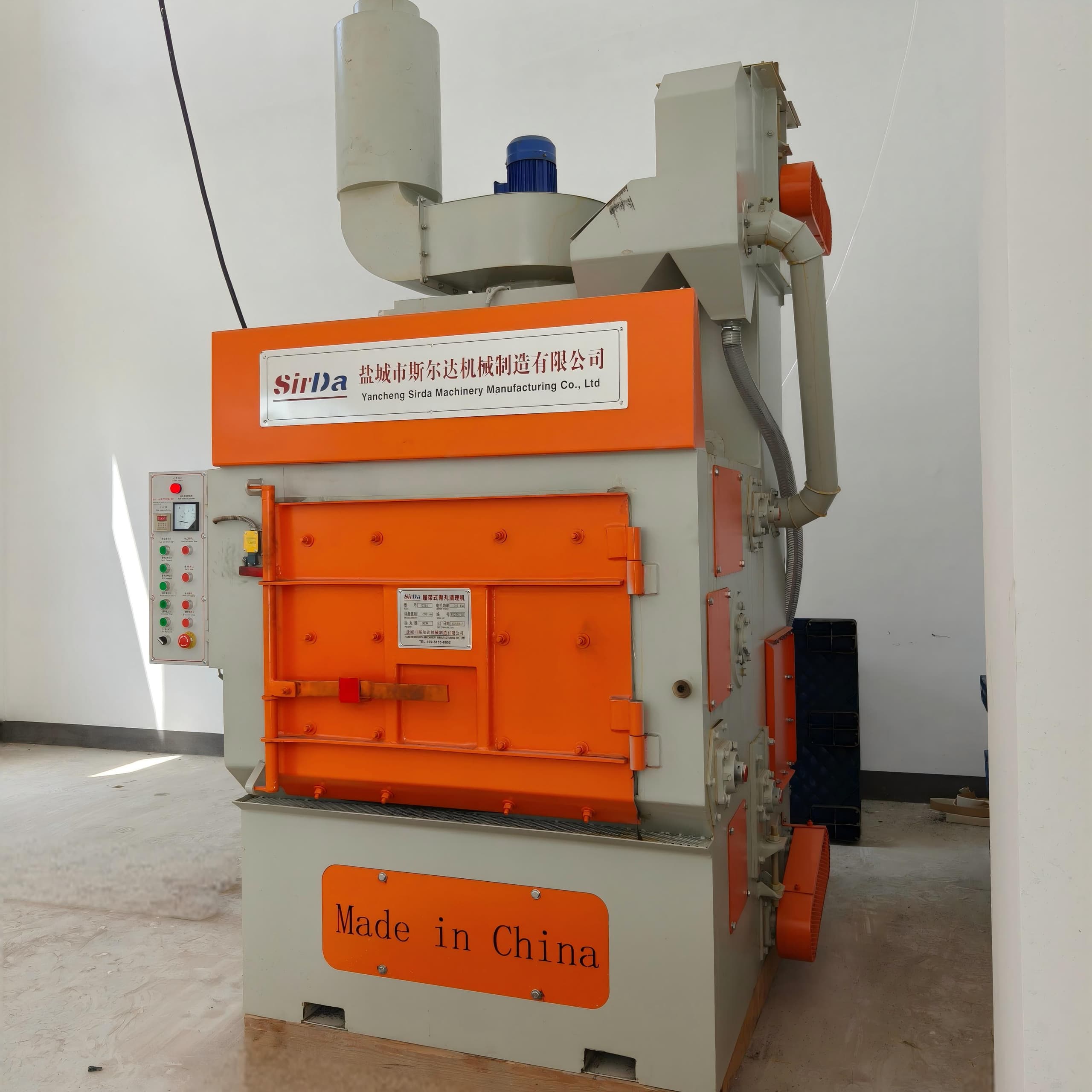
A tumble belt machine loads a batch into a rubber or steel belt chamber, closes the door and rotates the belt while wheels blast the tumbling load. Every part is exposed repeatedly as the load turns over.
It is efficient, compact and forgiving. It is also indiscriminate: the process cannot protect a delicate feature, and parts that nest will shield each other. Load mass limits and part size limits are hard constraints, not guidelines.
Typical fit: castings, forgings, fasteners, stampings, heat-treated parts without critical machined surfaces.
Typical mismatch: thin-walled aluminium, precision threads, parts that tangle, mixed loads with very different sizes.
Hanger type: one part, all faces
A hanger type machine hangs the workpiece from a hook inside the cabinet. The hook may rotate, the wheels are positioned around the chamber, and the part is blasted from several directions in a single cycle.
This is the choice when the part is too large to tumble, too valuable to risk, or has features that must not be impacted by other parts. It is also the most flexible family for job shops, because the same machine handles a wide range of geometries as long as they can be hung and fit the chamber.
The constraint is handling. Every part needs a lifting point and a crane or hoist, and cycle time includes loading and unloading. For high volumes of small parts, that handling overhead dominates.
Roller conveyor: the part is the conveyor
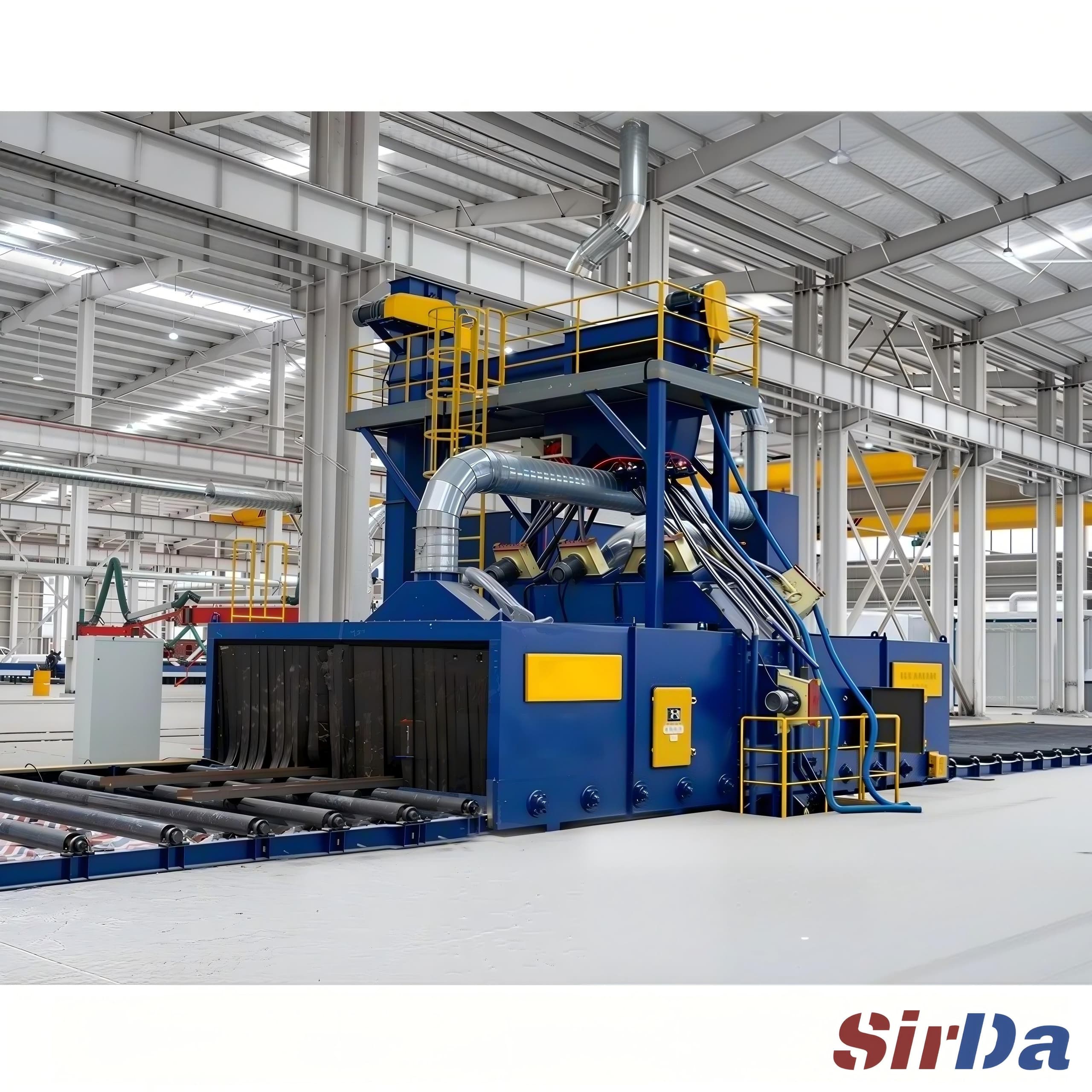
A roller conveyor machine passes plate, sections, tube or fabricated lengths over powered rollers through a blast cabinet. Wheels above and below treat top and bottom in one pass.
Throughput scales with line speed and width, and the process is continuous rather than batched. That makes it the natural choice for structural steel, plate processing and line-integrated fabrication.
The constraints are geometry and handling. Parts must be long enough and rigid enough to span the rollers, and they must be fed and received in line. Short or irregular parts fall between rollers or jam.
Mesh belt: continuous, gentle, fixtured
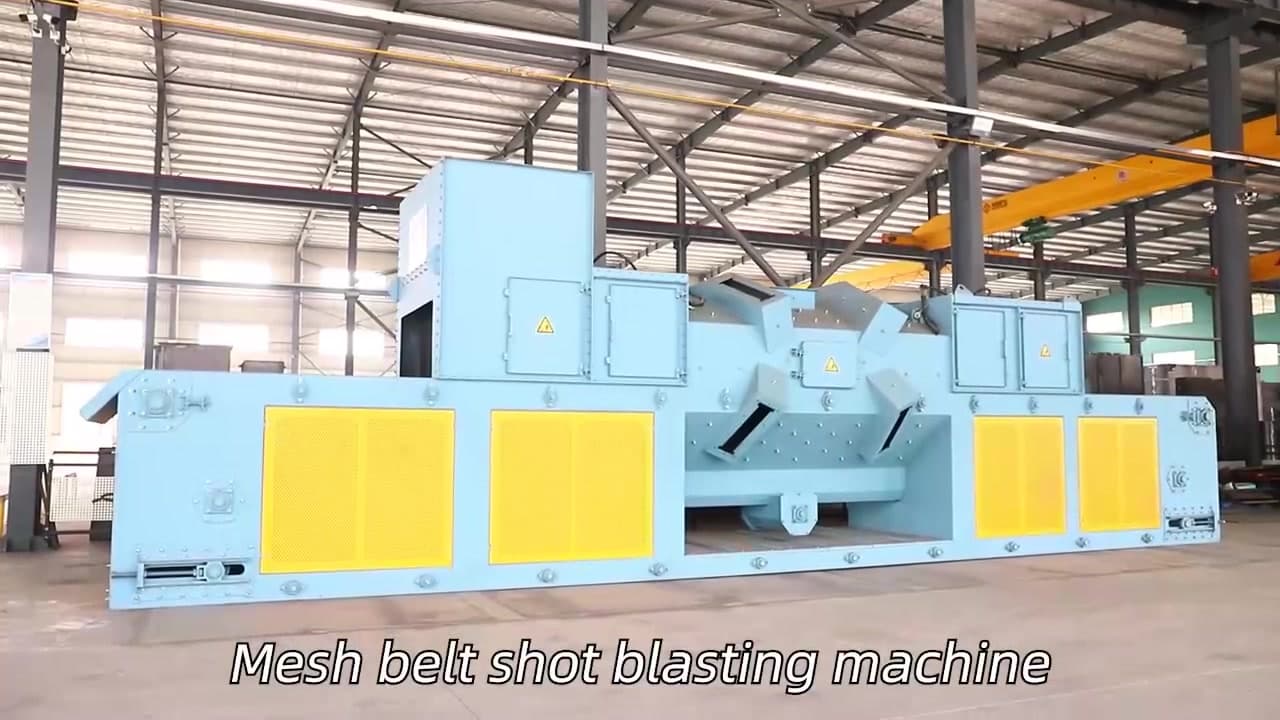
A mesh belt machine carries parts on a wire mesh conveyor through the blast zone. Parts sit on the belt rather than tumbling, so they can be small, flat or delicate, and they can be positioned deliberately.
It sits between the tumble belt and the roller conveyor: continuous like a roller line, but able to carry small and non-rigid parts. Throughput depends on belt width, belt speed and loading density.
The constraint is shadowing. Parts lying flat on the mesh have a contact face that the blast cannot reach, and tall parts can shield the parts behind them.
Throughput arithmetic before machine size
Throughput is not the same as blasting capacity. The number that matters is parts per hour at the specified cleanliness and profile, including handling.
Estimate it as: load per cycle divided by total cycle time, where total cycle time includes loading, blasting, unloading and any inspection. Buyers routinely compare blasting cycle times and forget that a hanger machine may spend as long handling as blasting.
For continuous machines, throughput is belt or roller speed multiplied by loading density, with a derating factor for gaps and part spacing. A line that looks fast on paper often runs at half its nominal rate because parts are loaded with generous gaps.
Utilities, footprint and dust
Machine family drives the utility envelope. Tumble belts and hanger machines are batch units with modest extraction demand relative to their chamber volume. Continuous roller and mesh belt lines need extraction sized to the full cabinet length and to continuous operation, and their dust load is steadier.
Footprint is often the deciding factor in an existing plant. A roller conveyor line needs length in both directions for infeed and outfeed; a hanger machine needs height and crane access; a tumble belt needs floor area for load handling and abrasive top-up.
When one machine cannot cover the range
Mixed product ranges often need two machines rather than one compromise. A tumble belt for bulk small parts plus a hanger machine for large or delicate parts usually costs less than a single oversized flexible machine, and each runs at its own optimum.
The exception is a plant with a genuinely narrow product mix, where a single well-matched machine beats two general-purpose ones on both footprint and operating cost.
Noise, dust and the operator environment
Machine family changes the working environment as much as the process. A tumble belt and a hanger machine are enclosed cabinets with relatively small openings, so the noisy and dusty part of the cycle happens behind steel and interlocked doors. A roller conveyor or mesh belt line has open entry and exit apertures that run continuously, so extraction has to capture dust at both ends and the surrounding area needs guarding.
Noise follows the same pattern. The wheels themselves are a constant source, but the dominant noise at a continuous line often comes from parts rattling on rollers or mesh, and from the extraction system. That noise is present for the whole shift rather than for a batch cycle.
Treat these as selection criteria rather than afterthoughts. A machine that cannot be installed without rebuilding the extraction ducting, or that pushes noise levels above the plant limit at the operator position, is not a fit regardless of its throughput.
Test before you commit
Ask for a trial on your actual parts, not on a demonstration sample. The trial should measure cleanliness, profile, cycle time and part damage, and should be run at the settings you would use in production rather than at maximum power.
Bring parts that represent the difficult end of your range, including the ones you think will nest, shield or jam. A machine that handles the easy 80% and fails on the difficult 20% will not solve the problem it was bought for.
If you are narrowing the options, send part drawings, material, required cleanliness and hourly volume through the contact form. We will tell you which family fits and where the real constraint sits, including when the answer is that no single machine covers the range.
Frequently asked questions
Which machine type is best for small castings?
Usually a tumble belt, provided the castings can tumble without damage and do not nest. It gives repeated exposure at low cost per part. Delicate or nesting castings are better run on a mesh belt or in fixtures.
Can a hanger machine process small parts in bulk?
It can, but handling dominates. Unless parts are loaded on fixtures in multiples, the crane time per part makes a hanger machine uneconomical compared with a tumble belt or mesh belt.
What part length does a roller conveyor need?
Parts must span the roller pitch reliably and stay stable in line. Short or irregular parts can fall between rollers or rotate. The minimum usable length depends on roller spacing and part stiffness.
How do I calculate realistic throughput?
Divide load per cycle by total cycle time including loading, blasting and unloading, or multiply line speed by loading density for continuous machines. Derate for gaps, part spacing and inspection.
Is one flexible machine better than two dedicated ones?
Only for a narrow product mix. For a wide range, two dedicated machines usually beat one compromise on footprint, cycle time and operating cost, and each can be set up optimally.
Should the trial use my own parts?
Always. Demonstration samples are chosen to look good. Trial your difficult parts at production settings and measure cleanliness, profile, cycle time and damage, not just appearance.