
Aerospace components
Aerospace components preparation, Europe
An aerospace component supplier in Europe machines brackets, housings and support parts from aluminium and titanium alloys. The parts are high value and small enough to handle on hooks, but they cannot be tumbled or allowed to contact one another. The previous cleaning method was a manual cabinet, and the results varied with operator technique, especially around edges and machined pockets. The supplier needed a controlled batch process with predictable coverage and a clear loading arrangement for each part family. The parts are inspected after blasting, and any embedded media or damaged edge would be a reject, so the process had to be repeatable rather than merely fast. The supplier also needed a loading arrangement that could be documented for its own process control.
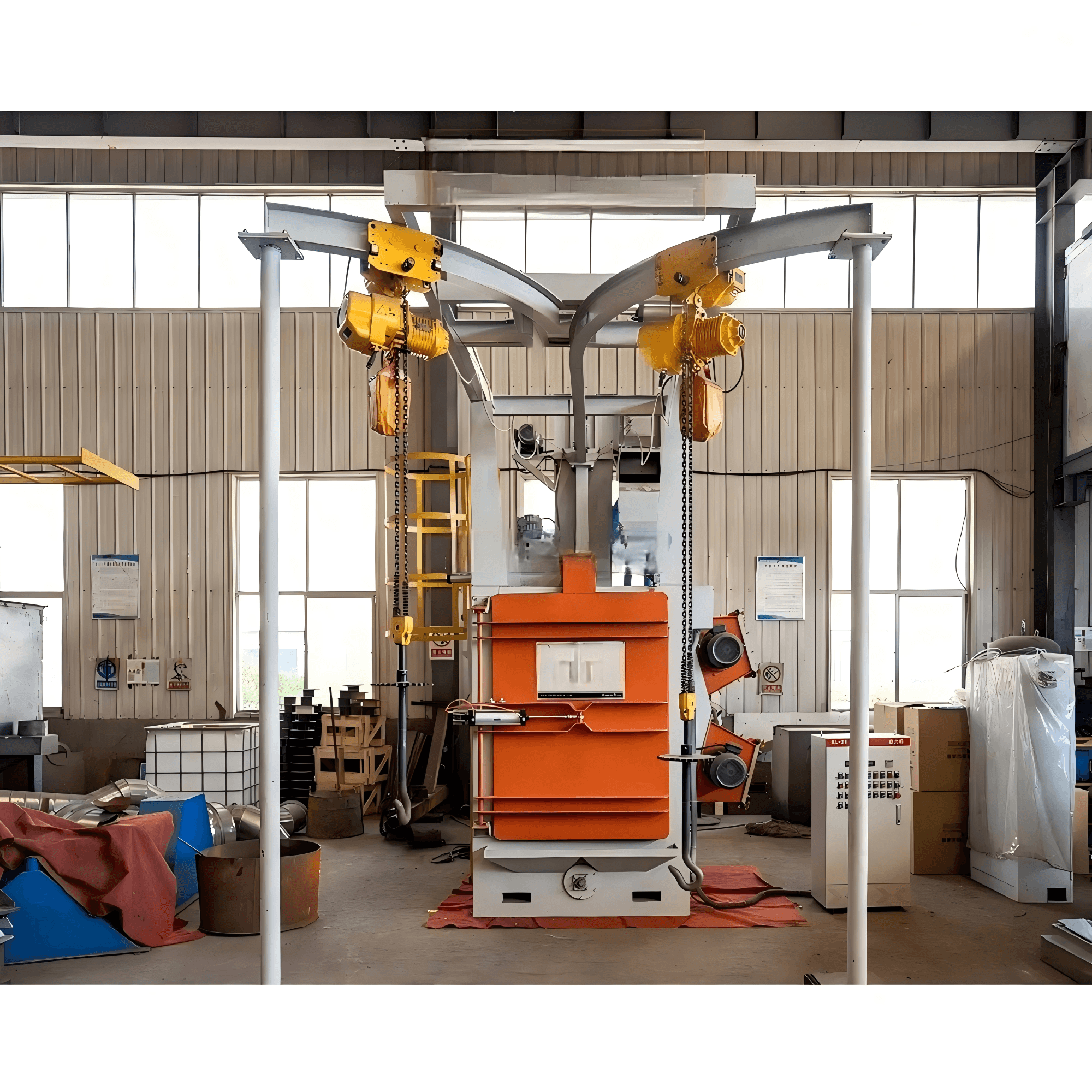
A Q37 hanger type machine was selected because each part can be suspended individually. Hook loads are kept at or below 600 kg, and typical batches are 300–500 kg. The published Q37 throughput is 1.0–2.0 t/h, and the cell runs at 1.0 t/h. The chamber and hook height were set around the largest housing, and the existing overhead crane serves the loading station. The machine sits in a finishing cell with access for masking and inspection before and after blasting. Individual hooks were made for the main part families so a bracket cannot swing into a neighbour during the cycle. The hook height was set so an operator can mask a part at bench level before lifting it.
The abrasive is selected for the alloy and the required finish, and the supplier confirmed media compatibility before commissioning. Critical surfaces are masked, and the hook positions are arranged so the blast stream reaches the faces that need preparation without over-processing thin sections. Dust is extracted through a filter, and the abrasive separator removes fines before the media returns to the wheel. The recipe records the wheel setting, the blast time and the hook position for each part family. The supplier wrote the recipe set with the process team, and each recipe is locked to a part number so an operator cannot change the blast time by accident. Masking plugs are reused and checked before each batch, and the inspection step after blasting includes a visual check for remaining masking.
At 1.0 t/h a 400 kg batch takes roughly 24 minutes of blasting, plus masking and inspection. The cell runs to the production schedule and keeps a reference part for the daily check. Accessible surfaces reach SA 2.5, and the inspection team receives parts with a repeatable surface instead of a manual patchwork. Delivery included foundations, the dust connection, commissioning with production parts, operator training and a documented recipe set. The supplier keeps a spare set of blades and liners so a wear change does not interrupt the cell. The cell is cleaned between families to avoid cross-contamination of different alloys, and the dust filter is monitored for pressure drop. The training covered loading, masking, recipe selection and emergency stop, and the supplier keeps a maintenance log for the wheel and the separator. Commissioning was done with production parts, and the first batches were inspected before the cell was released to the shop.
Project facts
- Industry
- Aerospace components
- Country / region
- Europe
- Workpiece
- Machined brackets, housings and support parts, 3–25 kg
- Machine
- Q37 hanger type shot blasting machine
- Result / takt time
- 1.0 t/h batch cleaning; SA 2.5 on accessible surfaces
Your next project
Let’s find your solution.
Send your workpiece and production requirements.
Let’s define the right blasting system.