Throughput math: estimating parts per hour for a blast machine
Throughput is a system result, not a catalog number. Learn to estimate a shot blasting machine's real hourly output from surface area and cycle time, then apply the efficiency factor most buyers forget.
Every buyer asks "how many parts per hour?" first, and that is exactly the wrong place to start. Throughput is a system result, not a catalog number. Here is how to estimate it honestly before you commit to a machine size.
Start with surface area, not the brochure
The most common estimating mistake is to begin from the machine model — its chamber size, its wheel power, its headline load. None of those tell you how much work the machine actually does. Capacity is always tied to how much surface needs cleaning, because a blast wheel only "pays" for the area it can keep exposed to abrasive.
Take a pipe as the simplest case. A 600 mm diameter, 12 m long pipe presents roughly π × 0.6 × 12 ≈ 22.6 m² of surface. That one number drives the estimate far more than any specification sheet. A structural beam, a casting family, a batch of small brackets — each has a surface-area-per-part that you must know before the machine size means anything.
Build the estimate from cycle time
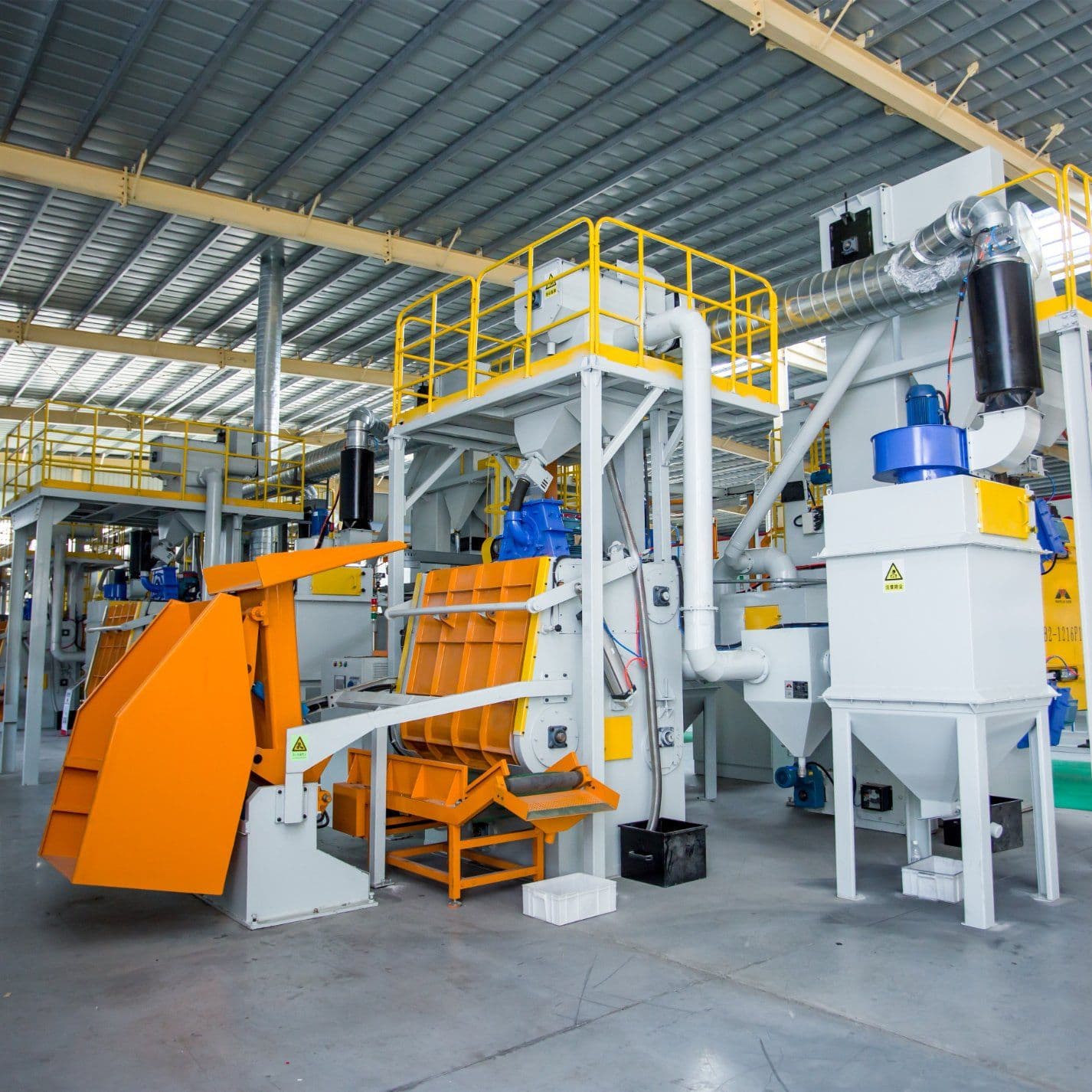
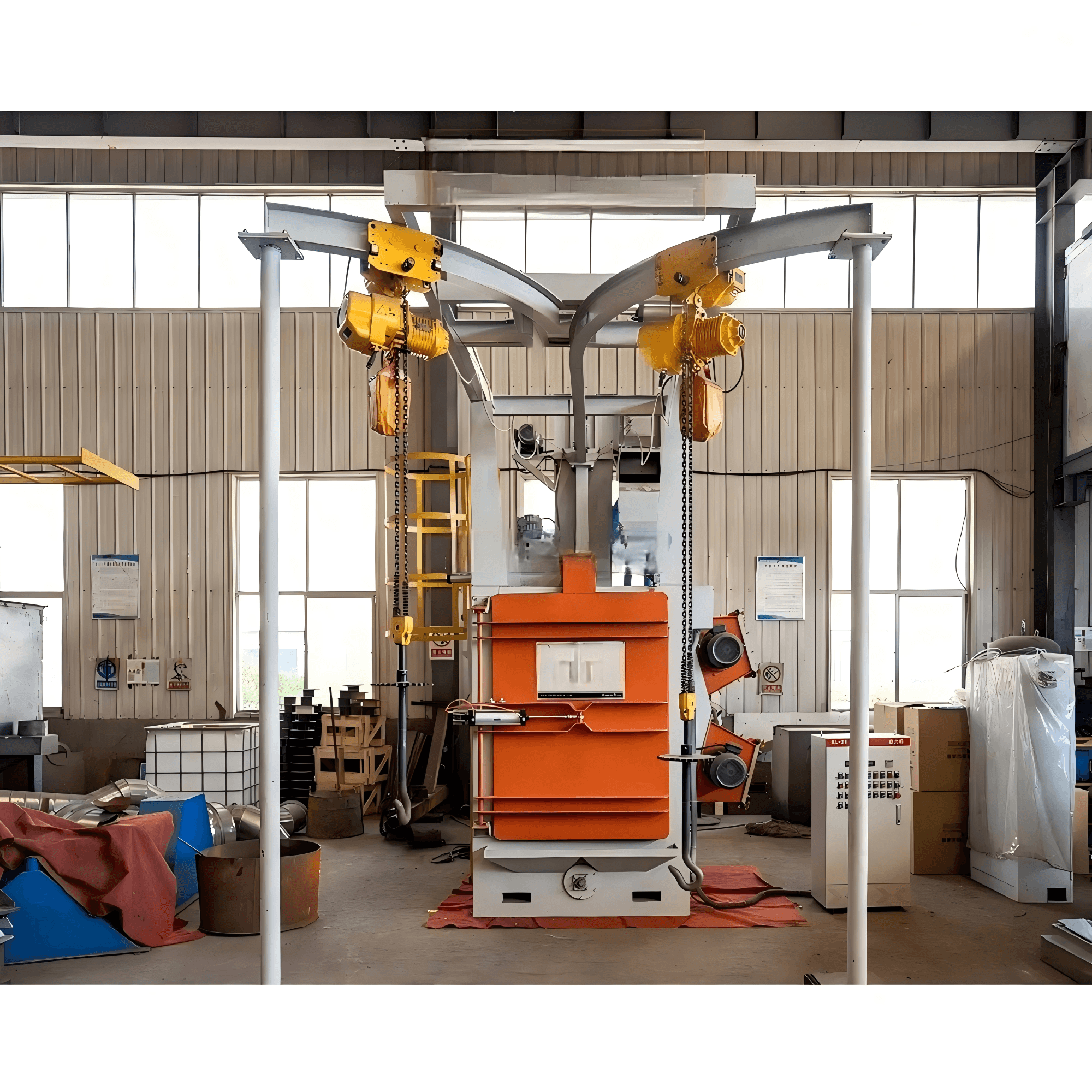
For batch machines — tumble belts, rotary tables, monorail hooks — the backbone of every estimate is the cycle-time formula:
- Theoretical hourly capacity ≈ batch load × 60 ÷ total cycle time (minutes).
- Total cycle time is not just "blast time." It is loading + blast exposure + rotation or tumbling + unloading + any post-blow-off.
- A 300 kg tumble batch with 8 minutes of blasting, 2 minutes loading and 2 minutes unloading runs a 12-minute total → about 1,500 kg/h on paper.
- For continuous roller or mesh lines, the analogous lever is conveyor speed: output (m²/h) ≈ speed × working width × 60 × fill factor.
Metallic blast wheels typically throw 150–300 kg/min of media each at 60–80 m/s wheel-tip speed; that flow, not the motor kW, is what sets how fast a given area reaches the target profile. The blast exposure itself depends on three things you cannot average away: the required cleanliness grade (Sa 2 is fast, Sa 2½ is the standard working target, Sa 3 is rarely needed and much slower), the starting surface condition (light rust may clean at 2.0–2.5 m²/min, medium scale 1.5–2.0, heavy mill scale or old coating 1.0–1.5), and the number and angular placement of blast wheels. Four well-placed wheels covering top, both sides and bottom will out-clean six poorly aimed ones — wheel count on a spec sheet is not coverage.
The efficiency factor you cannot skip
The brochure stops at the theoretical number. Real workshops do not. Once a machine is running with real parts, output drops for reasons that have nothing to do with the wheels:
- Loading and unloading delays, especially manual handling of heavy fixtures.
- Part rotation or tumbling instability — an unstable rotating pipe alone can cut effective efficiency by 20% or more.
- Abrasive circulation lag: a low shot charge or a mis-set separator throttles flow and lightens the result.
- Short stops for inspection, wheel-blade swaps, and changeovers between part families.
- A dust collector sized too small forces reduced wheel flow to stay under emission limits, silently capping throughput.
Across real installations, 70%–85% productive utilization is the realistic band. Plan around the low end until you have proven the line on your parts. A machine quoted at 1,500 kg/h of theoretical capacity typically delivers 1,050–1,275 kg/h in steady production — and that assumes the abrasive, the wheels and the dust system are all healthy.
Size for the bottleneck, not the daily average
Here is where most lines are quietly mis-sized. The daily average throughput is comforting; the peak hour is what actually backs up your molding line or starves your paint shop.
Consider a foundry running four casting families in one shift. Brake drums fly through a tumble belt at 4 minutes per batch; flywheel blanks need individual monorail hangers and 10 minutes each. The shakeout might dump a wave of heavy blanks at you exactly when you are still finishing pump housings from the previous batch. If you size the blast line to the 8-hour average, that one overlap hour becomes a permanent queue.
The fix is unglamorous: size for the peak bottleneck, then add 15%–20% capacity margin on top. Undersizing costs you daily output and forces the upstream line to slow; oversizing costs you chamber size, wheel-motor kW and media consumption you never use. Either error is expensive, but the queue is the one that shows up in your delivery lead time first.
The honest conclusion: throughput is something you work out from your real parts, your real surface condition and your real cleanliness target — then confirm with a documented test cycle on actual components. Treat any single "parts per hour" number as a starting assumption, not a promise.