
Foundry
Foundry castings cleaning, Southeast Asia
A foundry in Southeast Asia produces pump housings, valve bodies and impellers for water and process equipment. The castings arrive at the finishing area with sand, burned-on binder and mill scale packed into recesses, and for years the plant cleaned them by hand with wire brushes and abrasive discs. The manual route was slow, depended on the operator and left an uneven surface that reappeared at the painting stage. Several housings have thin walls and flat sealing faces, so a tumble belt was ruled out: parts would strike one another and the gasket faces could be marked. The foundry needed a batch process that could handle a mixed range of shapes without part-to-part contact. Production runs in campaigns, so the batch mix changes from large pump housings to smaller valve bodies within the same shift, and the cleaning cell has to absorb that variation without a separate setup for every size.
The application review pointed to a Q37 hanger type shot blasting machine. Each casting is loaded on a hook, so the blast stream reaches the outer walls, flanges and open recesses while the parts stay separated. The largest housing and the longest impeller were used to define the chamber and hook height, and the existing crane in the finishing bay set the loading position. Hook loads were limited to 800 kg, with typical batches between 500 and 800 kg. The Q37 range is published at 1.0–2.0 t/h for this envelope, and the plant runs the line at 1.2 t/h. The loading station was laid out so the crane drops a casting directly onto the hook and the operator can check the fixture before the door closes; a second hook position is kept free for changeovers.
The configuration uses the standard Q37 blast wheel arrangement, with an abrasive separator that removes broken shot and dust before the media returns to the wheels. Dust is drawn from the chamber through a filter, and the extraction duct was connected to the foundry ventilation route. The hook positions were arranged so the blast stream sees the main faces and the open cores. Blind pockets and deep internal passages are still touched up by hand; this was agreed during the review instead of being discovered after commissioning. The operator loads a batch, closes the door, selects the recipe and unloads into stillages. The extraction was balanced inside the machine 5000–16000 m³/h range, and the shot size was selected for cast iron rather than a generic mix. The chamber door is interlocked with the wheel drive so the cycle cannot start with the door open.
At 1.2 t/h a typical 600–800 kg batch takes about 35–40 minutes, including loading and unloading. The machine runs across two shifts, and the plant keeps a reference casting for the daily surface check. Exposed surfaces reach SA 2.5, and the painting line now receives a consistent surface instead of a mix of hand-cleaned patches. Delivery covered the foundation, the connection to the dust collector, commissioning with production castings and operator training. A recommended wear-part list is kept on site so a worn blade or liner does not interrupt the batch schedule. Safety interlocks and a daily walk-around are part of the shift routine, and the maintenance check covers the wheel blades, chamber liners and separator screen. The plant keeps a simple log of blasting time and surface result for each campaign.
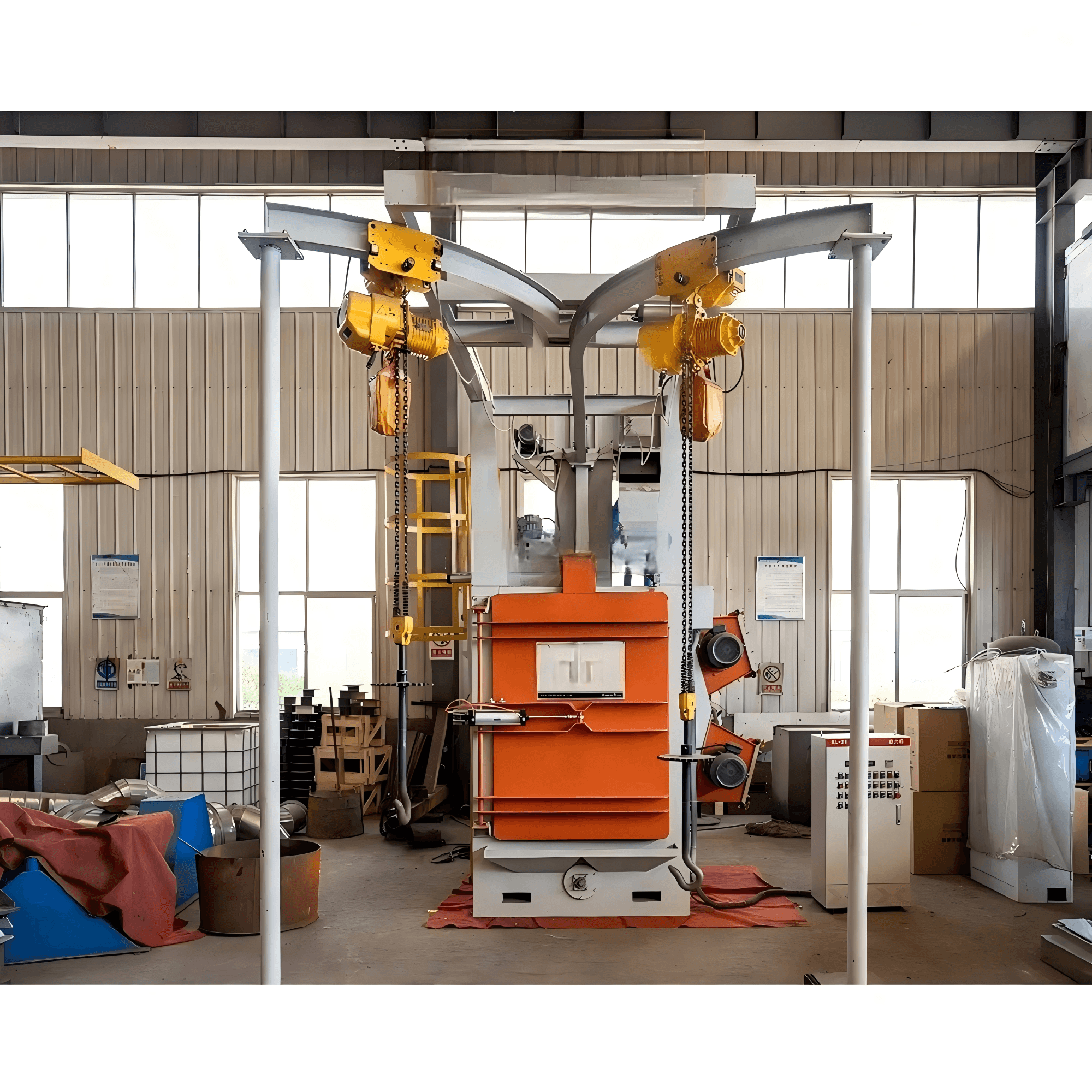
Project facts
- Industry
- Foundry
- Country / region
- Southeast Asia
- Workpiece
- Pump housings, valve bodies and impellers, 5–45 kg
- Machine
- Q37 hanger type shot blasting machine
- Result / takt time
- 1.2 t/h batch cleaning; SA 2.5 on exposed surfaces
Your next project
Let’s find your solution.
Send your workpiece and production requirements.
Let’s define the right blasting system.