Steel pipe manufacturing
Steel pipe surface preparation, Middle East
A pipe mill in the Middle East produces large-diameter longitudinal seam pipes for water transmission and structural projects. The external coating line needs a clean, uniformly profiled steel surface, but the plant was relying on manual blasting and spot repair. Mill scale and rust varied along each 6–12 m section, and the coating team was rejecting sections where the surface still carried shadowed patches. The pipes weigh between 5 and 18 t and cannot be turned by hand, so the cleaning step also had to fit the existing roller handling without adding a crane operation. Coating thickness and adhesion depend on the profile, so a pipe that fails the surface check is sent back before coating rather than patched afterwards. The mill also runs campaigns of different diameters, and the cleaning cell has to switch recipes without a long mechanical change.
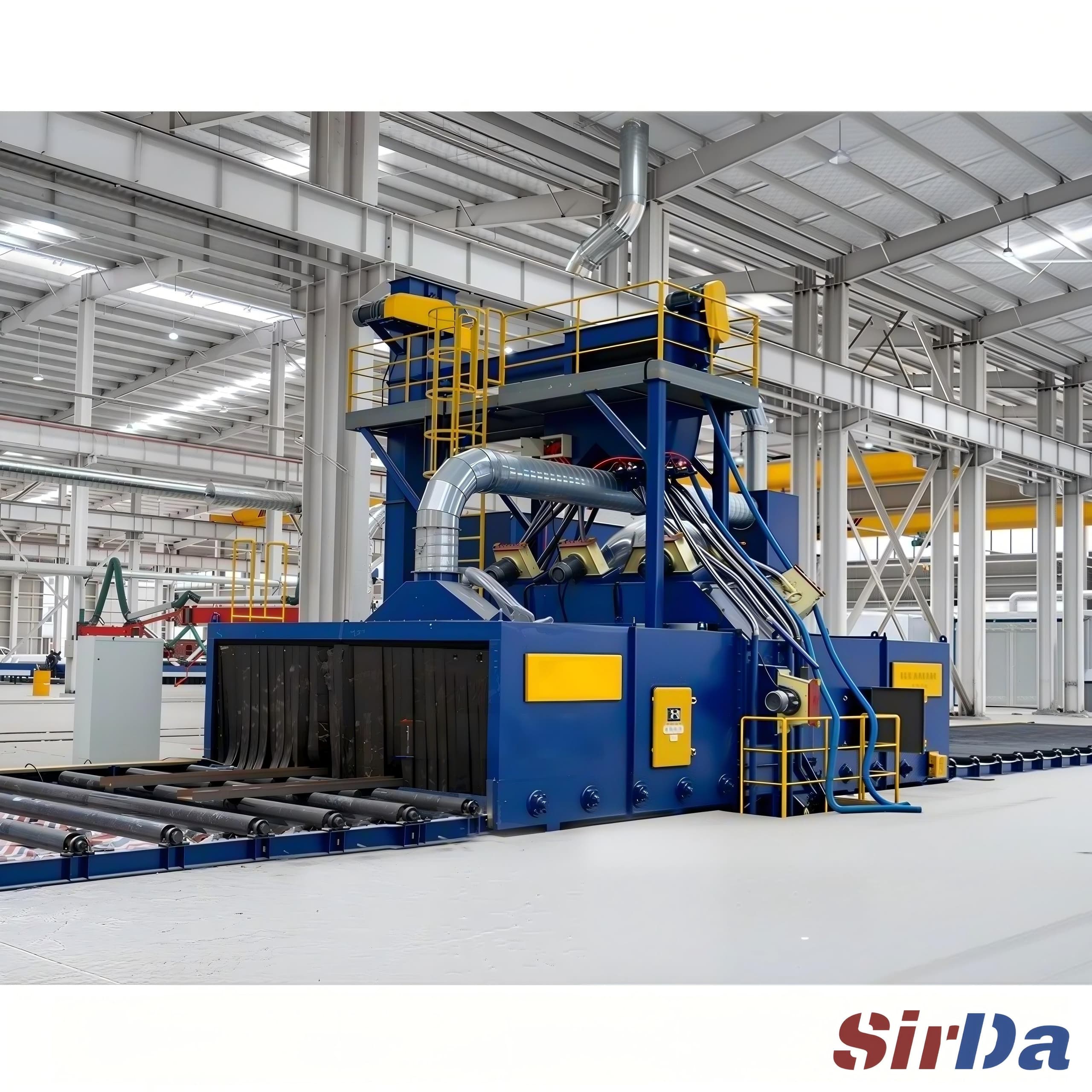
The Q69 roller conveyor shot blasting machine was selected for the pass-through layout. Pipes are carried on powered rollers through the blast zone and turned by the rollers as they travel, so the full circumference sees the blast stream. The published Q69 range covers 2.0–5.0 t/h and workpieces from 5 to 30 t, which matches the mill pipe sizes. The line runs at 3.2 t/h. The machine sits between the existing transfer table and the coating line, so a pipe moves from the yard to blasting and then to coating without being lifted out of the roller path. The roller line was lengthened to match the longest pipe, and the entry and exit tables were aligned with the yard conveyor.
The configuration has four 11 kW blast wheels arranged around the roller path. Roller pitch and line speed were set so each pipe receives the exposure needed for SA 2.5, and the wheels can be adjusted when the mill switches to a different wall thickness or diameter. Abrasive is recovered from the chamber floor, separated from scale and dust, and returned to the wheels. The dust collector was sized for the existing extraction header, and the discharge end was fitted with a short transfer roller section so the coating line can take the pipe at its own pace. The operator station shows the selected recipe and the line speed. Roller drives are monitored for slip so a pipe does not stall in the chamber, and the discharge section keeps the pipe clear of the blast zone before it reaches the coating crew. The chamber is sized around the largest pipe diameter in the current product range.
At 3.2 t/h the mill processes roughly 25 t in an eight-hour shift, depending on pipe length and handling time. The coating team checks the surface against a reference section before each campaign, and the line keeps a spare set of wear plates and blades on site. Delivery included the roller foundation, alignment with the existing transfer table, commissioning on production pipes and training for the line operators. The mill can now blast and coat in one continuous route instead of batching pipes for manual repair. Operators were trained on recipe changes and on the daily inspection of the rollers, and a spare roller and a set of wear plates are kept in the mill store.
Project facts
- Industry
- Steel pipe manufacturing
- Country / region
- Middle East
- Workpiece
- Longitudinal seam pipes, 6–12 m, 5–18 t
- Machine
- Q69 roller conveyor shot blasting machine
- Result / takt time
- 3.2 t/h continuous pass; SA 2.5 before coating
Your next project
Let’s find your solution.
Send your workpiece and production requirements.
Let’s define the right blasting system.