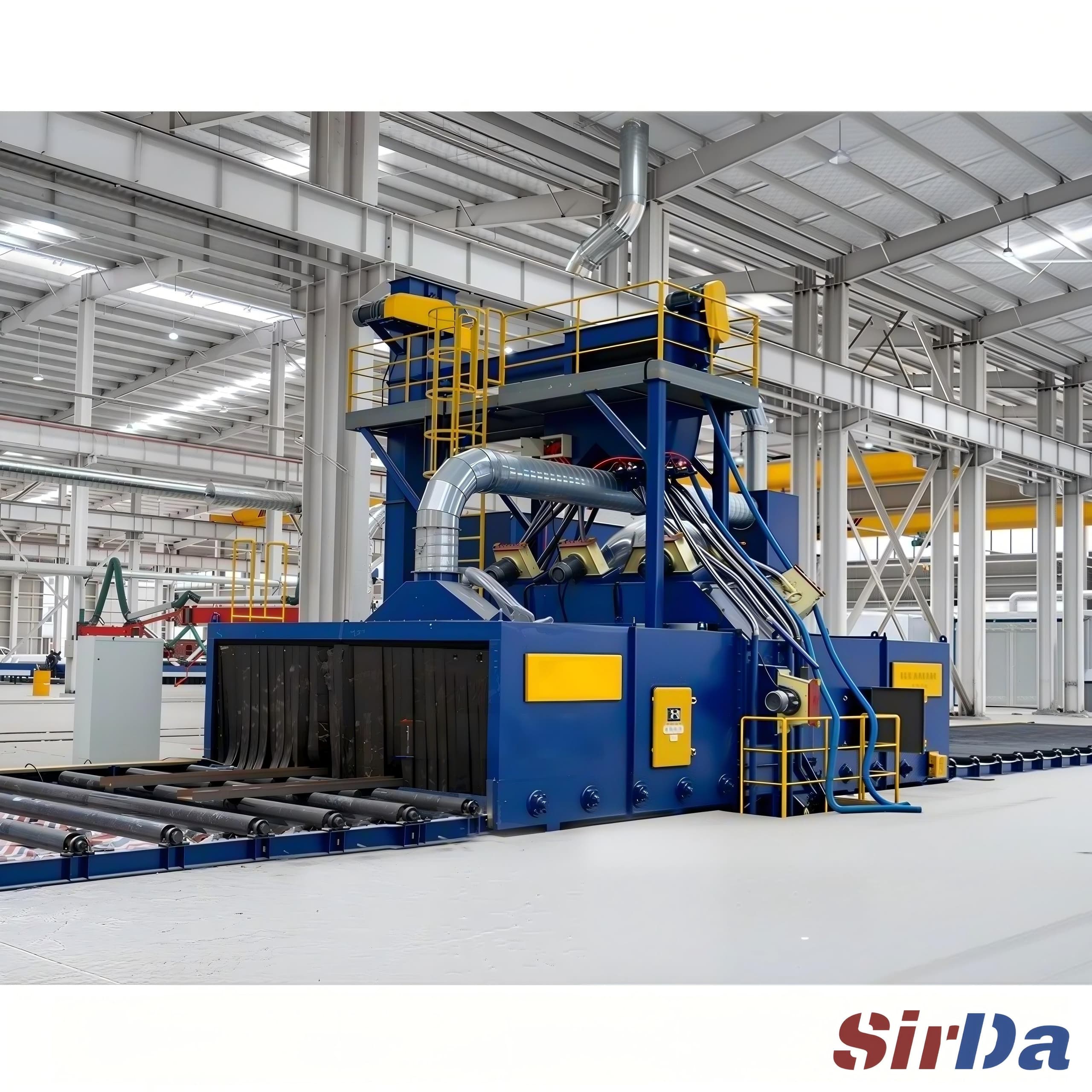
Hook, tumble or mesh: matching machine type to part geometry
Choosing between a hook, tumble belt and mesh belt blasting machine starts with how the part behaves under shot impact, not catalogue capacity. This guide covers the four handling questions, exposure-time and cycle calculations, media and separator settings, dust extraction and the failure modes a workpiece trial should expose before purchase.
Start with the part, not the machine name
Ask ten shops what size blasting machine they need and most will answer in tonnes per hour or chamber dimensions. Both are downstream questions. The first decision is mechanical: how will the workpiece behave when several kilograms of steel shot are thrown at it, and what happens when it meets its neighbours? A compact casting that can roll without damage, a thin aluminium plate that must never be marked, and a welded housing with deep internal pockets may all weigh the same and all be described as "small parts." They belong in three different machines.
Record the largest and smallest dimensions, the heaviest single piece, the material, the incoming surface condition and the finish you actually need. Then describe the awkward features: thin fins, threaded bosses, blind cavities, long projections, and any face that must stay free from contact marks. Add the real production pattern — normal lot size, or required pieces per hour. "High output" is not a specification; several large batches per shift and a continuous feed from heat treatment are completely different problems.
Four questions usually settle the family:
- Can the parts touch and roll against each other without deformation or marking?
- Can they be hung securely, and does hanging expose the surfaces that matter?
- Can they lie flat and stable on a conveyor without overlapping or tipping?
- Does production arrive in mixed batches, or as a steady stream of similar parts?
If the answers point in two directions, you probably have two part families and should group them by handling behaviour rather than forcing one machine to cover a catalogue.
Match the handling principle to the geometry
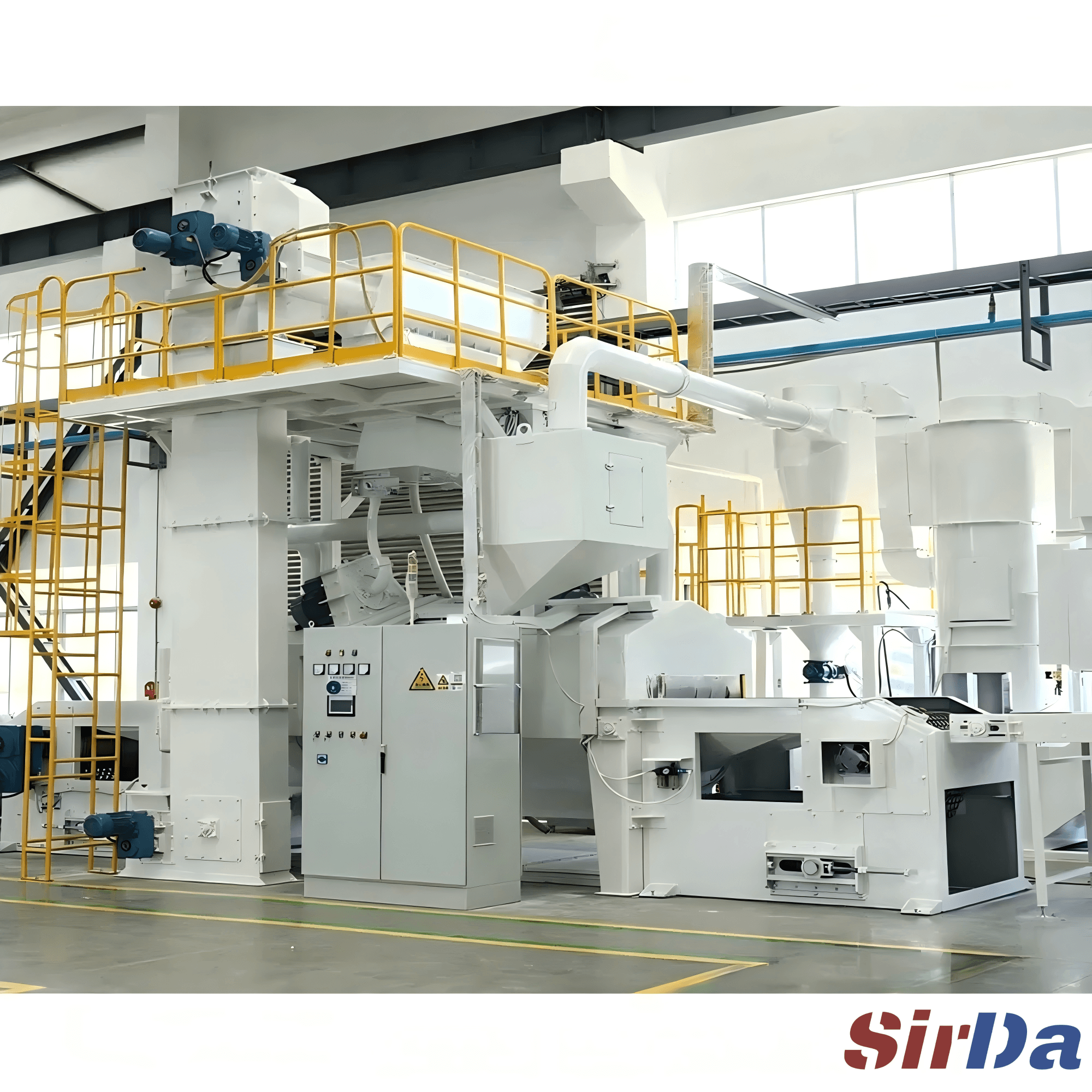
A tumble belt machine puts the batch inside a wear-lined chamber and rotates it through the blast stream. The belt does the work of presenting every face. It is the economical answer for compact, robust castings, forgings, fasteners and stampings that tolerate contact. The trap is volume: a batch can sit below the rated mass and still be impossible if one piece is too long, too heavy, or likely to interlock. Bulky low-density parts fill the drum before the weight limit is reached; dense parts hit the mass limit while the chamber is still half empty. Anything with finished faces, thin fins or a tendency to bend should stay out of a tumbling load.
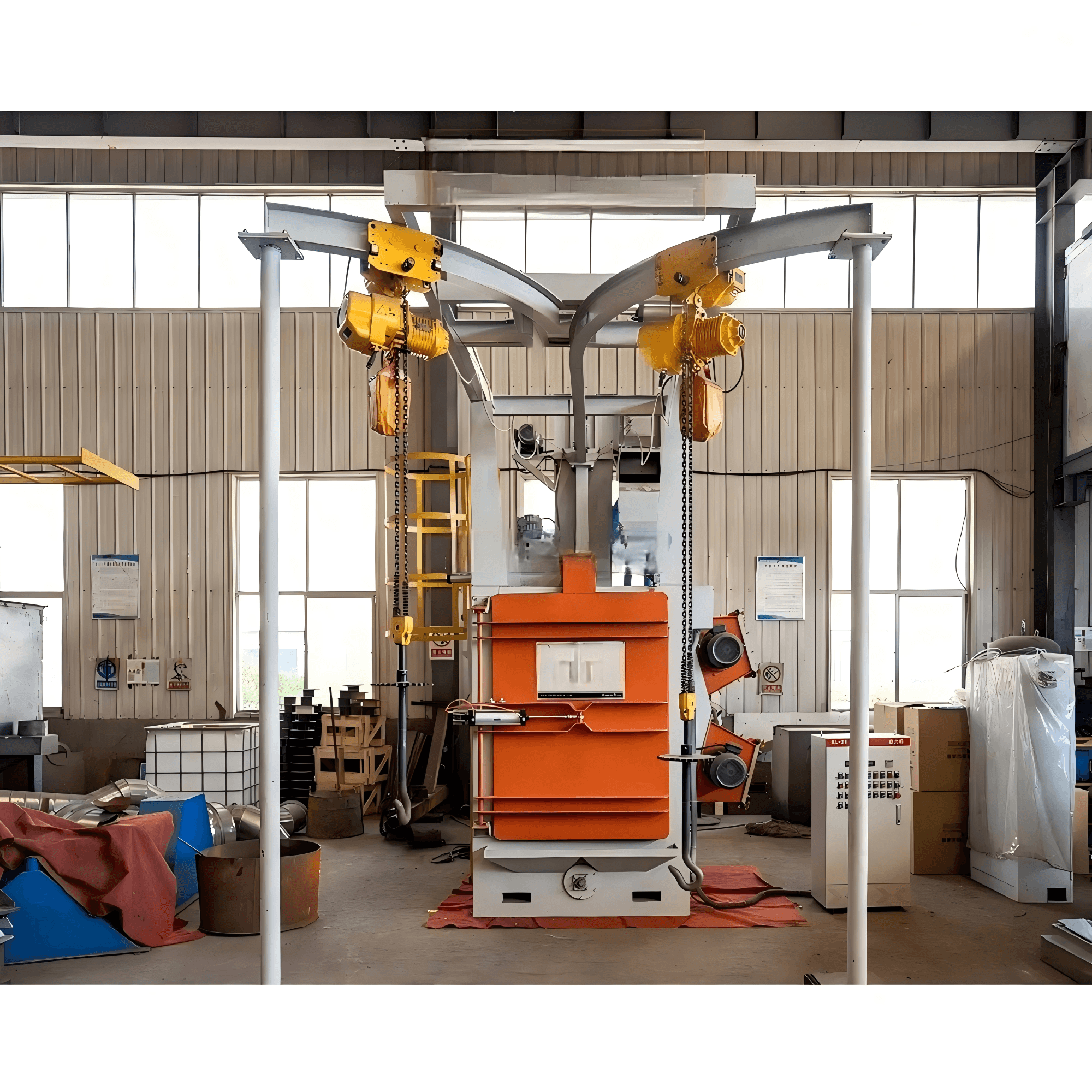
A hook machine suspends the load and rotates it in front of the wheels. Suspension separates parts and gives a controlled orientation, which is why housings, welded assemblies, engine blocks and components with recesses usually end up here. It is also the safer choice when collision damage is unacceptable. The cost is handling: every piece must be hung, and loading time can exceed blast time for thousands of simple parts. Ask about hook capacity, fixture design, lifting method, and whether an alternating double-hook arrangement is needed so one load is prepared while the other is cleaned. Note that a hook does not magically reach a deep blind pocket — if a surface is shielded by geometry, it needs a redirected wheel or a manual nozzle, and that has to be specified before the contract, not discovered at commissioning.
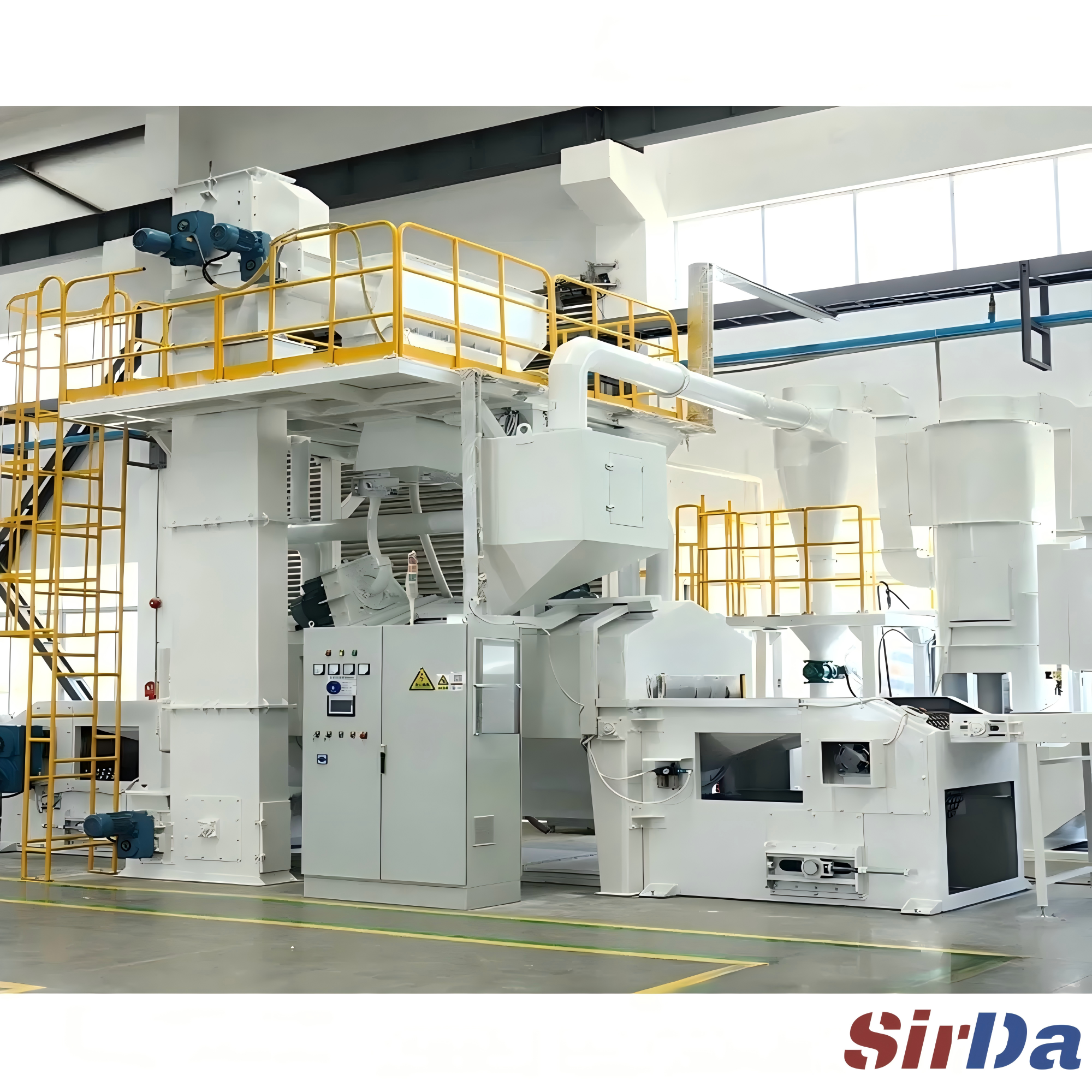
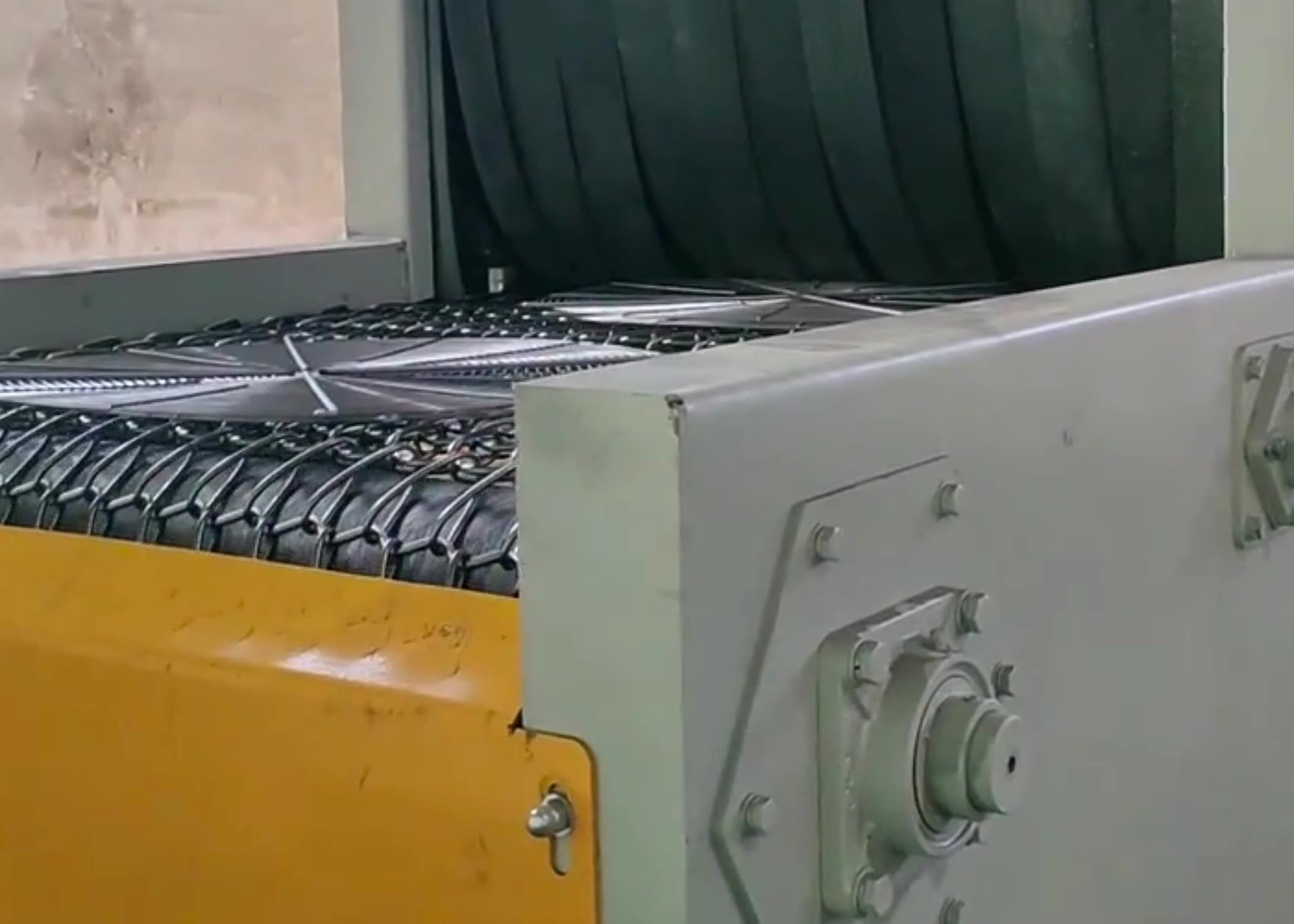
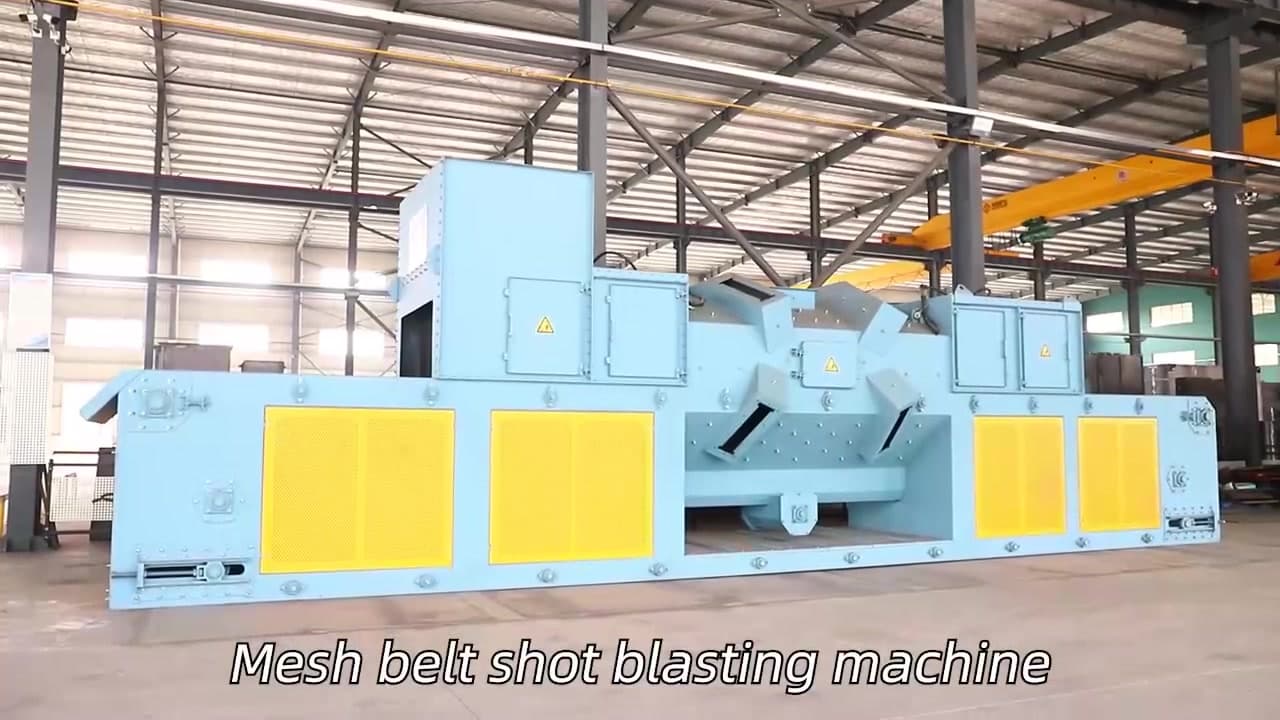
A wire mesh belt machine carries parts through the chamber on a continuous conveyor. It suits thin-wall castings, delicate iron or aluminium components and flat stable parts that must stay separate but cannot justify hanging. It also connects naturally to upstream and downstream operations. Check usable belt width, part orientation, conveyor speed and wheel coverage; stacked or overlapping parts shield each other regardless of how many wheels you buy. Lower collision risk is not zero risk — blast force can still move, rotate or overlap a light part, so the proposed layout should be proven with real workpieces.
Size the cycle before you argue about power
For a continuous line, the number that decides the result is exposure time: blast-zone length divided by conveyor speed. A 1.2 m blast zone at 2 m/min gives roughly 36 seconds; slow the belt to 0.8 m/min and you have about 90 seconds — the difference between cleaning light scale and cutting through thick heat-treatment oxide. Specify exposure time first, then cleaning width, then site works. A machine tuned for the wrong line speed cleans beautifully at half the required output.
For a batch machine, usable output is parts per cycle multiplied by cycles per hour, with loading, unloading, hook exchange and quality holds counted in. That simple equation exposes why nominal catalogue capacity misleads: a hopper rated for a large load still loses time to every manual move, while a continuous line with irregular feed idle-waits between batches. Judge both on net good parts per shift, including rework and downtime.
Media choice then closes the loop. Round shot peens and burnishes; angular grit cuts scale and builds a coarser anchor profile. Cast steel shot is commonly specified around 40–51 HRC under SAE J827, while stainless or non-ferrous media avoids iron staining on aluminium. Coverage matters as much as energy: test strips reach roughly 98% coverage when visible oxide is gone, while peening practice works toward about 200% — beyond that, saturation has arrived and extra time mostly wastes media and rounds off edges. Keep an eye on the separator: its air wash should continuously reject fines below roughly 60% of nominal shot diameter. Let broken particles exceed about 20% of the working mix and every part leaves with micro-notches instead of a clean profile.
Dust, fixtures and the trial that settles it
Geometry affects the dust system as much as the blast chamber. Hanging loads present a large, intermittent surface and sudden shot surges; a mesh belt presents a steady but wide dust load. Duct velocity is normally kept above about 20 m/s, rising to 23–25 m/s for heavy or damp metal, so particles do not settle and become a secondary explosion risk. Cartridge collectors need flame-retardant, anti-static elements, and extraction must be sized to hold negative pressure in the cabinet without pulling good shot into the filter. More airflow is not automatically better: oversized extraction carries usable abrasive away and quietly raises consumption.
The failure modes repeat across shops, whatever the machine name:
- Overloaded tumbles that clean unevenly and accelerate liner wear.
- Hooks hung so densely that inside faces never see the stream.
- Flat parts stacked on a mesh belt, shadowing each other.
- Separators left untuned, feeding broken shot back into the circuit.
- Blind pockets and root fillets assumed to be reachable without a trial.
- Collection hoppers emptied on a calendar instead of a measured pressure drop.
Before signing, run representative parts — the heaviest, the most fragile and the worst surface condition, not the easiest sample. Record media, cycle time, loading arrangement and inspection result. A surface that looks clean in a short trial proves nothing if the machine cannot repeat it at the required rhythm. SIRDA Machinery can help map your part family to a hook, tumble or mesh configuration and set the trial acceptance criteria around your actual geometry.