Rotary table blast machines: when batch indexing beats a tunnel line
A rotary table and a tunnel line solve different problems. This guide explains how a fixed turntable protects delicate parts, when indexed batch cleaning beats a tunnel after frequent changeovers, and how media, cycle time and dust collection decide quality.
Rotary Table Blast Machines: When Batch Indexing Beats a Tunnel Line
Choosing between a rotary table machine and a continuous tunnel line is rarely about which one blasts faster. It is about how your parts behave, how often your product mix changes, and what happens to a workpiece the moment it touches another one. Get that decision right and the machine pays for itself in rework avoided; get it wrong and you own a very expensive conveyor that your parts never quite fit.
What a rotary table actually does
A rotary table machine holds workpieces on a circular plate inside a closed cabinet while one or more fixed blast wheels throw media at them. The table turns at a controlled rate — commonly somewhere from zero to about fifteen revolutions per minute — so every face passes through the blast stream. The operative word is fixed: each part stays put for the whole cycle, clamped or nested on the plate rather than tumbling against its neighbours.
That single design choice decides the machine's whole personality. Because parts never collide, a turntable can clean thin-wall castings, machined faces, gears, brake discs, spring sets and valve bodies that would be chipped or driven out of tolerance in a tumble belt. Fixtures handle odd shapes that have no natural hanging point, which is exactly the case where a hanger machine turns awkward. On most machines the cycle is simply dialled in — typically a few minutes up to around a quarter of an hour, depending on how heavy the contamination is and how clean the surface must be.
Indexing takes this a step further. Instead of stopping to unload and reload a batch, a multi-station table steps between a load station, a blast station and an unload station. While one sector is being blasted, the operator is loading the next. The wheel never sits idle waiting for handling, and that is how a batch machine closes much of the throughput gap with a continuous line.
When batch indexing beats the tunnel
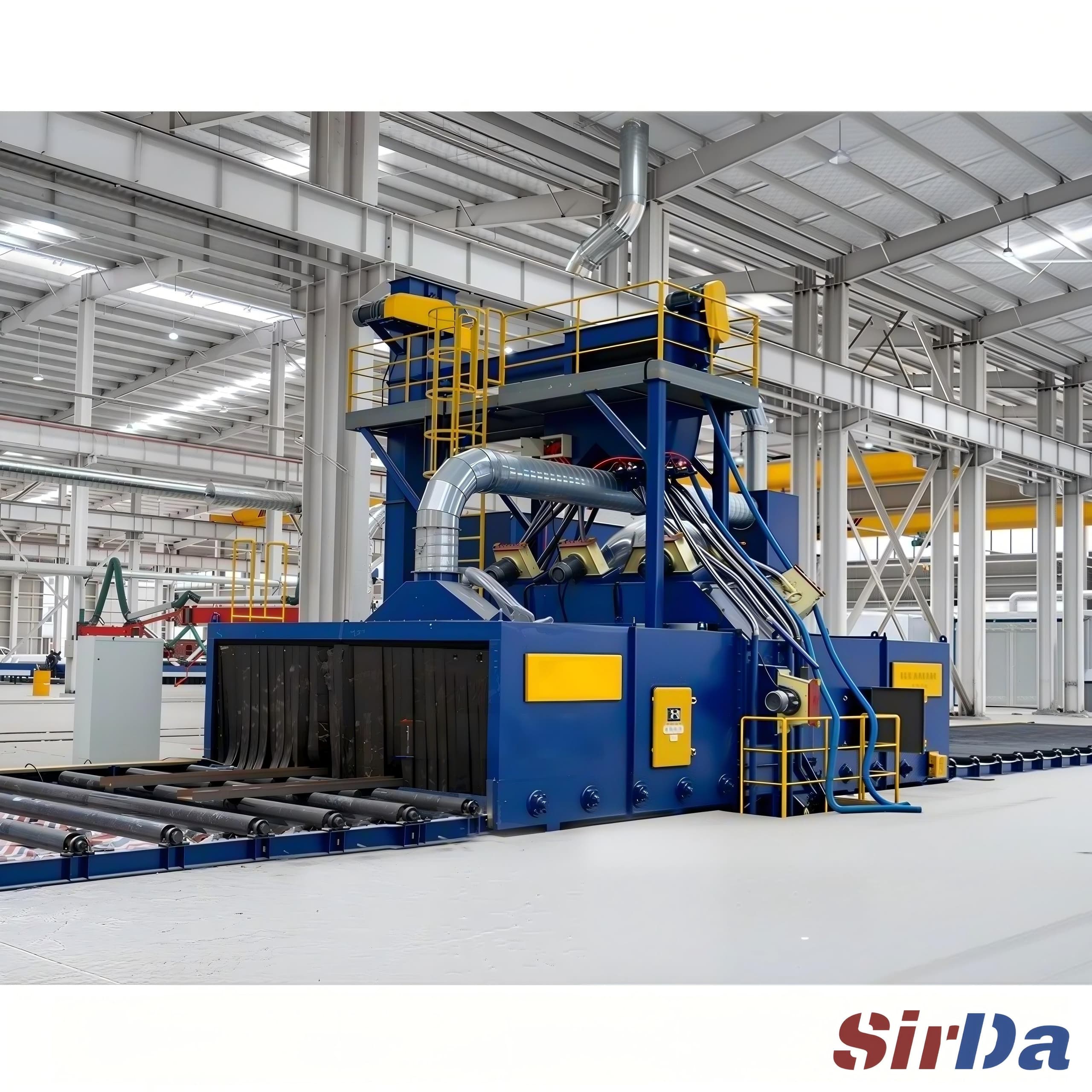
A through-feed tunnel line wins on one thing above all: uninterrupted volume. Plate, beams, pipe and long profiles travel past angled wheels on a roller conveyor, and the line runs as long as material keeps arriving. If you make one robust part, in one size, around the clock, a tunnel is usually the right answer.
Batch indexing wins almost everywhere else. Use this as the deciding test: how often does your product mix change? A tunnel line has to slow down, re-time its wheels and reset its guides for a new section; every changeover eats a slice of the shift. A turntable swaps a fixture and adjusts a timer. Shops running ten short jobs a week often find that the "slower" batch machine actually ships more good parts than a tunnel that spends its days being reset.
Part geometry points the same way. Flat, thin-wall or precision pieces that cannot tolerate contact with each other belong on a table; collision-tolerant small parts that can tumble freely are usually cheaper to process in bulk. Very heavy or oversized workpieces belong on a bogie or hanger, and long stock belongs in a tunnel. Choose the machine around the part, never the part around the machine.
Media, cycle time and dust control
Three settings decide whether a good machine produces good parts.
- Media shape. Round steel shot peens and smooths — the right call for cosmetic finishes or fatigue-critical surfaces. Angular steel grit cuts a deeper anchor profile for coating adhesion and strips scale faster. Softer substrates such as aluminium take smaller shot at reduced wheel speed; heavy steel forgings take larger grit at full power.
- Cycle time. Treat it as a budget, not a guess. What matters is the exposure the part actually receives in the blast zone; on a table that is set by rotation speed and how many stations sit under the wheels. More installed wheel power shortens the cycle, but only up to the point where media still reaches the surface at a useful angle — wheel arrangement matters as much as total kilowatts. Validate every setting on a sample part before quoting a rate.
- Dust collection. Blasting breaks media and lifts scale, so extraction is part of the process, not an accessory. An undersized collector announces itself as poor cleaning quality long before anyone suspects the filter: contaminated media stops cutting and the separator can no longer sort cleanly. Match extraction to the machine from the outset, watch the differential pressure across the filters, and keep the separator tuned — a stream of broken grains and fines is wasted money and extra dust.
Failure modes worth watching
Rotary tables are mechanically simple, but a few slow faults quietly cost throughput:
- Separator drift — fines build up in the working mix, coverage drops and cycles stretch out. Check the air-wash setting weekly.
- Wheel blade wear — throw velocity falls, so the same timer produces a lighter profile. Replace blade sets as a matched set.
- Seal and cabinet wear — media leaks at the door or table edge; containment goes first, dust load follows.
- Fixture shadowing — a clamp that hides a face leaves an unblasted patch however long the cycle runs. Design fixtures for exposure, then verify with a coverage coupon.
- Index repeatability — worn locators put the part in a slightly different spot each cycle, showing up as inconsistent cleaning on precision faces.
None of these are dramatic. They are why a machine that ran beautifully on day one can be quietly making scrap by month six.
The bottom line: choose a rotary table when parts are collision-sensitive, flat or precision, when the mix changes often, or when flexibility matters more than raw line speed. Choose a tunnel when one robust part runs in genuine continuous volume. If you are still unsure, send the part drawing and your changeover pattern — the SIRDA machines range covers both layouts, and a sample-part trial settles the question faster than any specification sheet.