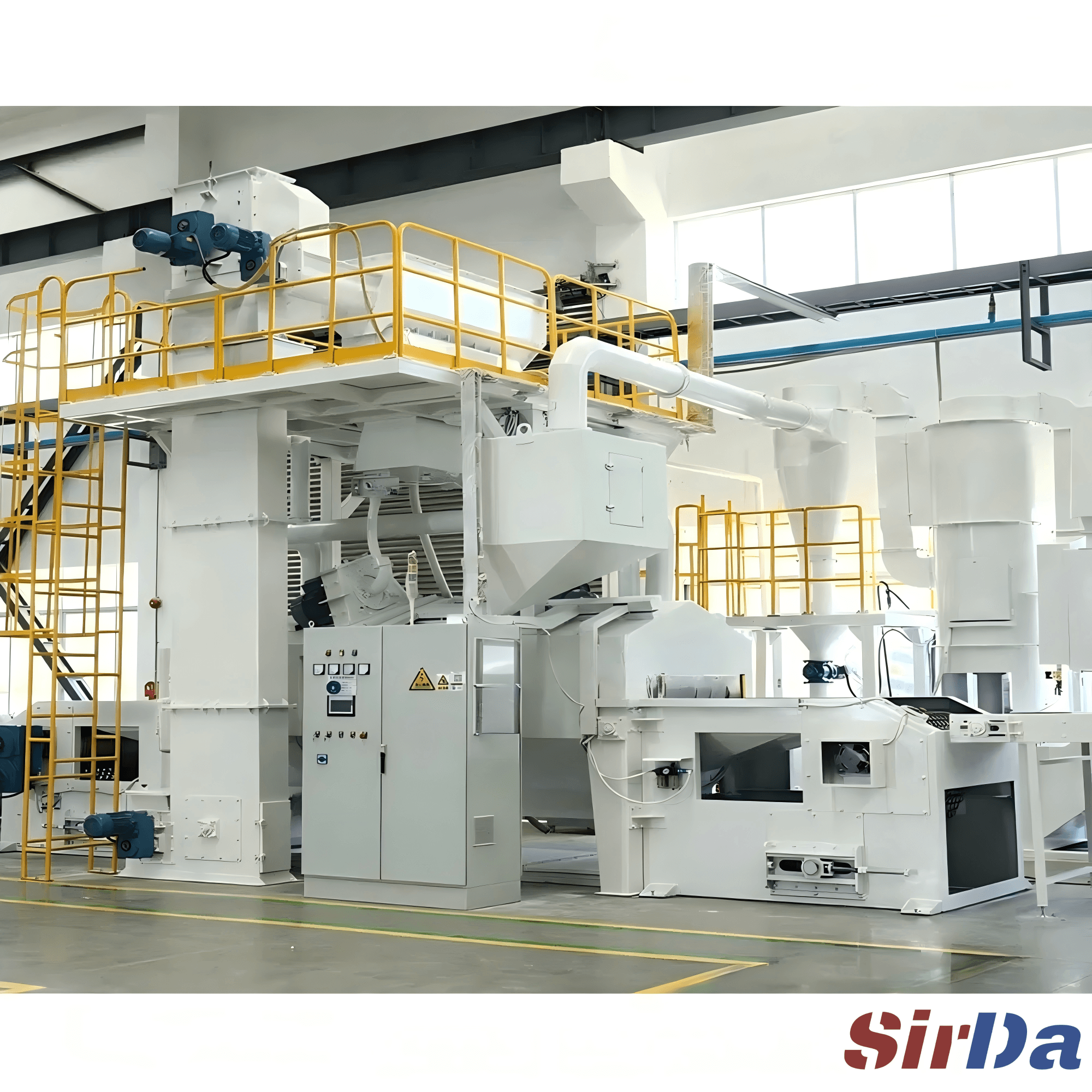
Shot Blasting in Wind Tower, Bridge and Shipyard Work
Why heavy fabrication needs different machine logic from general job work, and how handling, recovery and documentation decide the outcome.
Heavy fabrication is not simply job shop work at a larger size. Wind tower sections, bridge girders and ship blocks bring constraints that change the machine architecture: parts that cannot be moved once positioned, coating windows measured in hours, and documentation that has to survive a client audit years later.
What makes heavy fabrication different
Three properties separate it from general blasting.
The workpiece is the handling system. A 30-metre tower can or a bridge girder cannot be lifted casually. Either the machine moves over the work, or the work moves through a line designed around it.
The blast area is large and the geometry is repetitive. A tower shell is a long cylinder. A girder is a long box. Repetition rewards a line with fixed wheel positions and stable parameters rather than a flexible batch machine.
The coating follows immediately. On a large structure the blast and paint operations are adjacent in time and often in the same facility. The interval between them is a specification item, and any delay means recleaning.
Wind tower sections
Tower sections are rolled plate, longitudinally welded, with flanges at each end. The internal and external surfaces both need preparation, and the flanges and weld caps need particular attention because they are where coating thickness and adhesion problems concentrate.
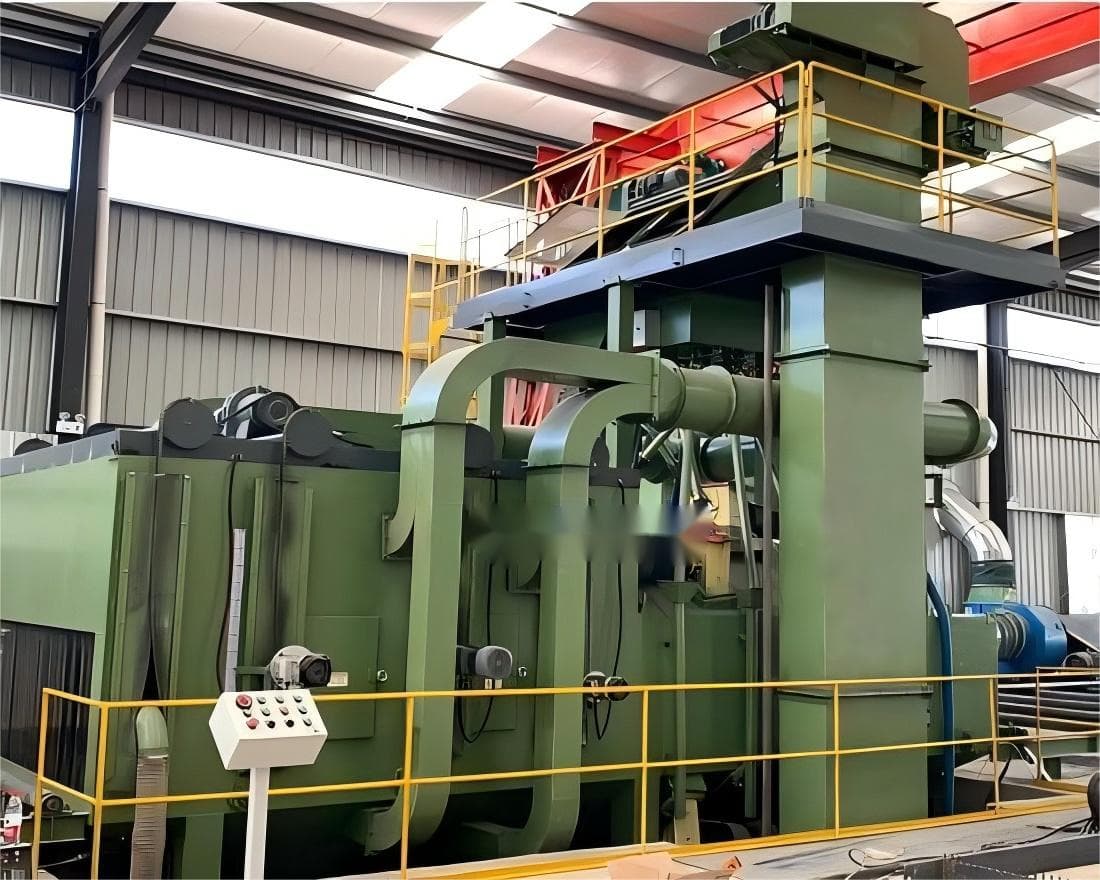
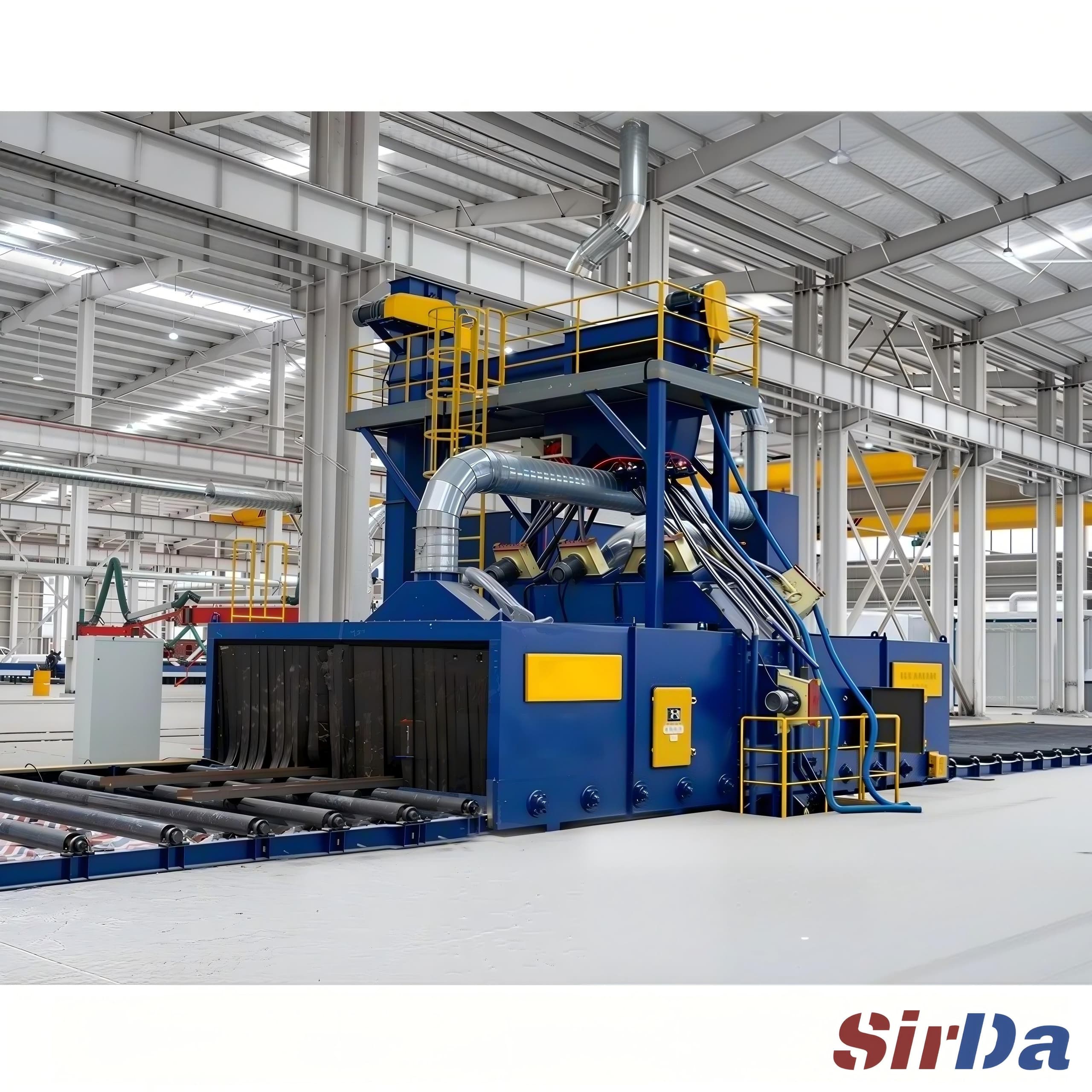
The natural configuration is a roller conveyor line, with the section supported and rotated or passed over rollers. External blasting from wheels above and internal blasting with a lance or an internal wheel arrangement handles both faces. A roller conveyor machine with a wide, heavy-duty roller bed is the usual base, sized for the shell diameter and mass.
Two design details dominate: roller loading and abrasive containment. A tower shell is a thin-walled cylinder, and point loads from rollers can deform it. Roller spacing and contact geometry have to be engineered for the wall thickness. Abrasive that escapes the cabinet inside a large open-ended cylinder is hard to recover, so end sealing matters.
Bridge girders and plate
Bridge work is plate and box girder fabrication at long lengths, with stiffeners, diaphragms and weld access holes that create shadowed geometry.
The cleaning specification is usually driven by the coating system: a zinc-rich primer over a defined profile, or a multi-coat system for a specific exposure category. The plate line is typically a continuous through-type line with wheels above and below, treating plate before it is cut and welded.
Blasting after fabrication is the harder case. Stiffeners and diaphragm plates create faces that no wheel pattern reaches directly. Those areas are handled by repositioning, additional wheel positions, or manual touch-up with a nozzle. The specification should state how shadowed areas are treated, because the answer is never "the machine will get it".
Shipbuilding blocks and profiles
Shipyards process plate and profiles before assembly, and blocks after assembly. Pre-assembly plate blasting is a line operation with tight throughput requirements, because the plate feeds a cutting and welding schedule.
Block blasting is different. A block is a three-dimensional weldment with internal structure, and access is through openings. Blast rooms with multiple wheels and manipulators handle blocks, and the work is positioned rather than conveyed. A blast room with abrasive recovery floor and mechanical or pneumatic collection is the usual arrangement.
The recurring problem in shipyard block work is abrasive recovery from inside enclosed spaces and from the floor of the room. Recovery floor design, sweep efficiency and the separation plant capacity determine how much abrasive is lost per block and how stable the working mix stays.
Handling defines the machine
In heavy fabrication, the handling study comes before the machine specification. A machine that is technically correct but requires a crane movement the shop cannot make is useless.
Questions to settle early: what lifting capacity is available and where, whether the part can rotate, whether it can be conveyed, how the part enters and leaves the blast zone, and how long that movement takes relative to the blasting cycle. On long parts, the handling time often exceeds the blast time, and the investment case changes accordingly.
Abrasive recovery at scale
Recovery is where large installations succeed or fail economically. Abrasive is the dominant consumable, and at heavy fabrication volumes a small percentage loss becomes a significant annual quantity.
The recovery chain has four stages: collection from the blast zone, transport to the separator, separation of usable media from fines and debris, and return to the wheel hoppers. Each stage has a failure mode.
Collection fails when the floor is not swept effectively or when abrasive accumulates in structural recesses. Transport fails when screw conveyors or bucket elevators are undersized or worn. Separation fails when the separator is asked to handle a dust load beyond its capacity. Return fails when the distribution system cannot keep every wheel supplied at the required flow.
Design the chain from the dust load backwards, not from the wheel forwards.
Coating windows and flash rust
A large structure cannot be blasted and left. The interval to priming is a specified maximum, and in humid conditions it is short.
This has two machine implications. First, the blast line's throughput has to match the paint line's capacity, or blasted steel waits. Second, the machine should be positioned so that the transfer to coating is short and covered where possible.
Where a delay is unavoidable, the specification should define the recleaning trigger — visible flash rust, or a measured humidity exposure limit — rather than leaving it to operator judgement at the end of a shift.
Documentation that survives audit
Heavy fabrication contracts usually require records per component, not per shift. A workable record includes the steel grade and rust grade, the preparation grade achieved, the profile readings with locations, the salt test results where specified, the abrasive lot used, and the interval between blasting and coating with the ambient conditions.
The record is also the diagnostic tool. When a coating fails in service years later, the record determines whether the failure is a preparation issue, an application issue or a coating system issue. Without it, every party defends its own scope and the cause is never established.
What to measure in a trial
A trial that reports only "the surface looked good" has produced no information. Define the measurements before the trial starts, and make sure the supplier knows they will be taken.
The minimum set is: cleanliness against the comparator, profile at three defined locations, cycle or line speed at the specified grade, and a record of any part damage. For heavy fabrication, add dimensional checks before and after blasting on the thinnest section in the batch.
Run the trial at the parameters you expect to use in production, not at maximum power. A machine that meets the grade only at its highest settings has no operating margin, and margin is what absorbs the variation in incoming steel, ambient humidity and abrasive condition over the following years.
Ask for the trial record in writing. It becomes the baseline for acceptance testing and, later, the reference when performance is questioned.
Selecting the configuration
For a tower or plate line, the decision turns on section size, mass, required throughput and whether internal surfaces must be treated in the same pass. For a bridge fabrication shop, it turns on plate width, whether blasting happens before or after welding, and how shadowed geometry is handled. For a shipyard, it turns on block size, room capacity and recovery efficiency.
Send the component drawings, the coating specification and the hourly throughput requirement through the contact form and we will set out which configuration fits and where the handling constraint lies.
Frequently asked questions
Can a standard roller conveyor machine handle wind tower sections?
Only if the roller bed, spacing and drives are engineered for the shell diameter and wall thickness. Point loads on thin-walled cylinders can deform the section, so roller contact geometry has to be designed for the load case.
How are stiffeners and shadowed areas cleaned?
By repositioning the work, adding wheel positions, or manual nozzle touch-up. The preparation specification should state explicitly how shadowed geometry is treated rather than assuming the machine pattern reaches it.
Why is abrasive recovery so important in heavy fabrication?
Abrasive is the dominant consumable and volumes are large, so a small percentage loss becomes a significant annual quantity. Recovery efficiency also determines working mix stability and therefore profile consistency.
What is used for shipyard block blasting?
Usually a blast room with multiple wheels, manipulators and a recovery floor, because blocks are three-dimensional weldments that are positioned rather than conveyed. Recovery from enclosed spaces is the main design challenge.
How long can blasted steel wait before priming?
Until flash rust appears, which depends on humidity and temperature and can be very short. The specification should define the maximum interval and the recleaning trigger rather than leaving it to judgement.
What records should be kept per component?
Steel and rust grade, preparation grade, profile readings with locations, salt results where specified, abrasive lot, and the blasting-to-coating interval with ambient conditions. These are both audit evidence and failure diagnostics.