Descaling hot-rolled steel before fabrication
Hot-rolled steel leaves the mill wrapped in mill scale—a cathodic oxide layer that causes pitting and coating failure if left in place. This guide explains why descaling before fabrication is a quality gate, how to choose steel shot vs grit or a blend, how to set roller-conveyor line speed and dust collection, and the silent failure modes that ruin the job after welding or painting.
Why mill scale must come off before fabrication
Hot-rolled steel leaves the mill wrapped in a rolled-in oxide layer—mill scale—that most buyers never see until it betrays them. It is not a single compound but a layered stack of iron oxides (FeO, Fe₂O₃ and Fe₃O₄) formed above roughly 570 °C as the slab is rolled and cooled. On plate it typically runs 0.5–2 mm thick, brittle, and tightly keyed into the surface.
The danger is electrochemical, not cosmetic. Mill scale is cathodic to the steel beneath it. Where the scale is cracked at a shear edge, a punch mark, or a rust pit, the exposed steel becomes the anode and corrodes preferentially. The familiar result is pitting that blooms under flakes of scale, and the corrosion product then lifts any coating applied on top. Add the salt film and light rust picked up in transit and storage, and you have a surface that will shed paint in 12–24 months no matter how expensive the primer.
That is why surface preparation is treated as a quality gate, not a finishing step. EN 1090 requires a defined grade for structural steel, and most industrial coating specs call for Sa 2.5 under ISO 8501-1—"very thorough blast cleaning," at least 95% of the surface free of visible scale, rust and foreign matter, with only slight streaking. Sa 3 (near-white metal) is reserved for immersed or offshore zones under ISO 12944 C4/C5-M.
Picking the abrasive: shot, grit, or a blend
The abrasive does two jobs at once: it fractures the oxide and it roughens the steel to a controlled anchor profile. The shape of the particle decides which job wins.
- Steel shot is spherical, quenched and tempered, 40–50 HRC (or 55–65 HRC high grade), recyclable for 2,000+ cycles. It peens rather than cuts, leaving a smooth, dimpled profile around 25–50 µm Rz. Sizes run S70–S780 under SAE J444 / ISO 11124; for general descaling S330–S460, heavier plate S550–S660.
- Steel grit is that same shot crushed into angular fragments. The sharp edges cut, giving a deeper, etched profile of 50–125 µm Rz and the fastest scale removal. GP/GL/GH hardness grades (≈46/56/63 HRC) trade edge-retention against breakage. Coarse G14–G18 tackles thick mill scale; G25–G40 is the workhorse for Sa 2.5 coating prep.
- Blends dominate high-volume roller conveyor lines: roughly 70% shot (S330–S460) for kinetic energy plus 30% grit (G40–G50) for the angular shear that opens a sharp anchor profile, typically 40–75 µm.
Grit generates more fines than shot, so the operating mix must be topped up and the air-wash separator kept healthy—otherwise broken abrasive recirculates as dark dust and re-contaminates the silver-grey metal. Abrasives themselves are governed by ISO 11124 (requirements) and ISO 11125 (test methods); reject lots below 7.2 g/cm³ apparent density, which signals hollow particles.
Throughput and the blast line: takt, wheels, and dust
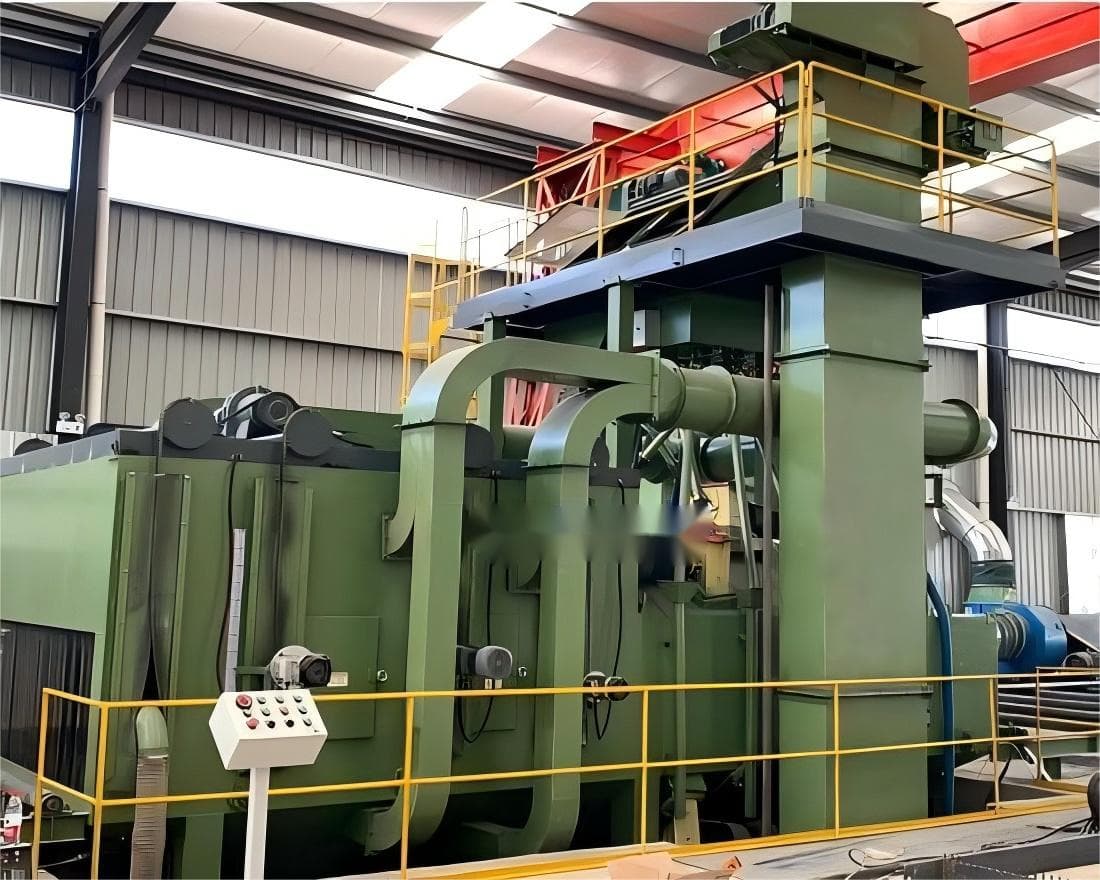
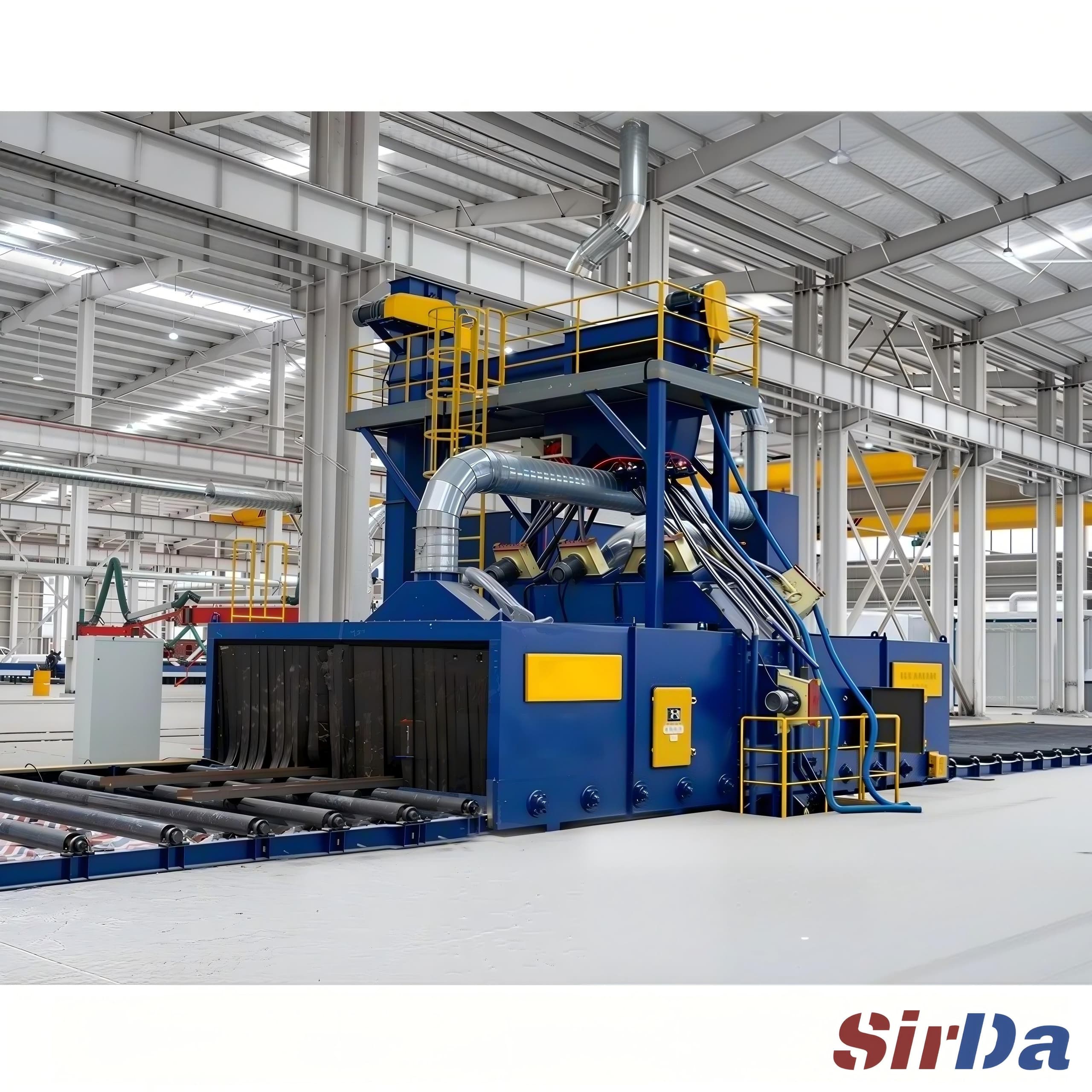
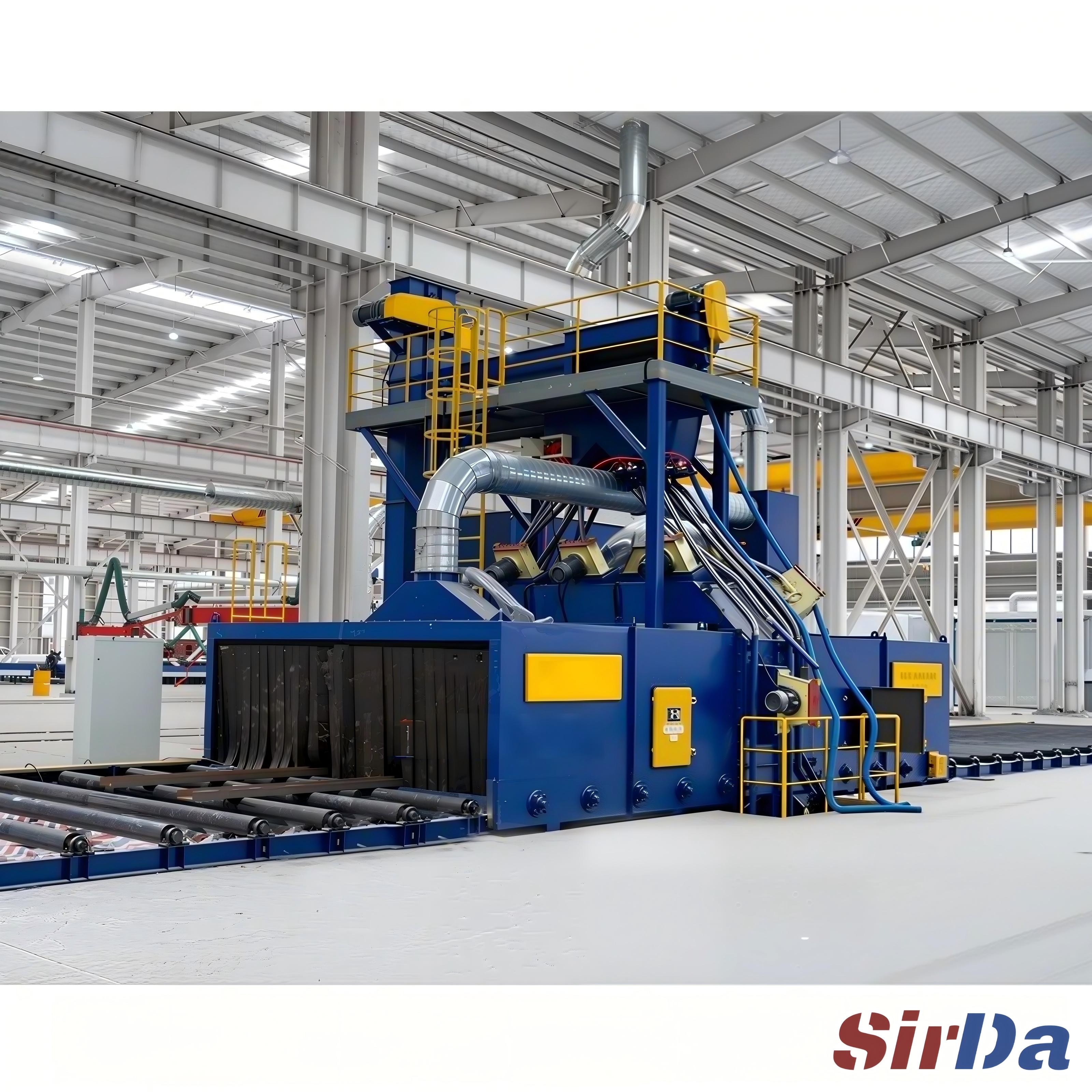
On a roller conveyor line the throughput is set by how fast the section can pass the wheels while still hitting Sa 2.5. For Grade B rust on structural profiles, line speed is typically 1.2–2.5 m/min; Grade C rust and heavy scale demand a slower pass, never a faster one, because the only way to catch up is to leave scale behind.
Direct-drive blast wheels throw media at a blade-tip velocity of 75–80 m/s (≈2,900 RPM). Watch the ammeter: every wheel should sit at 85–90% of rated current. A sudden drop almost always means the abrasive level in the hopper has fallen—an early warning of a low-media fault, not a motor problem. Multi-wheel layouts (top and bottom, angled into H-beam webs) exist specifically to kill "shadowing," the missed strip in recesses where a single wheel cannot reach.
Dust control is the third leg. A blast cabinet without a healthy collector is a closed loop of fines. Target stack emissions below 5–10 mg/m³ with a cartridge or fabric filter sized on an air-to-cloth ratio the separator can actually sustain; the static pressure at the air-wash plenum is the number that tells you fines are being pulled out rather than recirculated. For steel media, a magnetic separator reclaims 95%+ of good abrasive; the rest is replaced or, in closed shops, vacuumed to avoid embedded shot in the finished surface.
Failure modes that quietly ruin the job
Most descaling rejects are not dramatic. They are small, silent, and discovered months later under a failing coating.
- Residual scale in corners — H-beam webs, inner radii, and weld toes are the classic shadow zones. Cause: line speed too high, a wheel down on amperage, or a layout with a blind spot. Fix before fabrication, because you cannot blast a welded joint as easily afterward.
- Over-blasting — pushing profile past 75 µm wastes abrasive and paint, and on sections below ~1.5 mm it induces distortion. Wheel blasting thin gauge sheet is a known distortion risk; switch to lower-pressure air blast or chemical cleaning.
- Flash rust — cleaned steel is a fresh, reactive surface. In humid or coastal air it can show rust in 4–6 hours; at high humidity, under 4 hours. Apply a weldable zinc-silicate shop primer (SSPC-Paint 20, ~15–25 µm DFT) inside that window, or oil the plate per ASTM D610 rating ≥8 for transit.
- Soluble salts left behind — visual cleanliness cannot see chloride. Measure with the Bresle method (ISO 8502-9) and keep it under ~20–50 mg/m²; salt under the coating drives interfacial corrosion no blast grade can fix.
- Cross-job contamination — abrasive carried over from a previous, dirtier job seeds the next batch with embedded debris. Keep the operating mix audited and the separator clean.
- Oil on the incoming steel — rolling oils and greases blind the blast and smear. Degrease alkaline first; blasting over oil just polishes it in.
The through-line is simple: descaling is the first and most influential stage of the corrosion-protection system, and its result is measured and recorded against standards rather than judged by eye. Spec the Sa grade, the profile band, and the salt limit together—then verify each one before the steel goes to the welder or the paint line.