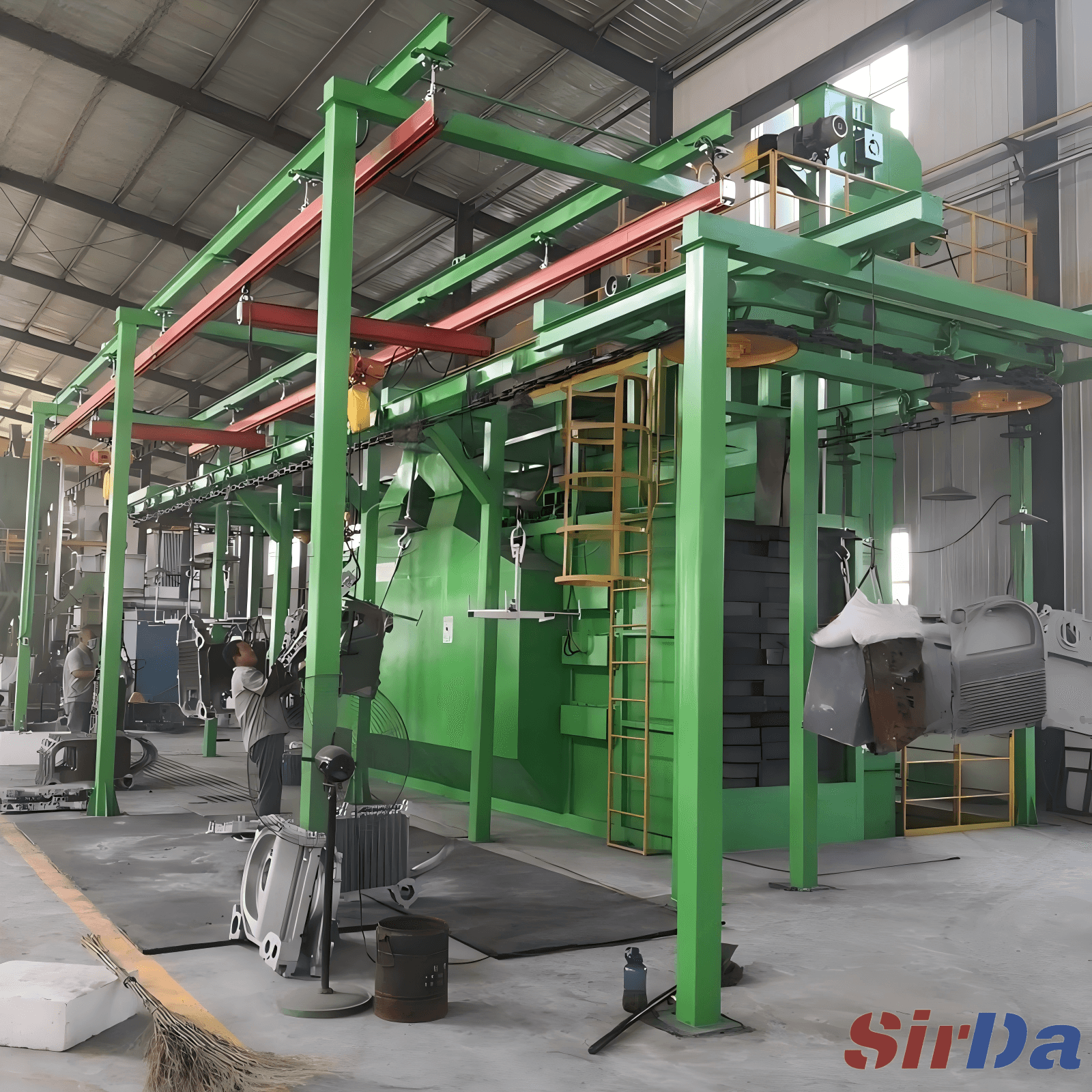
Robotic blast cells versus manual blasting
A robotic blast cell holds nozzle angle, stand-off and traverse speed to a programmed value on every cycle, while manual blasting rides on operator skill. We compare throughput, consumables, labor, the cases where manual still wins, and the engineering pitfalls such as shadow zones, media breakdown and nozzle wear that quietly erode the ROI.
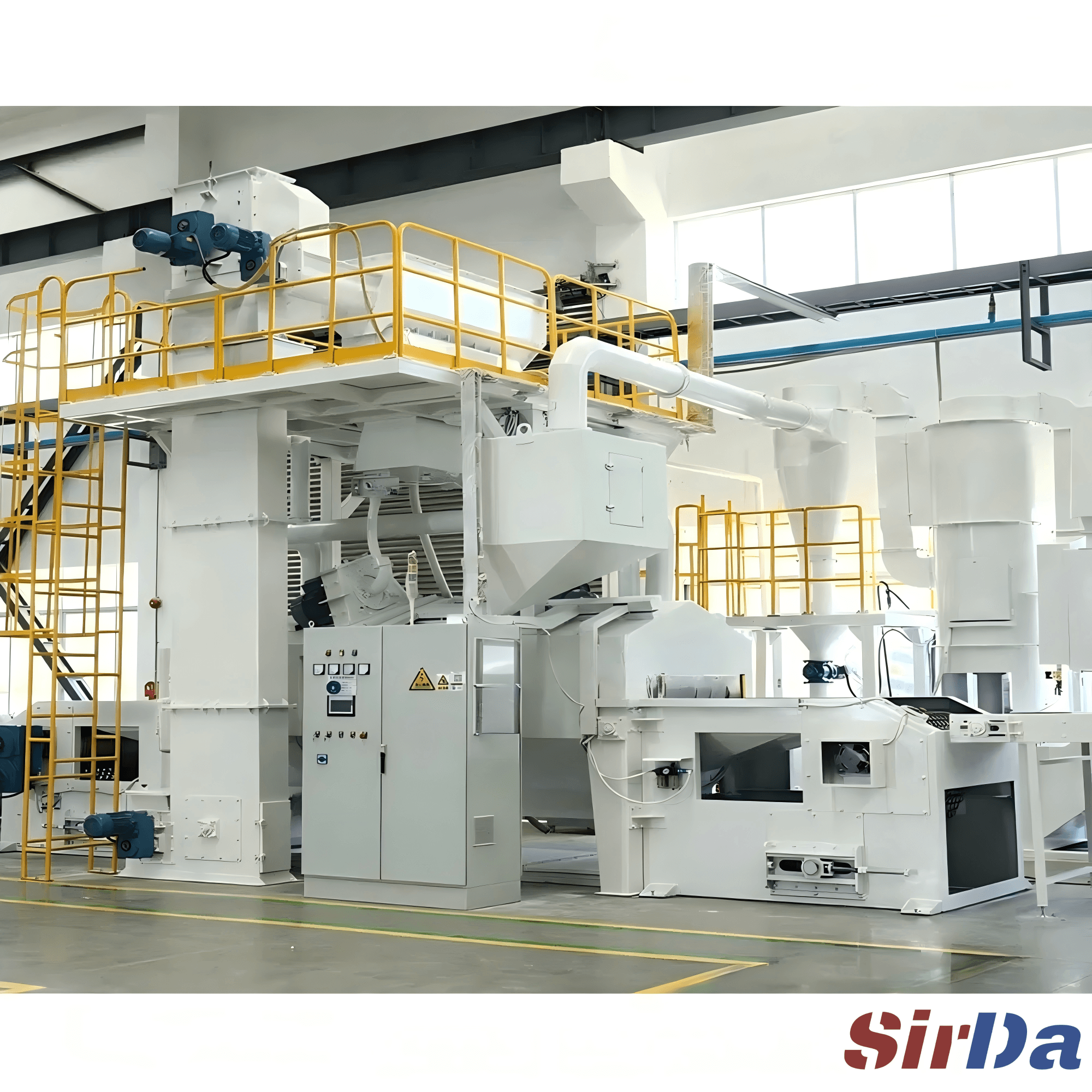
What changes when you put a robot on the nozzle
A manual blaster stands inside the enclosure with a handheld nozzle. Surface quality depends on that person's skill, fatigue, and discipline across an eight-hour shift. A robotic blast cell bolts a six-axis arm inside a fully enclosed cabinet and lets the robot carry the nozzle — or, in the more common layout, the robot fixturing the part while a fixed nozzle fires. Either way, the machine holds stand-off distance, blast angle, and traverse speed to the programmed value on every cycle, not just on the parts the operator felt like concentrating on.
The repeatability comes from three things working together:
- Programmed path — imported from a CAD model or a 3D scan of the part, so coverage is defined once and replayed identically.
- A seventh axis — the turntable or positioner that rotates the workpiece is slaved to the robot controller, letting the nozzle follow curved and recessed geometry at constant stand-off.
- Closed-loop media delivery — a pressure vessel, flow controller, and classifier keep the abrasive mix and feed rate stable instead of drifting as the pot empties.
The numbers that decide the business case
Automation is rarely about the sticker price. It is about cost per finished part over the life of the equipment, and on that basis the comparison usually splits along production volume and part mix.
Throughput is the first lever. A manual operator suited up in a blast room is typically built a 30-50% rest allowance into the allowed process time, because the helmet, heat, and vibration are physically unsustainable otherwise. A robot does not tire, so that wasted time disappears immediately. Published case studies on comparable jobs report automated cells running several times faster than manual blasting once the path is tuned, driven mostly by eliminated fatigue drift and consistent pattern control rather than raw speed.
Consumables are the second lever. A fixed multi-gun machine often cross-fires opposed nozzles; one vendor's study replaced a six-nozzle setup drawing 45 CFM per nozzle with a single 75 CFM robot nozzle and reported the annual compressed-air cost dropping from roughly 9,200 dollars to 2,545 dollars, with media consumption down 30-50% because there was no cross-fire breaking shot prematurely. The smaller reclaim system — one cyclone and classifier instead of a bank — also lowers capital and footprint.
Labor is the third. One cell operator can load, monitor, and unload several programs, and offline programming means the next part's path is being simulated while the current run is still producing, so changeovers drop to minutes. For plants facing operator turnover in physically demanding roles, that decoupling from skilled manual labor is often the real reason to buy.
Where manual blasting still wins
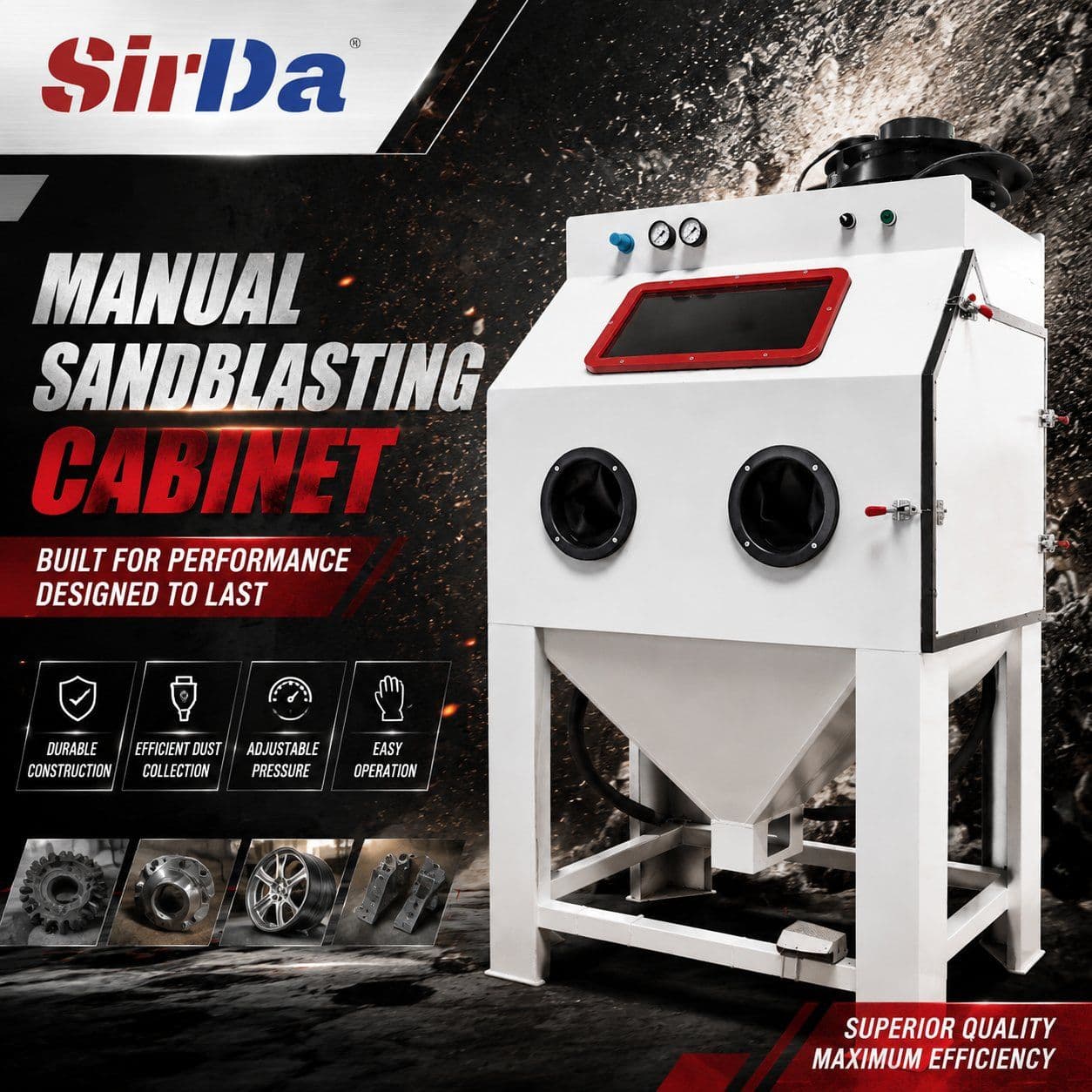
Automation is not a universal upgrade, and pretending otherwise is how shops buy the wrong machine. Manual or semi-automatic blasting stays the smarter choice when:
- Volume is low and the part mix is high — the programming and fixturing cost per part exceeds any efficiency gain.
- Parts are large or irregular — structural steel, oversized fabrications, and one-off weldments suit a blast room with a human in the loop better than a cell with a fixed envelope.
- The work is exploratory — prototype runs where the surface target is still being defined do not reward a validated, repeatable recipe yet.
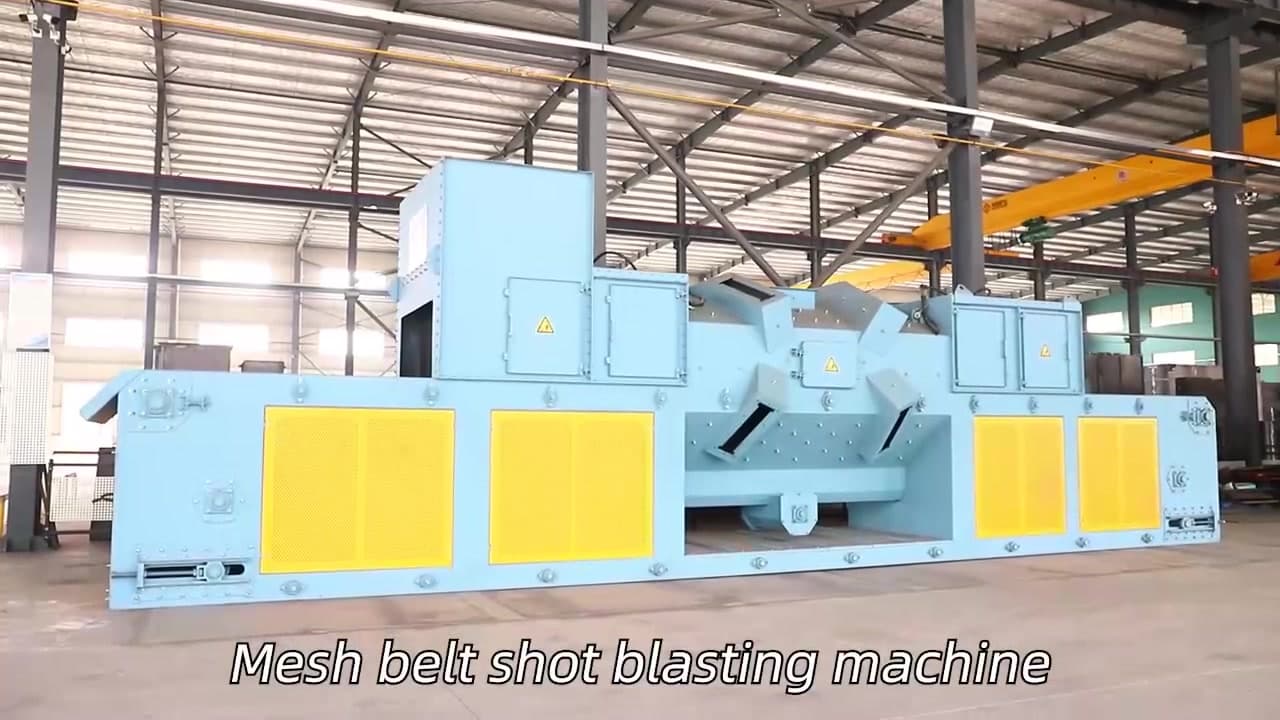
A tumble or mesh-belt machine also beats a robot for bulk small parts: there is no geometry to teach, just a conveyor speed and blast-wheel setting to set.
Engineering pitfalls that break the ROI
The failure modes of a robotic cell are different from a manual booth's, and most of them show up after commissioning, not before.
- Shadowed and blind areas — if the path does not reach a recess or the back of a flange, that face stays dirty and the part fails inspection. Solving it needs a second positioner, a seventh/eighth axis, or a lance tool, planned up front rather than discovered in production.
- Fixture and stand-off drift — a compliant or vibrating fixture lets the part move relative to the programmed path, so the real stand-off wanders even though the robot held its coordinates.
- Media breakdown in the reclaim loop — a closed loop that never reclassifies the abrasive lets fines accumulate, and the surface profile creeps coarser or softer without anyone changing a setting. A screen classifier sized to the target mesh is not optional.
- Nozzle wear — a worn boron-carbide or tungsten nozzle widens the bore, drops velocity, and silently changes the coverage pattern until finish quality drifts.
- Over- and under-blasting — constant parameters are a double-edged sword: a recipe tuned for the worst-case area over-blasts the rest and can erode tolerances, while a timid recipe leaves residue that kills coating adhesion.
Dust and noise scale with the machine, not the operator count. Enclosures need a dust collector rated to keep the operator breathing zone below exposure limits — MERV 16 or finer media and airflow matched to the cabinet volume — and manual operations still carry the 85/90 dBA hearing-conservation threshold plus supplied-air respiratory protection. None of that disappears in an automated cell; it just moves from the operator's face to the maintenance schedule.
The decision rule
Before quoting a cell, map three numbers: monthly part volume, current cost per part (labor plus abrasive plus rework), and the payback horizon the plant will accept. If volume is high and geometry repeats, a robotic or conveyorized cell usually pays back faster than expected. If the work is varied, low-volume, or physically immense, a manual blast room or a tumble machine remains the honest answer. SirDa configures both ends of that range; the right call is the one that fits the part, not the one with the most axes.